Muon g-2 Experiment Pioneers Win Breakthrough Prize in Fundamental Physics
Recognition honors experiments and scientific collaborations at three institutions that explored the subtle wobble of a subatomic particle
April 18, 2026
 enlarge
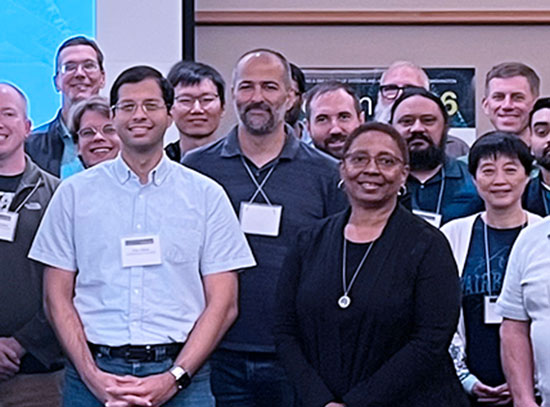
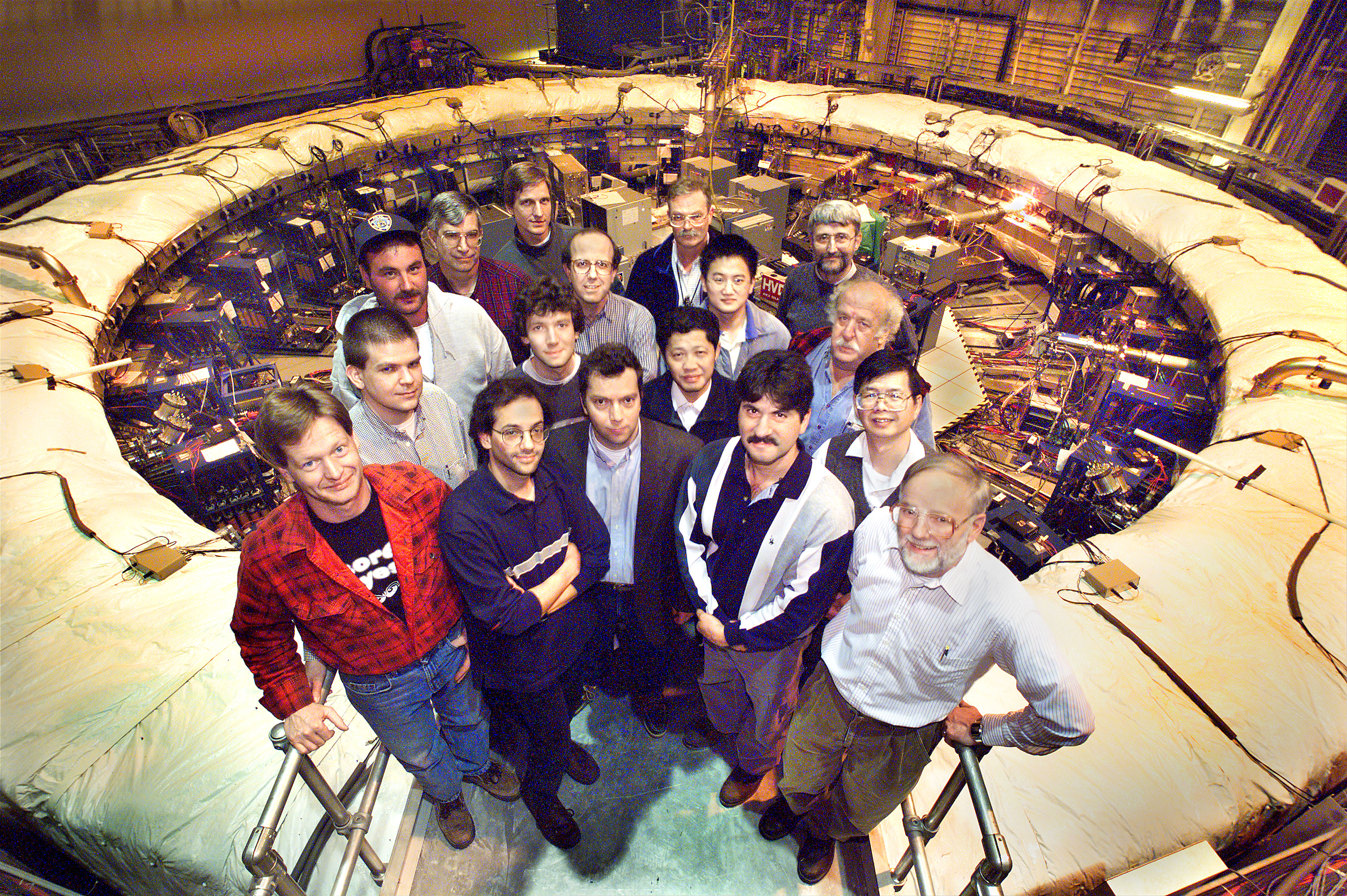
Just some of the members of the Brookhaven Lab Muon g-2 experiment collaboration circa 2001, when the first results were published, posing with the exquisite storage magnet used for the experiment. (Brookhaven National Laboratory)
Editor's note: The following news release is being issued jointly by the U.S. Department of Energy's (DOE) Brookhaven National Laboratory, DOE's Fermi National Accelerator Laboratory, and CERN, the European Organization for Nuclear Research.
UPTON, N.Y., BATAVIA, Ill., and GENEVA — The Muon g-2 Collaborations at CERN — the European Organization for Nuclear Research — and two U.S. Department of Energy National Laboratories — Brookhaven National Laboratory and Fermi National Accelerator Laboratory (Fermilab) — are the recipients of this year’s Breakthrough Prize in Fundamental Physics. Over a period of more than 60 years, experiments at these three renowned research institutions pursued a quest to measure, as precisely as possible, the subtle wobble of the muon — a tiny subatomic particle that offered an opportunity to test physicists’ fundamental understanding of particles and forces.
The Breakthrough Prize Foundation citation recognizes the awardees’ “multi-decade, groundbreaking contributions to the measurement of the muon’s anomalous magnetic moment, pushing the boundaries of experimental precision and igniting a new era in the quest for physics beyond the Standard Model.”
The prizewinners are the living co-authors of the publications that reported the results from the measurement campaigns at CERN, Brookhaven, and Fermilab. The $3 million prize will be split among all living co-authors at all three institutions.
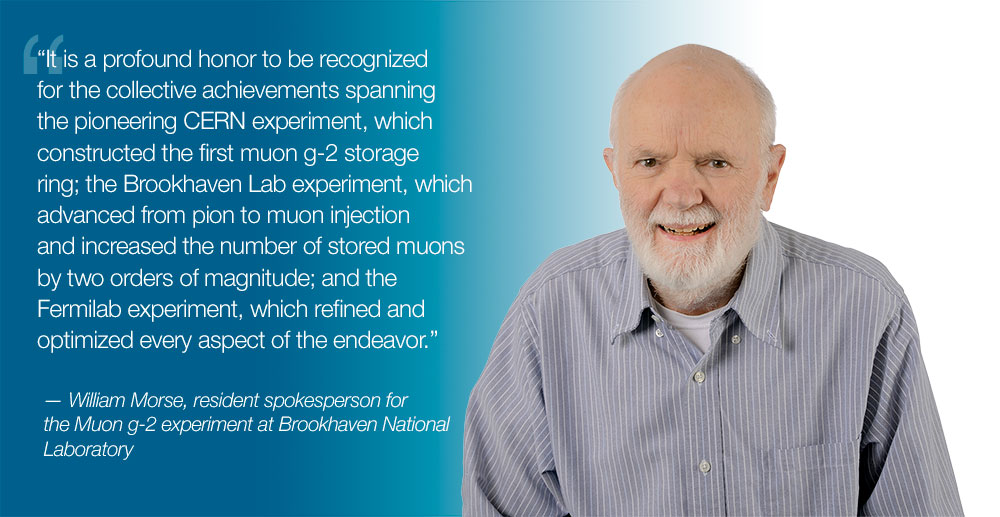
Two pairs of scientists representing the experiments at Brookhaven and Fermilab will accept the prize on behalf of the group at a gala celebration at the Barker Hangar in Santa Monica, California, on Saturday, April 18, 2026. They are: William M. Morse of Brookhaven Lab and Bradley Lee Roberts of Boston University, who helped lead the “Muon g-2” experiment at Brookhaven from construction in 1990 to the publication of final results in 2004; and Chris Polly of Fermilab and David Hertzog of the University of Washington, who helped lead a follow-up “Muon g-2” experiment at Fermilab from 2013 through publication of final results in 2025. The award also recognizes an earlier series of “g-2” experiments conducted at CERN from 1959 to 1979.
Popularly known as the “Oscars® of Science,” the Breakthrough Prizes were created in 2012 by a group of Silicon Valley innovators to recognize the world’s top scientists working in the fundamental sciences — the disciplines that ask the biggest questions and find the deepest explanations. Additional prizes were awarded in a variety of categories, including the life sciences and mathematics.
Background: mystery of the muon
The muon has been a bit of an enigma since its discovery in 1936. It shares certain characteristics with electrons, including its negative charge and a form of internal magnetism, dubbed “g,” but is 200 times heavier. Was it just a heavy cousin of the electron, or something else? Measuring its magnetism might point to clues.
Early calculations suggested the value of g should be two for both electrons and muons. But experiments in the 1940s revealed that electrons have a tiny bit of extra magnetism. Physicists expressed this “anomalous magnetic moment” as “g-2,” to represent the amount that g differs from the calculated value of two. Over time, physicists realized that the electron’s tiny deviation from two is caused by interactions with a sea of “virtual particles” popping in and out of existence.
By measuring the g-factor of muons, physicists could see if these interactions were affecting muons, too. If they observed more deviation than expected, that discrepancy might point to a hole in their understanding of the virtual particles causing the magnetic disturbance — and possibly the existence of yet-to-be-discovered particles.
 enlarge
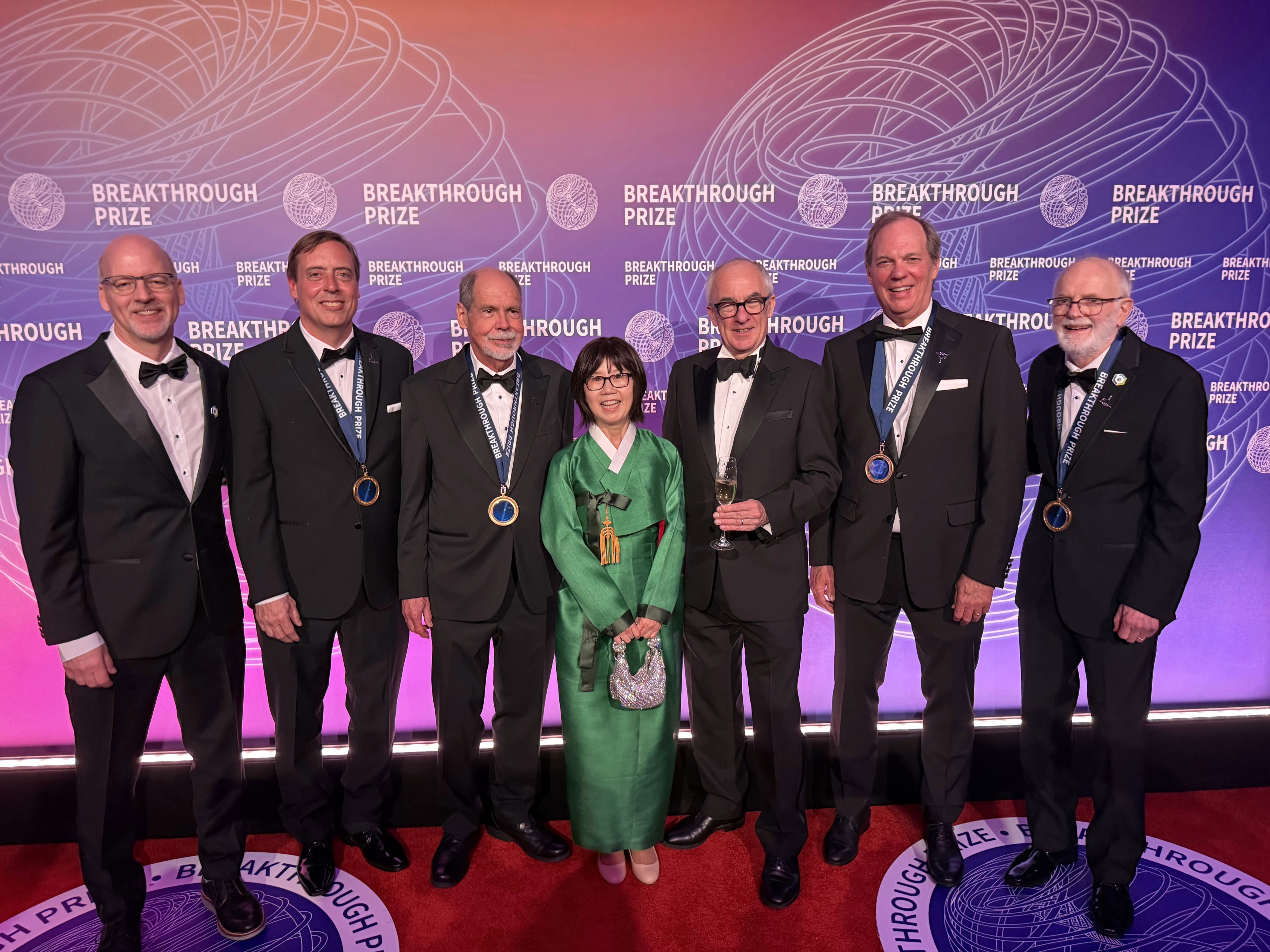
At the Breakthrough Prize ceremony on April 18, 2026, left to right: Brookhaven National Laboratory Interim Director John Hill, Fermi National Accelerator Laboratory (Fermilab) physicist Chris Polly, Boston University physicist Lee Roberts, Fermilab Director Emeritus Young-Kee Kim, CERN Director General Mark Thomson, University of Washington physicist David Hertzog, and Brookhaven Lab physicist William Morse. (Courtesy of Kat Morse)
Method: comparing measurements with predictions
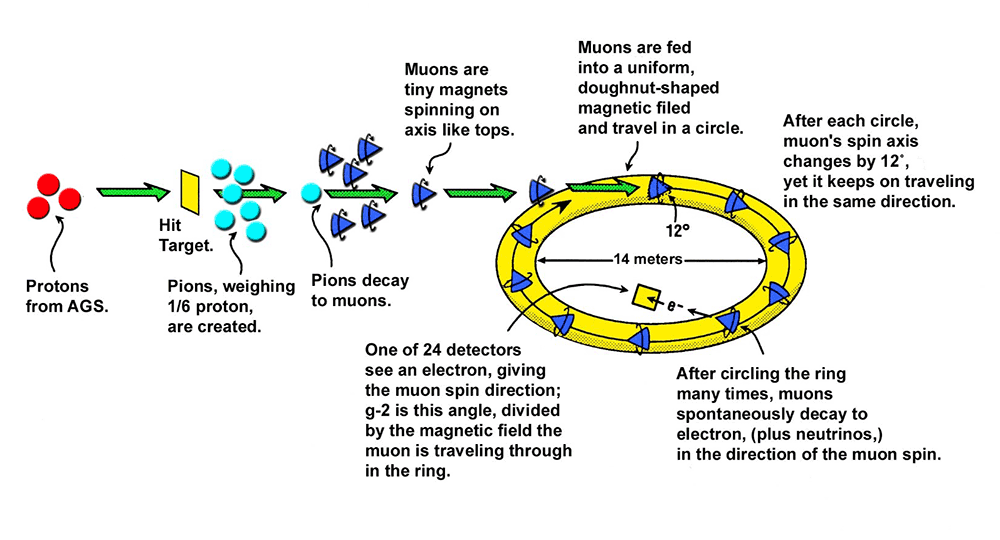
The experiments at all three institutions recognized by this prize were driven by this same basic principle: measure the muon g-2 value with the highest precision possible and compare those measurements with the best predictions available at the time. They all used a similar experimental setup: sending a beam of muons into a magnetic ring and using sensitive detectors to measure the degree to which these tiny spinning particles began to wobble, or “precess,” away from perfect alignment as they sailed around the ring.
 enlarge
At Brookhaven, muons began their journey into the g-2 experiment as protons accelerated in the Alternating Gradient Synchrotron (AGS). The protons struck a target generating particles known as pions, which in turn decay into muons that spin like tiny tops. The muons entered the storage ring with their spins aligned with their direction of motion, but as the muons move around the ring, their spins "wobbled" away from that perfect alignment. Scientists measured how much the muons wobbled by tracking electrons produced when the muons decayed — and used that information plus their measurements of the magnetic field to arrive at the value of g-2. (Brookhaven National Laboratory)
Results: from CERN, Brookhaven
Three separate experiments at CERN from 1959 to 1979, each with increasing precision, measured the muon’s g-factor as slightly higher than two, exactly as predicted by the theory-based calculations. This confirmed the predictions and firmly established the muon’s identity as a heavy cousin of the electron.
Improved experimental techniques and expanded knowledge of particles and forces motivated new muon g-2 experiments. That’s when Bill Morse and Lee Roberts entered the scene. Together with Vernon Hughes of Yale University (deceased in 2003), they built and led the “E821 g-2” experiment at Brookhaven Lab.
When the first Brookhaven Muon g-2 experiment results were published in 2001, it set off a worldwide spark of excitement. The findings revealed a tantalizingly larger-than-predicted anomaly, but not enough of a difference between experiment and theory to claim a discovery. Results published in 2002 improved the precision of Brookhaven’s measurement. The final result, published in 2004, deviated further from the prediction, but was still just a hint that muons might be affected by something unknown.
The continuing mystery launched an effort among physicists to improve the precision of both the theoretical predictions and the experimental measurements.
 enlarge
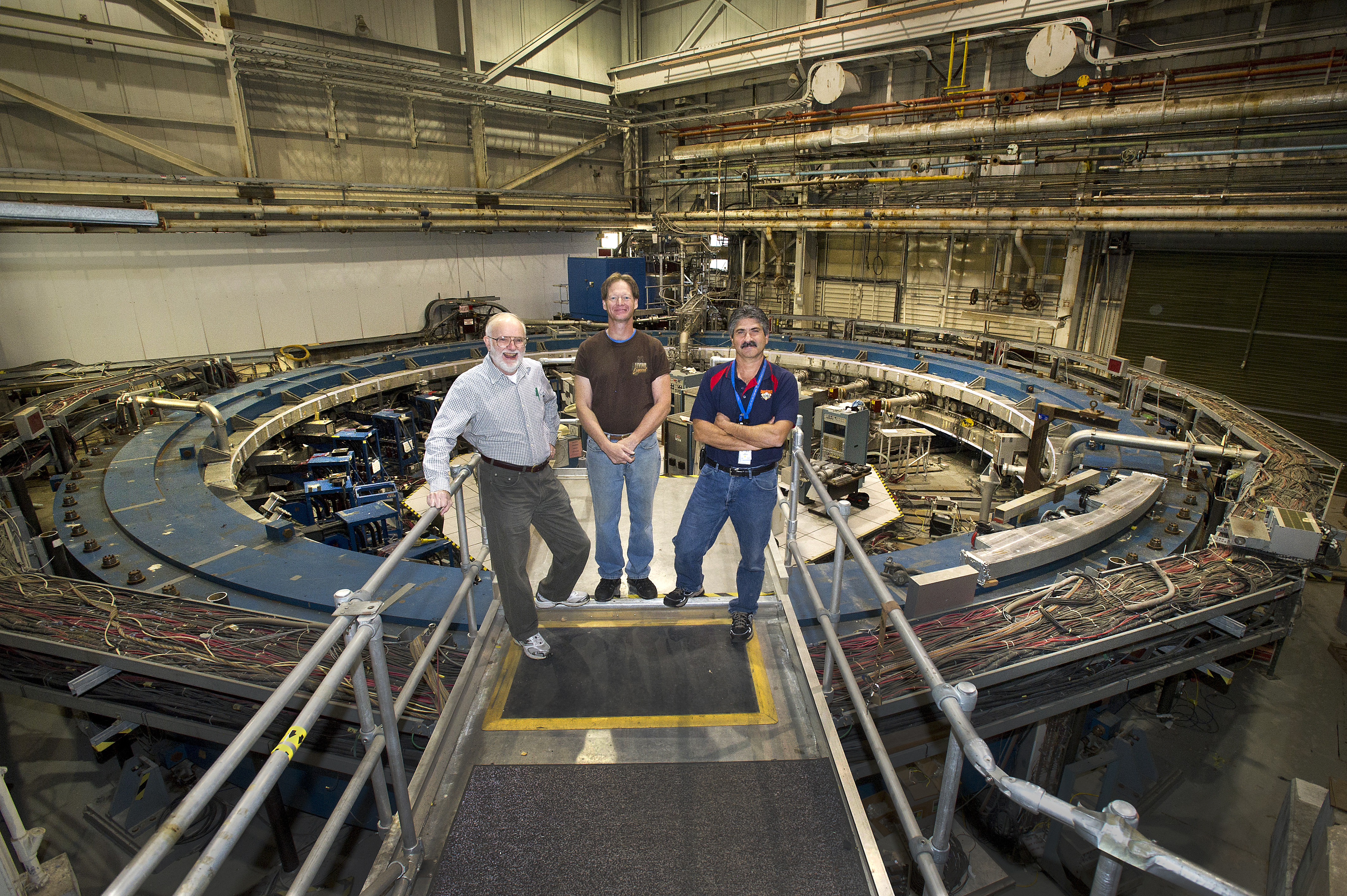
Marvelous muon magnet: William Morse stands above the 149-foot-circumference storage magnet used for the Muon g-2 experiment at Brookhaven Lab with Don von Lintig and John Benante of the Lab's Collider-Accelerator Department in 2011. Beams of muons entering this ring, supplied by a process that began in the Alternating Gradient Synchrotron, enabled precision measurements of how the negatively charged muons "wobble" in the magnetic field. "We can only measure the anomalous magnetic moment of the muon as well as we know the magnetic field going around the ring," Morse said. Thanks to a series of minute adjustments to the magnet, known as shimming, the team achieved the goal of measuring the magnetic field to a precision of 0.1 parts per million — the equivalent of being able to measure the distance from New York to Los Angeles to an accuracy of within 0.3 meters. "This beautiful magnet was so well made that in 2013 we transported it to Fermilab for a repeat experiment," Morse said. (Brookhaven National Laboratory)
Fermilab: moving muons to Illinois
 enlarge
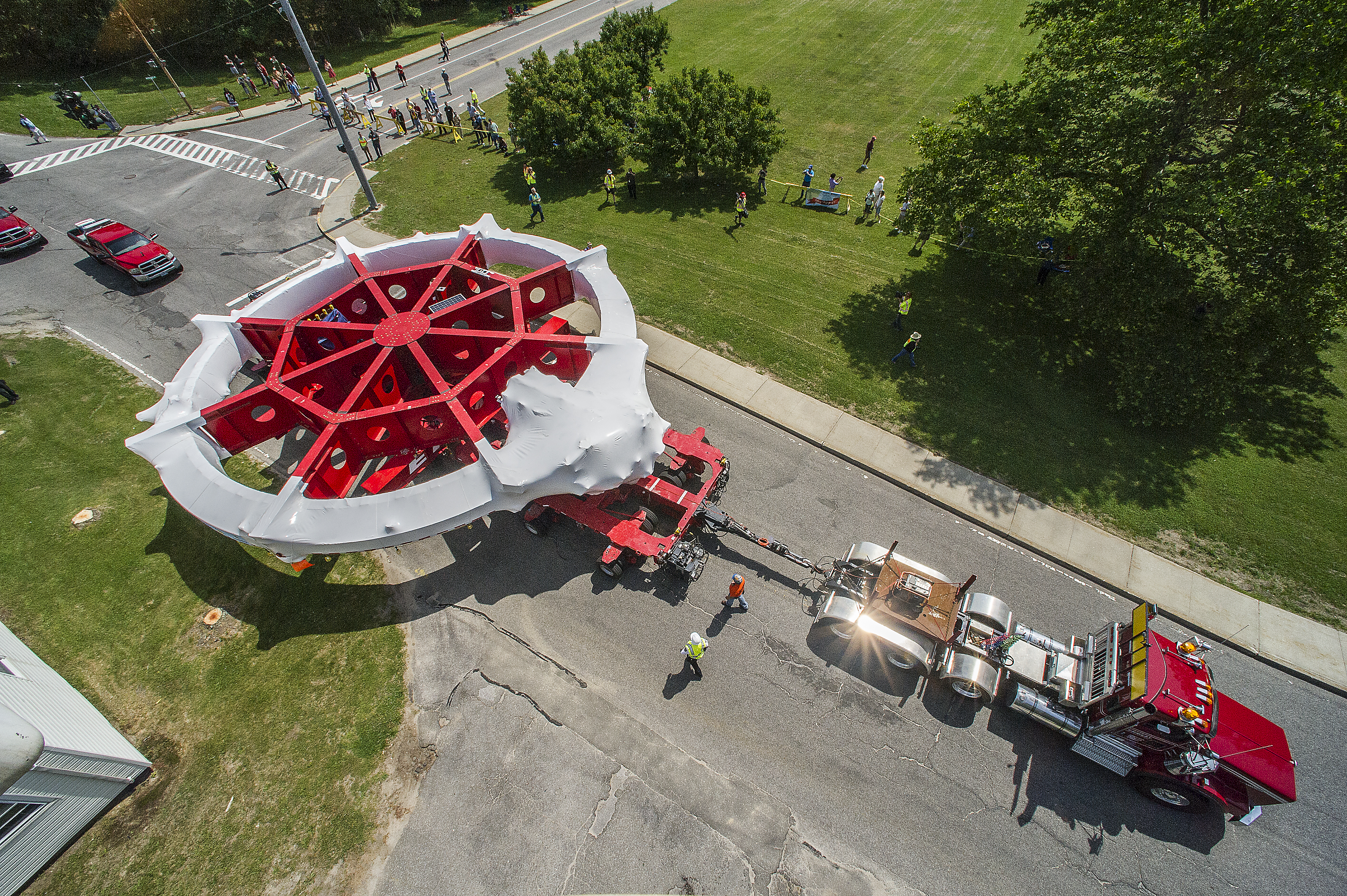
In 2013, Brookhaven Lab's muon g-2 magnet was packed up and transported 3,200 miles by land and sea to Fermilab in Illinois for the next-generation muon g-2 experiment. Many Brookhaven scientists, including Morse, continued working on the Fermilab experiment in their quest for precision muon measurements. (Brookhaven National Laboratory)
In 2013, under the guidance of Morse, Roberts, David Hertzog, and Chris Polly — working with a large international team — Brookhaven Lab’s g-2 muon storage magnet embarked on an epic land-and-sea journey from Long Island, New York, to Fermilab outside of Chicago. There, it was set up to repeat the experiment using Fermilab’s higher-intensity muon beam and new state-of-the-art technologies.
In parallel, an international collaboration of theorists formed the Muon g-2 Theory Initiative to improve the theoretical calculation. In 2020, the Theory Initiative published an updated, more precise muon g-2 prediction based on a technique that uses input data from other experiments.
The discrepancy between experiment and the prediction from that technique continued to grow in 2021 when Fermilab announced its first experimental result, confirming the Brookhaven result with a slightly improved precision. At the same time, a new theoretical prediction came out based on a new technique that heavily relies on computational power. This new predicted value was almost in agreement with the experimental measurement, suddenly narrowing the discrepancy.
The theory: a new discrepancy
Recently, the Theory Initiative published a new prediction combining the results of several groups that used the new computational technique. This prediction agrees with the experimental measurement, dampening the possibility that muons will point to “new physics.” However, theorists will continue to work to understand this new discrepancy — not between experimental measurements and predictions but between the data-driven and computational approaches for making the predictions.
Is there still a possibility that the muon’s magnetic moment could be a harbinger of new physics? The mystery continues. But either way, the Breakthrough Prize is a testament to the ever-increasing precision of these experiments and the persistence of the researchers in their quest to pursue an answer.
Fermi National Accelerator Laboratory is America’s national laboratory for particle physics and accelerator research. Fermi Forward Discovery Group manages Fermilab for the U.S. Department of Energy Office of Science. Visit Fermilab’s website at www.fnal.gov and follow us on social media.
CERN, the European Organization for Nuclear Research, is one of the world's leading laboratories for particle physics. The Organization is located on the French-Swiss border, with its headquarters in Geneva. Its Member States are: Austria, Belgium, Bulgaria, Czech Republic, Denmark, Estonia, Finland, France, Germany, Greece, Hungary, Israel, Italy, Netherlands, Norway, Poland, Portugal, Romania, Serbia, Slovakia, Slovenia, Spain, Sweden, Switzerland and the United Kingdom. Cyprus is an Associate Member State in the pre-stage to Membership. Brazil, Chile, Croatia, India, Ireland, Latvia, Lithuania, Pakistan, Türkiye, and Ukraine are Associate Member States. Japan and the United States of America currently have Observer status, as do the European Union and UNESCO. The Observer status of JINR is suspended in accordance with the CERN Council Resolution of 25 March 2022. For more information, visit home.cern.
Brookhaven National Laboratory is supported by the Office of Science of the U.S. Department of Energy. The Office of Science is the single largest supporter of basic research in the physical sciences in the United States and is working to address some of the most pressing challenges of our time. For more information, visit science.energy.gov.
Follow @BrookhavenLab on social media. Find us on Instagram, LinkedIn, X, and Facebook.
Media Contacts:
Karen McNulty Walsh
Media & Communications Office
Brookhaven National Laboratory
Tel: +1 (631) 344-8350
kmcnulty@bnl.gov
Tracy Marc
Media Relations Manager
Fermi National Accelerator Laboratory
Cell: +1 (224) 290-7803
tracym@fnal.gov
Anaïs Gerard
CERN Press Office
Tel: +41 (0) 22 767 21 41
anais.gerard@cern.ch/press@cern.ch
2026-22877 | INT/EXT | Newsroom