Six Brookhaven Lab Scientists Receive Early Career Research Awards
The awards provide new funding for research on particle accelerators and detectors, artificial intelligence, and quantum materials.
April 6, 2026
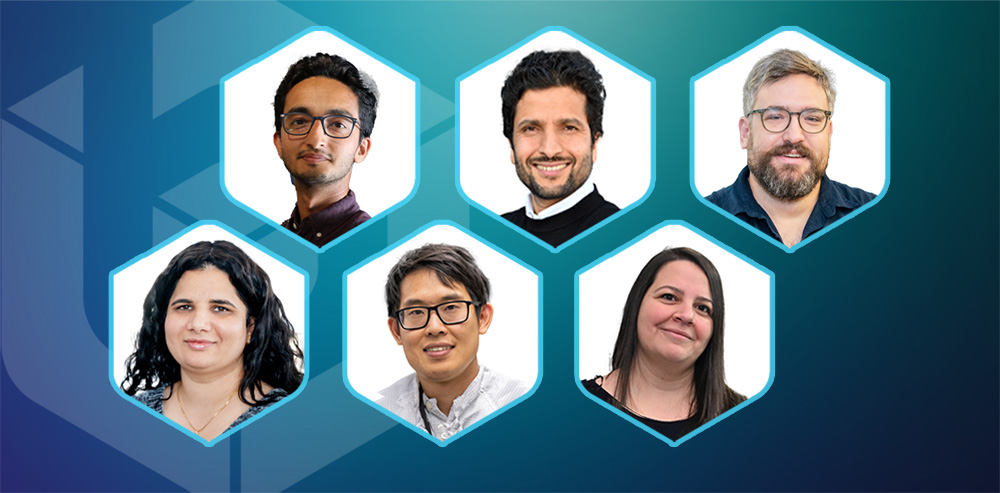
Brookhaven Lab's Early Career Research Award recipients from left, top row: Syed Haider Abidi, Niraj Aryal, Kiel Hock, Aamna Khan, Albert Liu, and Stefania Stucci.
UPTON, N.Y. — Six scientists at the U.S. Department of Energy’s (DOE) Brookhaven National Laboratory have been selected by DOE’s Office of Science to receive significant funding through its Early Career Research Program. The program, now in its 16th year, bolsters the nation’s scientific workforce by supporting exceptional researchers at the outset of their careers, when many scientists do their most formative work.
The awards are part of DOE’s longstanding efforts to support critical research at the nation’s universities and National Labs, grow a skilled STEM workforce, and cement America as a global leader in science and innovation.
“These are very prestigious grants. Having six awardees at Brookhaven speaks highly to the talent we attract,” said Brookhaven Lab Interim Director John Hill. “I’m very excited for them to begin their projects — and to see the exciting discoveries they will make in the next few years.”
Each awardee will receive approximately $2,750,000, distributed over five years, to conduct DOE mission-critical research projects. Read on to learn about the Brookhaven Lab awardees and their projects.
Syed Haider Abidi, “Unlocking New ZZ* Decays of the Higgs Boson with Analog AI/ML Algorithms”
 enlarge
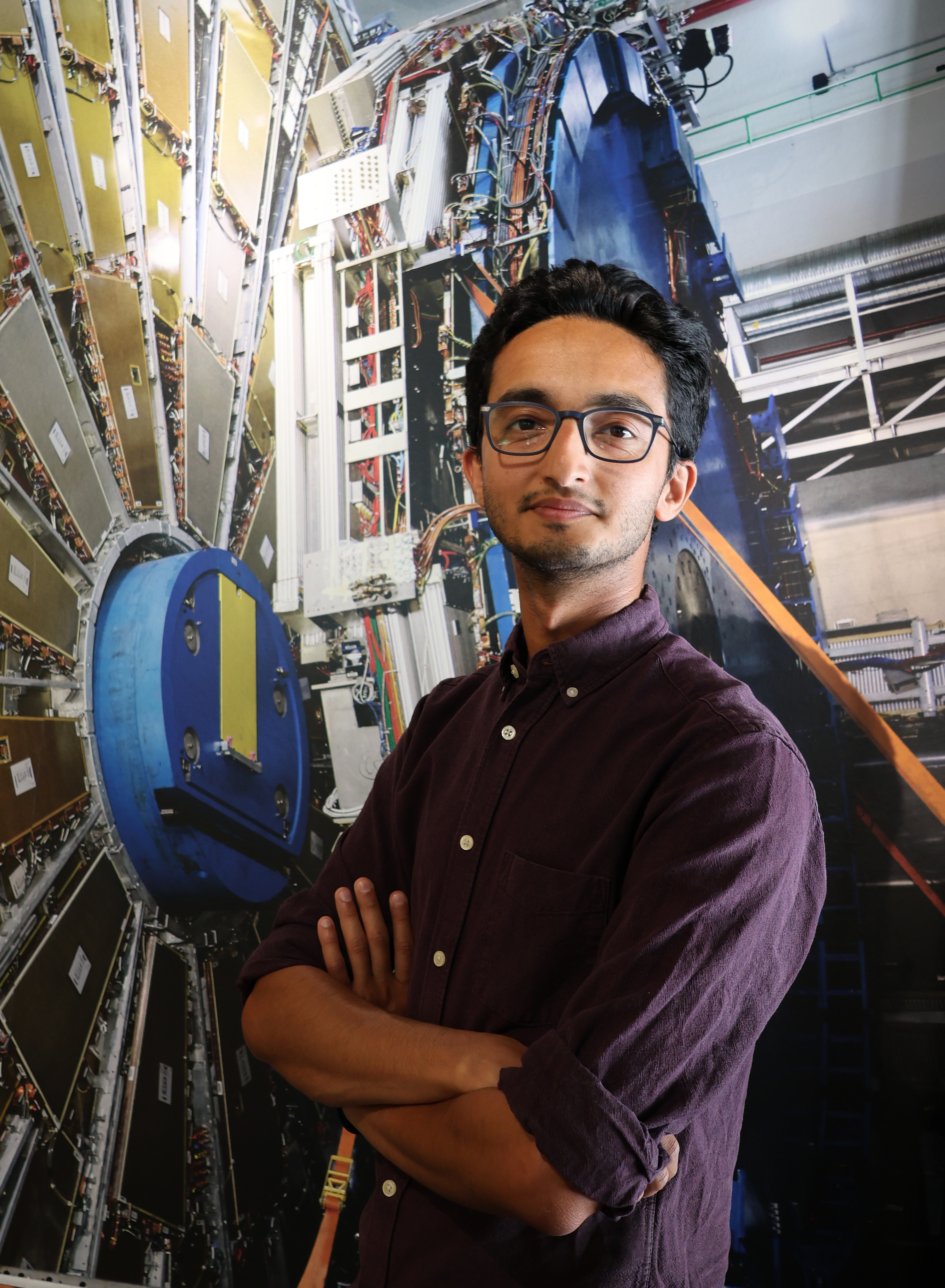
Syed Haider Abidi in front of the ATLAS detector at CERN's Large Hadron Collider. (Punit Sharma)
Syed Haider Abidi is an experimental particle physicist in Brookhaven’s Omega Group, working on the ATLAS experiment at the Large Hadron Collider at CERN, the European Organization for Nuclear Research. He leads efforts to integrate modern machine learning (ML) into real-time event selection, shaping how the experiment identifies the most informative particle collisions. He currently serves as the artificial intelligence (AI) and ML coordinator for ATLAS’s software trigger upgrade. Abidi earned his Ph.D. in physics from the University of Toronto, started at Brookhaven Lab as a postdoc, and was awarded the Goldhaber Fellowship in 2021 before joining the research staff in 2024. Now supported by an Early Career Award, he is evaluating new AI/ML computing concepts with an eye toward measuring the Higgs boson, a fundamental particle that is responsible for giving mass to other particles, and developing the next generation of high-energy physics detectors.
Abidi’s research probes whether the Higgs boson behaves exactly as the Standard Model — physicists’ best model to understand the forces of particles’ interactions that shape the universe — predicts, or whether it conceals signs of “new physics.” Scientists study what happens to particles as they lose energy, or decay, to understand particles’ behavior and keep an eye out for new particles. Using ATLAS data, Abidi targets an unexplored decay channel called Higgs→ZZ* that involves tau leptons — elusive particles difficult to detect amidst the “noise” of millions of collisions. To extract these rare signals in real-time, Abidi is developing and introducing real-time AI/ML-based tagging algorithms and low-power analog computing into the ATLAS trigger to reduce costly memory transfers and increase the number of useful events saved for offline analysis. Together, smarter algorithms and integrated analog computation aim to sharpen sensitivity to unusual Higgs boson behavior, expand tests of the Standard Model, and inform future detector design.
“Having the Early Career Award to test these technologies in a realistic environment is super exciting,” Abidi said. “This application of AI/ML is unique and has tons of potential for the future and long-term implications for pushing real-time data analysis closer to the detector.”
Niraj Aryal, “Development of Efficient First Principles and Machine Learning Methods to Study and Predict Magnetic Topological Materials Exhibiting Dual Berry Phase Effects”
 enlarge
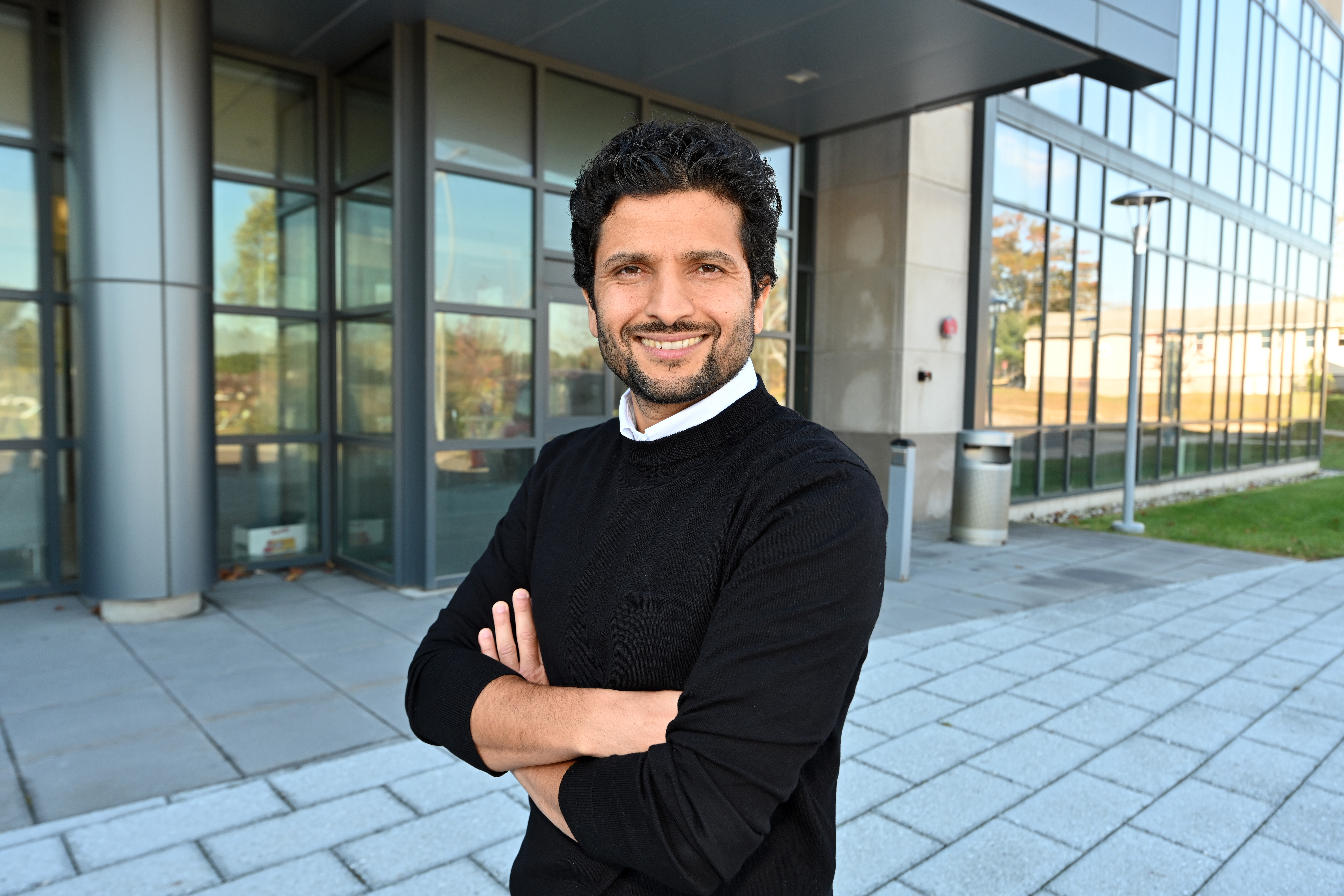
Niraj Aryal outside the Interdisciplinary Science Building at Brookhaven Lab. (Kevin Coughlin/Brookhaven National Laboratory)
Niraj Aryal, a computational condensed matter physicist with Brookhaven Lab’s Condensed Matter Physics and Materials Science Department, will receive funding for research that could help set the stage for discovery of new quantum materials to power next-generation technologies.
Realizing breakthroughs in energy-efficient electronics, novel data-storage platforms, and faster, more secure quantum computing requires identifying materials that operate at the smallest scales and follow the unconventional laws of quantum mechanics. This need is increasingly urgent as current technologies reach limits in performance and efficiency. Successful integration of quantum materials — enabling ultra-low-power, highly miniaturized devices — would represent a paradigm shift aligned with DOE priorities in AI and quantum information science.
The search for such quantum materials entails solving high-dimensional, coupled integro-differential equations and typically demands substantial computational resources over extended runtimes. By combining advanced machine-learning methods, high-performance computing, and state-of-the-art electronic-structure calculations, Aryal will develop, validate, and deploy new theoretical and computational models on world-class supercomputers to efficiently investigate a wide range of candidate topological materials and quantify their stability, transport responses, and tunability under applied fields to guide targeted experimental discovery.
“Each leap in human progress has followed a leap in materials,” Aryal said. “With smarter algorithms and powerful computers, we can uncover novel quantum materials that make future electronics and information processing more capable while using far less energy.”
Kiel Hock, “Maximizing Helium-3 Polarization at the Electron-Ion Collider”
 enlarge
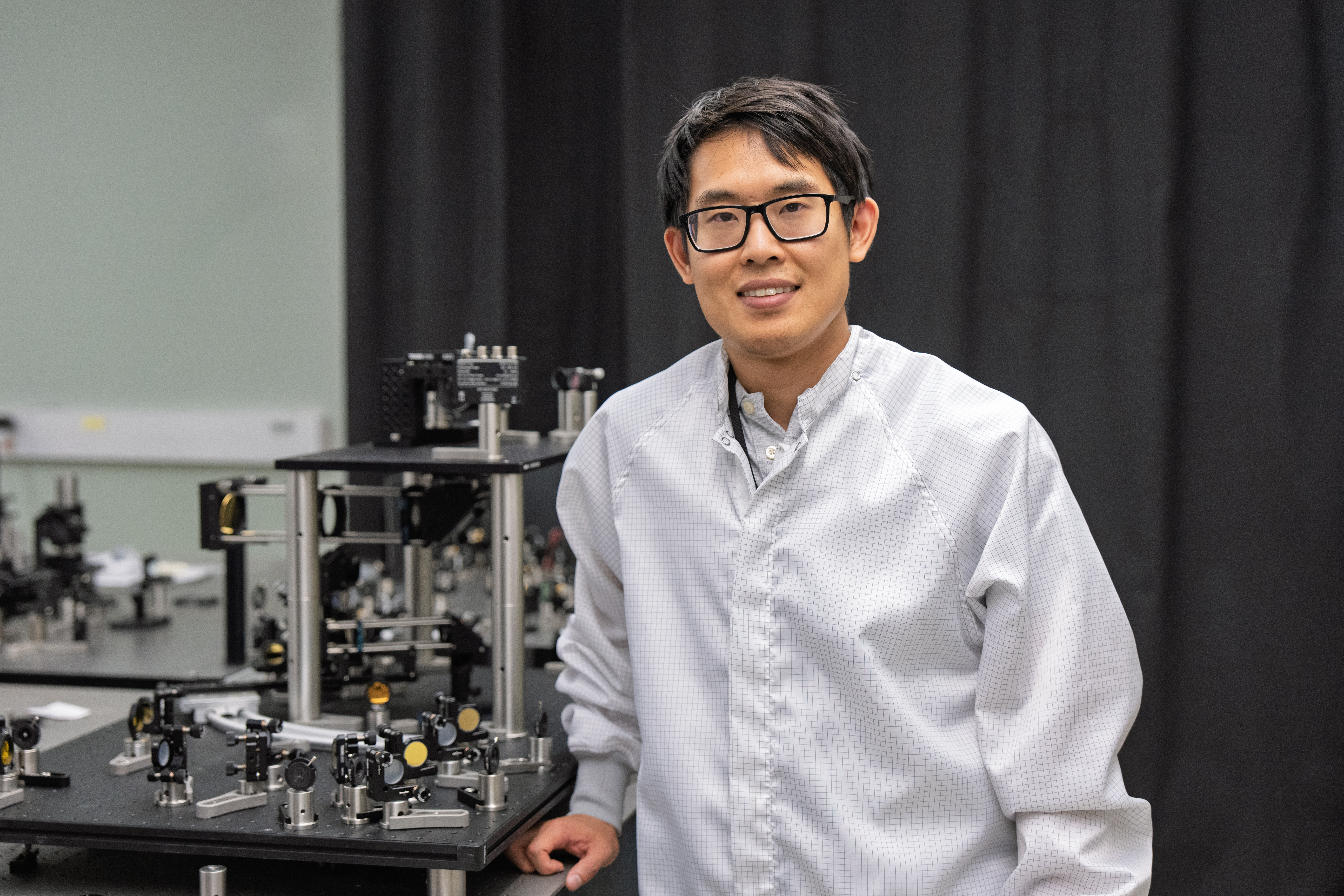
Kiel Hock in the main control room of the Relativistic Heavy Ion Collider. (David Rahner/Brookhaven National Laboratory)
Kiel Hock, an accelerator physicist in the Collider-Accelerator Department (CAD), will receive funding to explore strategies for maintaining the spin alignment, or polarization, of helium-3 nuclei as they are accelerated to high energies. These polarized helium-3 nuclei are an essential component of the planned research at the future Electron-Ion Collider (EIC), where collisions with a polarized beam of electrons will give scientists insight into the spin structure of neutrons, one of the essential building blocks of atomic nuclei. Helium-3 nuclei give scientists access to neutron spin because the net polarization of these nuclei is held mostly by their single neutron. Studies of neutron spin will be complementary with the EIC’s studies of proton spin using collisions of electrons with polarized proton beams. But helium-3 nuclei are much more susceptible to depolarization during acceleration than simple protons are — and they’ve never been accelerated to the energies required for the EIC. Hock will therefore conduct experiments to test various methods for maintaining polarization in helium-3 beams accelerated using Brookhaven’s Booster accelerator and Alternating Gradient Synchrotron (AGS) to almost 1,000 times the energy previously achieved. He has also contributed to the development of codes used to model particles in the accelerator. The experimental data and predictions from model-based simulations will inform strategies and possible upgrades to optimize the performance of these accelerators for injecting helium-3 beams into the ion ring of the EIC.
“I am greatly honored to receive this Early Career Award; this research is exhilarating,” Hock said. “Helium-3 will be the first new polarized ion species accelerated at Brookhaven’s CAD since polarized protons were first introduced into the AGS in the early 1980s. Ensuring that polarized helium-3 ions can meet the demands of the EIC will lay the foundation for high quality physics data. I thank my colleagues and managers in CAD for their wholehearted support of this research.”
Hock earned his bachelor’s and master’s degrees in physics from the University at Albany in New York in 2010 and 2012, respectively, and his Ph.D. in physics from the Universite Grenoble-Alpes, France, in 2021. He joined Brookhaven Lab as an accelerator operator in 2013 and advanced to operations coordinator, supervising other operators, in 2019. In both roles, he helped ensure smooth and safe operations of the Booster, AGS, and the Relativistic Heavy Ion Collider (RHIC). In 2022, he was promoted to accelerator physicist, and he served as run coordinator for RHIC Run 24. Most recently, Kiel developed the formalism to incorporate spin tracking into the European Center for Nuclear Research’s (CERN) comprehensive accelerator modeling code developed for a possible future high-energy circular collider. He has served on the organizing committees for accelerator workshops and is a member of the American Physical Society.
Aamna Khan, “Maximizing Electron Beam Intensity for High-Brightness Synchrotron Light Sources”
 enlarge
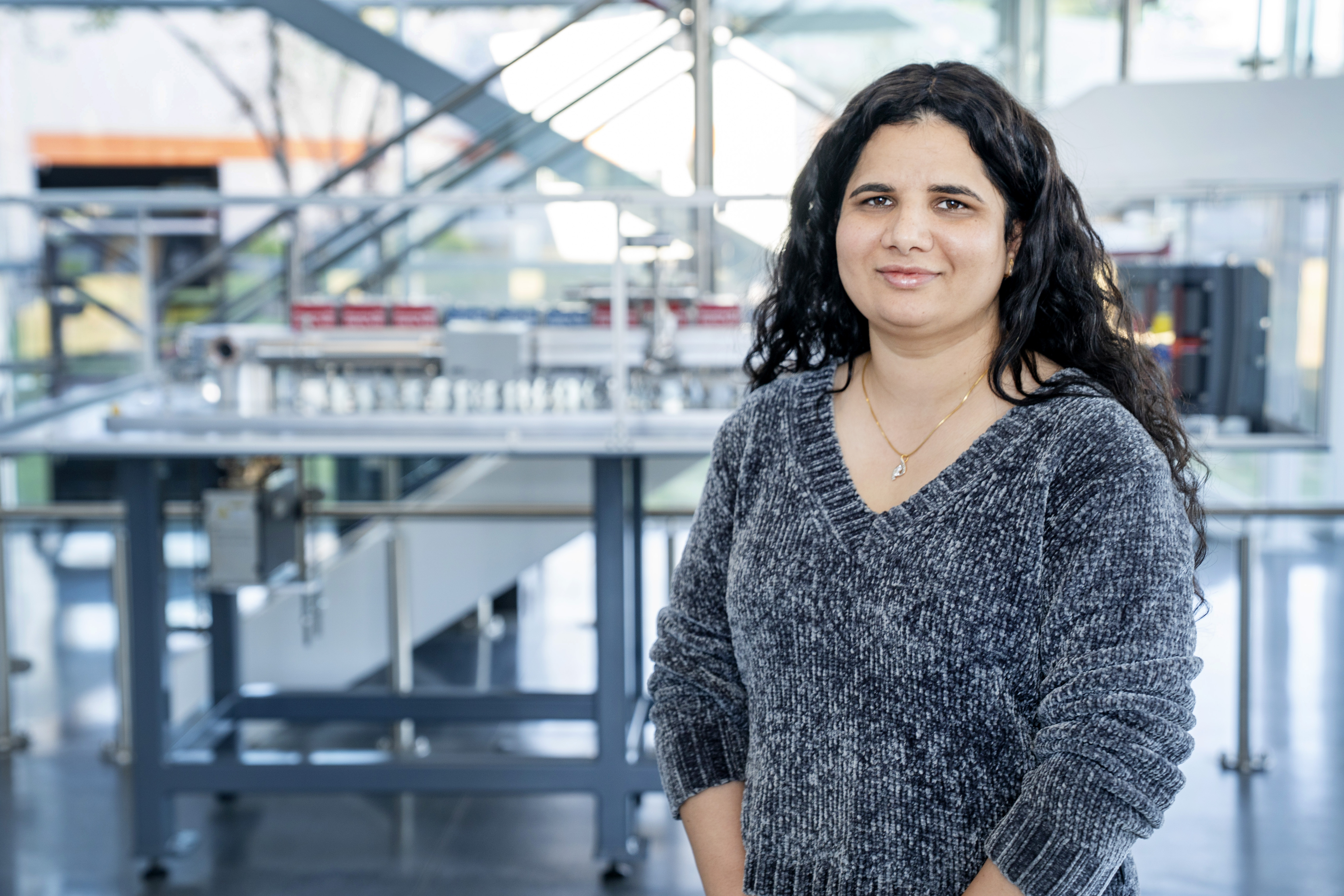
Aamna Khan in the main lobby of the National Synchrotron Light Source II. (David Rahner/Brookhaven National Laboratory)
Aamna Khan, an accelerator physicist at the National Synchrotron Light Source II (NSLS-II), is tackling one of the core challenges for next-generation synchrotron facilities: understanding and mitigating adverse collective effects in high-intensity electron beams that can degrade beam quality, shorten beam lifetime, and ultimately limit the achievable beam intensity. Next-generation synchrotron light sources promise exceptionally bright X-rays that can drive advances in materials science, chemistry, and biology. Achieving these capabilities requires beams with much higher particle densities than those in today’s machines. At such high intensities, particle interactions within the beam and with the accelerator surroundings become stronger, degrading beam quality and limiting achievable X-ray brightness. With Early Career Award funding, Khan will advance the theoretical and computational foundations required to maximize the performance of these powerful light sources. By integrating theory, advanced simulations, and experimental validation at NSLS-II, in collaboration with other leading facilities, this research tackles critical limitations in beam intensity.
“I am honored to receive this award,” Khan said. “This award enables me to explore new directions in beam physics that are vital for the next generation of ultra-low-emittance light sources, including the NSLS-II upgrade. I look forward to collaborating with colleagues on these challenges and building a small team dedicated to advancing this work.”
Khan earned her bachelor’s degree in physics from Panjab University in India, followed by a master’s degree in physics from the Indian Institute of Technology Roorkee. She then pursued a doctorate in accelerator physics at the Technical University of Darmstadt in Germany, where she worked on novel energy recovery linear accelerators. She later joined Brookhaven Lab as a postdoctoral research associate at NSLS-II and is now an accelerator physicist.
Albert Liu, “Multidimensional Optical Probes of Quantum Materials”
enlarge
Albert Liu in his lab at Brookhaven's Interdisciplinary Science Building. (Timothy Kuhn/Brookhaven National Laboratory)
Albert Liu, a physicist in the Condensed Matter Physics and Materials Science Department, aims to disentangle the intricate physics of quantum materials using multidimensional spectroscopies — an advanced class of techniques based on the same principles as magnetic resonance imaging (MRI). Instead of relying on magnetic field pulses, multidimensional spectroscopies employ ultrafast pulses of laser light to study how molecules and materials interact on extremely short time scales. Liu is adapting these techniques, conventionally used to study molecular and biological systems, to probe quantum materials that pose unique experimental challenges. For example, many quantum materials are most responsive to terahertz-frequency light, which is invisible to the human eye and difficult to work with because it is easily absorbed by air. Many quantum materials are also microscopic, often far smaller than the width of human hair. At Brookhaven, Liu plans to develop and apply new multidimensional spectroscopies that can operate in the “terahertz gap” and integrate with a microscope to accommodate the smallest quantum materials. This next generation of multidimensional spectroscopies will shine light on the fundamental behaviors of quantum materials, including how material imperfections or “disorder” can disrupt the delicate quantum states that researchers hope to harness for future technologies — and how magnetic and structural properties interact to give rise to entirely new quantum effects.
“Expanding multidimensional spectroscopies to new regions of the electromagnetic spectrum — and to microscopic length scales — will significantly bolster Brookhaven’s portfolio of powerful experimental capabilities, enabling us to study the wide range of quantum materials that interest the DOE,” Liu said. “I am both honored to receive this award and grateful for the resources and scientific community here at Brookhaven that make this ambitious project possible. Most importantly, I am excited to address some of the most compelling problems in quantum materials research.”
Liu pursued his education at the University of Michigan, Ann Arbor, where he earned two bachelor’s degrees in 2015, followed by a master’s degree in electrical engineering in 2016, and a Ph.D. in applied physics in 2020. He was a Humboldt postdoctoral fellow at the Max Planck Institute for the Structure and Dynamics of Matter in Hamburg, Germany, from 2020 to 2023, before joining Brookhaven Lab as a staff scientist later that year.
Stefania Stucci, “A Warm Revolution in Particle Tracking”
 enlarge
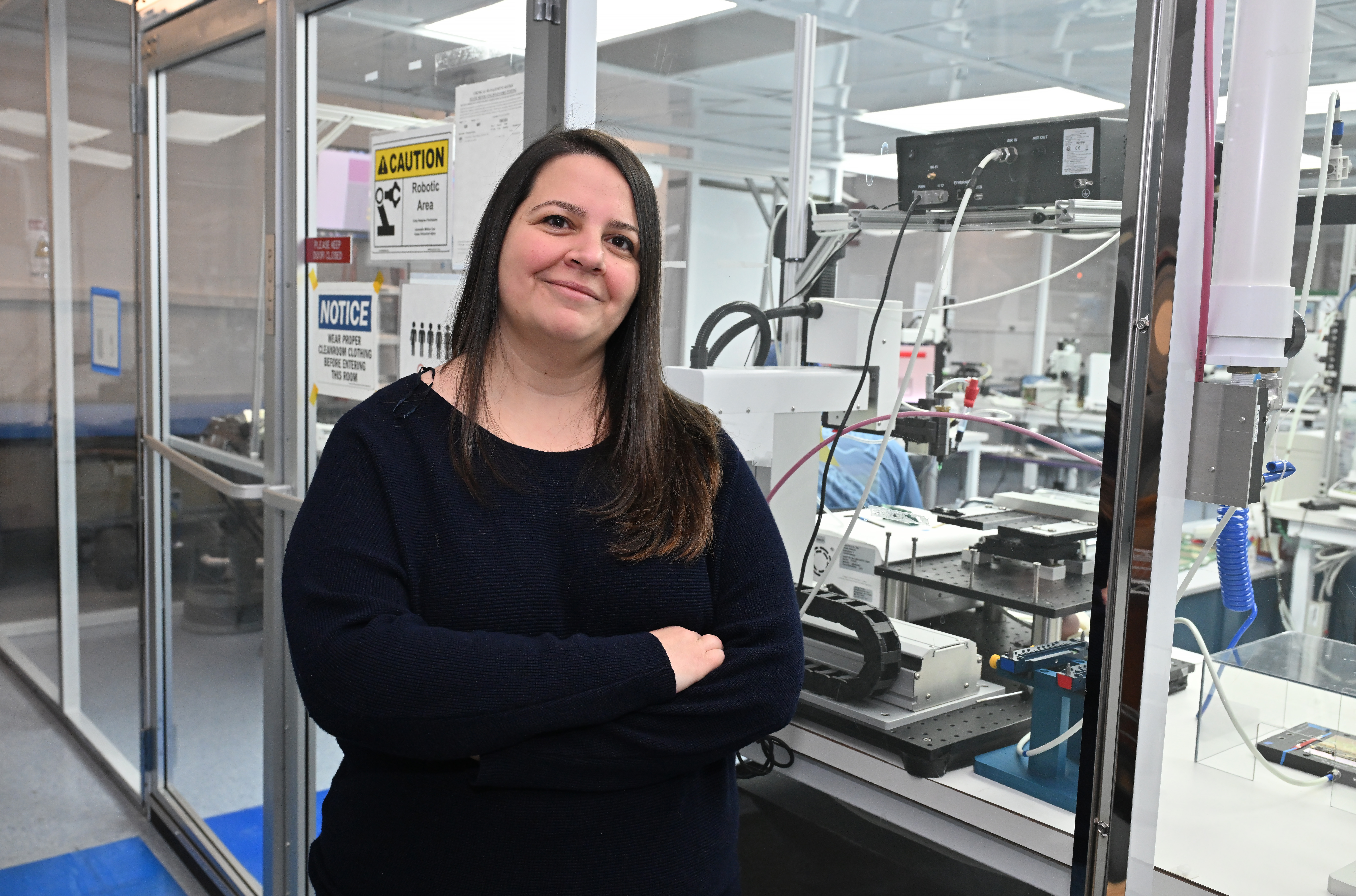
Stefania Stucci outside the ATLAS ITk assembly cleanroom at Brookhaven Lab. (Kevin Coughlin/Brookhaven National Laboratory)
Since the 1980s, silicon has been the standard material for high energy physics detectors because of its ability to withstand radiation and precisely track particles. Silicon carbide (SiC) has a weaker signal output, but it offers other key advantages, including its tolerance to higher voltages, temperatures, and radiation. Stefania Stucci, a scientist in the Omega Group in the Physics Department, will receive funding to advance SiC-based Low Gain Avalanche Detectors (LGADs), sensors that amplify particle signals for precise measurements of space and time. Leveraging recent advances in SiC fabrication, as well as Brookhaven Lab’s research facilities and fabrication capabilities, Stucci aims to develop high-performance SiC LGADs that are tough, nimble, and accurate — with the necessary radiation tolerance and thermal resilience to undergird a new wave of scalable detectors for next-generation colliders.
“This work will seed an entirely new high energy physics research hub in the United States — one that can support all stages of detector development,” Stucci said. “It will bridge fabrication and detector design, push boundaries, and shape the next technological directions for particle detector innovation. I can’t wait to get started.”
Stucci earned her doctorate in physics at the University of Bern in Switzerland. She joined Brookhaven Lab as a postdoctoral researcher in 2016 and has been a staff member in the Physics Department since 2020. Stucci has more than a decade of experience working with silicon detectors, system integration, and radiation testing, and she has mentored dozens of students, postdocs, and technicians, actively sharing her passion for discovery with a new workforce.
Brookhaven National Laboratory is supported by the Office of Science of the U.S. Department of Energy. The Office of Science is the single largest supporter of basic research in the physical sciences in the United States and is working to address some of the most pressing challenges of our time. For more information, visit science.energy.gov.
Follow @BrookhavenLab on social media. Find us on Instagram, LinkedIn, X, and Facebook.
2026-22851 | INT/EXT | Newsroom