Seth Nemesure Builds the Brain that Runs the Electron-Ion Collider
April 15, 2026
 enlarge
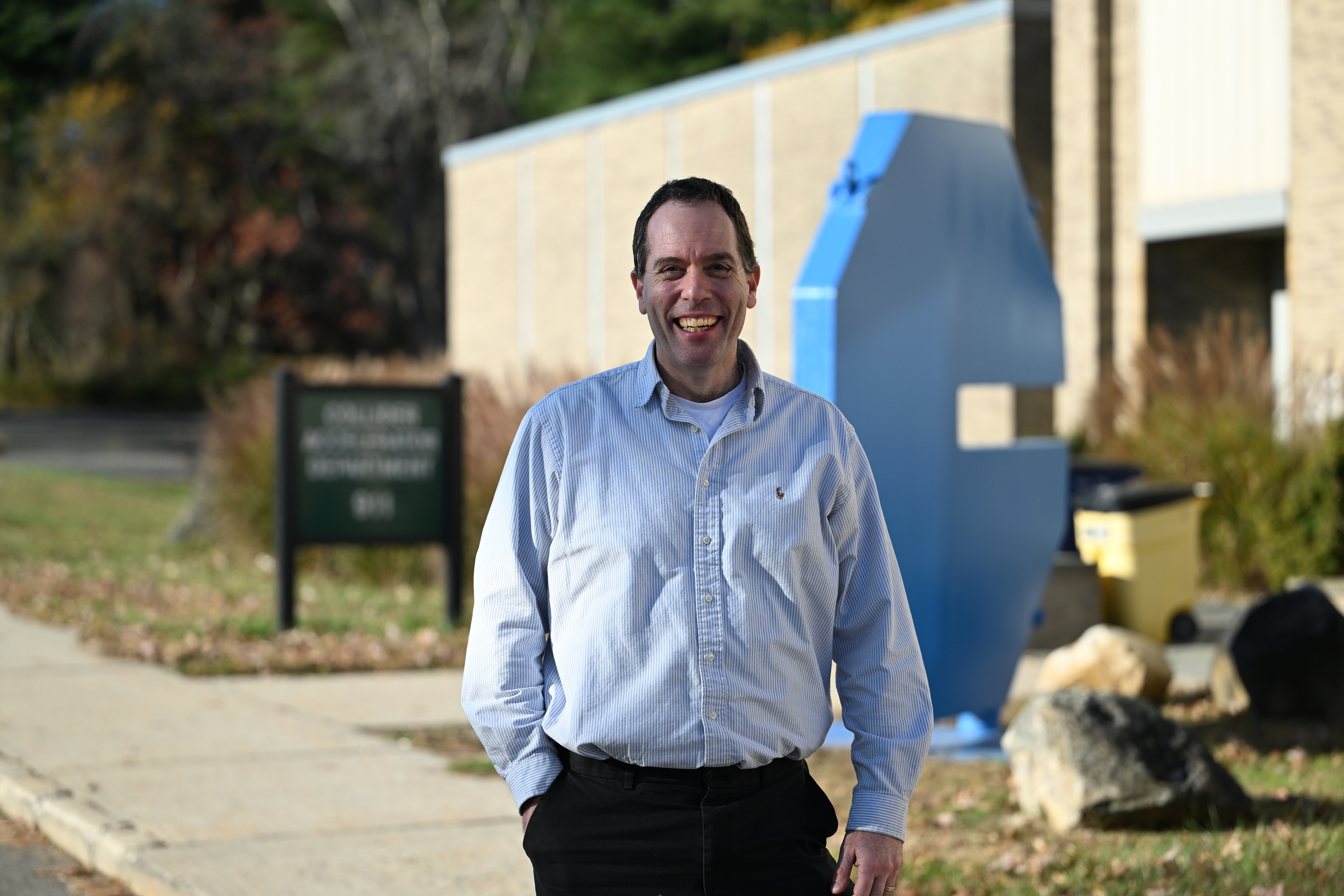
Seth Nemesure stands outside the Collider-Accelerator Division building, where he works as a high-level applications manager and supervisor in the Controls Group for the Electron-Ion Collider (EIC) project. He recently shared insights about the different hats he wears on the project. (Kevin Coughlin/Brookhaven National Laboratory)
Editor’s note: This story is a part of a series of profiles highlighting the scientists, engineers, and other professionals who are helping to design the Electron-Ion Collider (EIC), a next-generation nuclear physics research facility being built at the U.S. Department of Energy’s (DOE) Brookhaven National Laboratory in partnership with DOE’s Thomas Jefferson National Accelerator Facility (Jefferson Lab) and collaborators around the world. The only collider in the United States, and the only one of its kind in the world, the EIC will probe the fundamental structure of visible matter by colliding polarized electrons with protons and atomic nuclei at nearly the speed of light inside its 2.4-mile-circumference accelerator rings. A state-of-the-art detector will capture detailed images of quarks and gluons as they interact within protons and nuclei. This research will reveal how these interactions establish key properties of matter while advancing accelerator technology, artificial intelligence, and data science with potential benefits beyond nuclear physics.
What is your title and group?
I am the high-level applications manager and supervisor in the Controls Group for the Electron-Ion Collider (EIC) project at Brookhaven National Laboratory.
Describe the purpose of your job.
I wear multiple hats. My current role is to manage the controls software for the EIC project. A controls system is basically the brain and nervous system of a large accelerator facility. It monitors thousands of signals through the system, sends commands to adjust equipment like magnets and power supplies, keeps everything running safely, and provides the interfaces — the screens and controls that operators use, as well as the software connections that allow different systems to work together — to run the facility. I’m responsible for coordinating the controls software requirements. These are the decisions for signal response times, the data that needs to be collected, and what information should be visible to operators. I help to coordinate a team of developers to build software that meets those needs.
My “other” hat is to provide support for the existing injector systems, a complex of accelerators that run their own experiments and prepare particle beams for the future EIC, that were instrumental to the successful running of the Relativistic Heavy Ion Collider (RHIC).
RHIC is a DOE Office of Science user facility that recently concluded its seminal 25-year run.
 enlarge
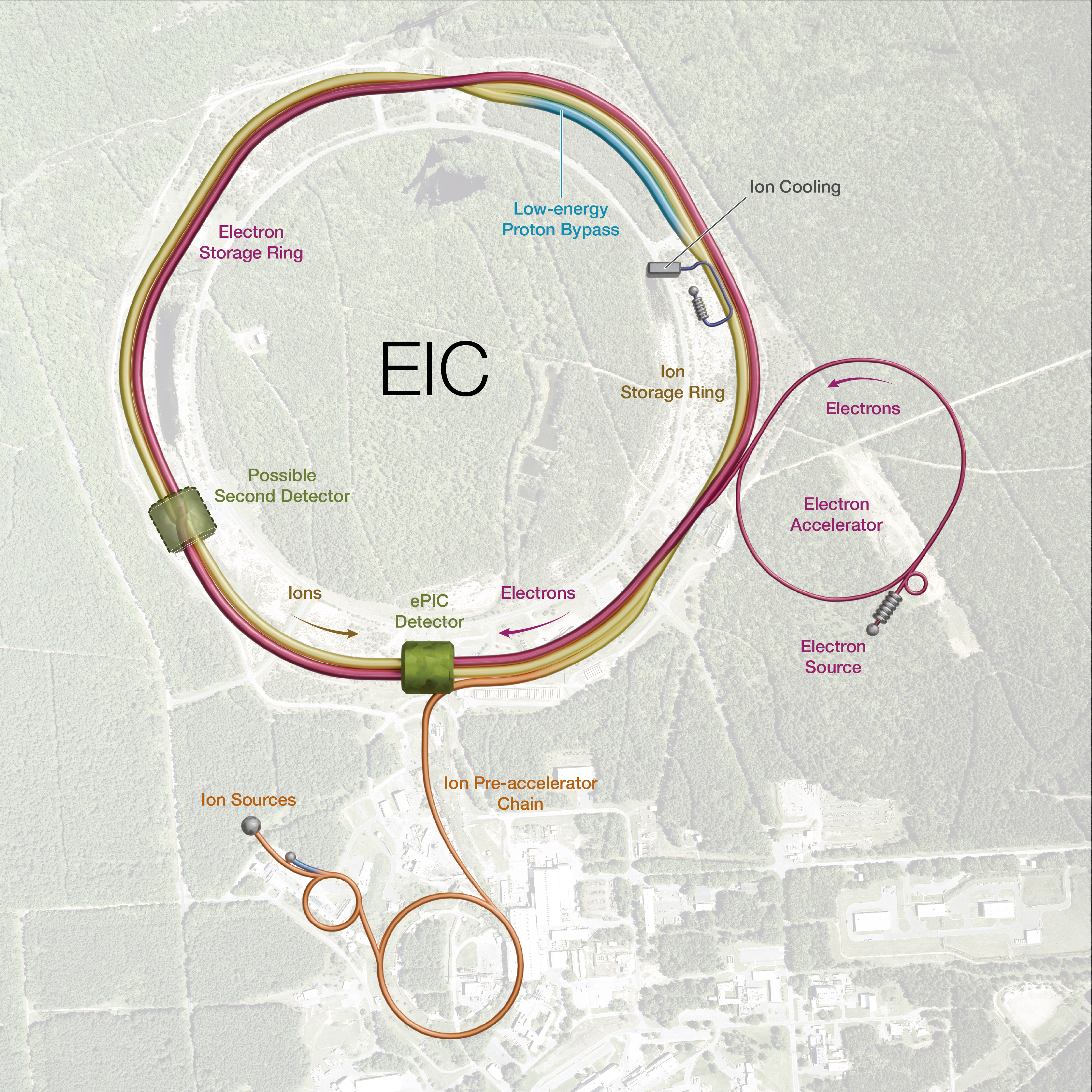
The Electron-Ion Collider (EIC) will consist of new accelerator components — including an electron source, electron accelerator, and an electron storage ring — added to a repurposed ion storage ring and the ion pre-accelerator chain from the Relativistic Heavy Ion Collider (RHIC). (Valerie A. Lentz/Brookhaven National Laboratory)
Can you give a sense of how much data accelerators like RHIC have generated — and how much the EIC will generate?
The software infrastructure provides the gateway to petabytes of data, roughly a million gigabytes, that is generated, collected, stored, and ultimately analyzed. The software also provides automation — from scripted processes and sequences to AI and machine learning — along with real-time feedback of signals and alarms that enhances confidence, productivity, and reliability.
What is challenging about managing controls software?
Controls software is instrumental across the project. We are responsible for providing common and familiar interfaces to accelerator and detector physicists and engineers. This is challenging because controls provide software and hardware that must consider the varying needs and requirements for each of these groups. This includes tools, services, and applications for physicists, engineers, technicians, and eventually, operations. Ultimately, the goal is to provide a software interface that is accommodating to all.
One major challenge is addressing the scope of the EIC controls system. The controls system will need to support upwards of 10 million signals. We are confident in our ability to scale the controls to this level, but it is challenging because, while we are confident in our design, it will take time to acquire the resources and real-world data feeds from the accelerator hardware needed to test.
What is the most exciting aspect of your job?
On a larger scale, the EIC project provides an opportunity to explore new scientific frontiers that we expect to lead to exciting new discoveries.
On a more personal scale, I am being given the opportunity to drive the next 25-plus years of controls software. This includes integration into a modern controls system called EPICS, which has the benefit of a globally contributing accelerator community, and a fresh start in building software from the ground up based on the experience we have gained over the previous 25-plus years of running the RHIC project.
What are some notable accomplishments you and/or your group have achieved thus far?
We have been able to accomplish a great deal. Some of the highlights include building a bridge between the previous generation controls system from the RHIC project to the EPICS controls system to be used at the EIC. This includes translation of data and alarms into a form that can be easily viewed within the EPICS ecosystem. A robust tool has been developed to help developers generate applications in python, one of the most popular programming languages used today, using a set of templates integrated with our version control system. This helps to provide consistency when developing applications, services, libraries, and scripts.
Tell us about your career journey?
I have a bachelor’s degree in mechanical engineering, and I graduated with a master’s degree in atmospheric science from Stony Brook University in 1991. I began my career at Brookhaven Lab in 1992 as a research scientist in what was then called the Environment Chemistry Division. I transferred to the Controls Applications Group for the RHIC project in 1998 as a C++ and Java developer. In 2011, I began supervising the Applications Group until I transferred over to the EIC as a supervisor and project manager for high-level applications in the spring of 2025.
Do you have advice for early career folks or those in your field?
For software development, it is important to build a solid programming background. While AI has helped lower the barrier to software development, it has limitations that can lead to inefficiencies and faulty logic. A software project is not just about lines of code. A thorough understanding of the system being designed, including user specifications, at minimum, a cursory understanding of the software goals, and maybe even some of the basic physics and/or engineering, is critical to successfully design a quality piece of software.
What are some non-work facts about you?
My wife and three children are my priority in life. Time spent with family is my happy. I live an active lifestyle — running, cycling, weight training, and, before the knees started to creak, basketball, softball, tennis, ping pong, or anything involving a ball.
I'm extremely competitive and it has rubbed off on my children. For example, my youngest son, who is a freshman in college, tells me he is determined to earn a Ph.D., if for nothing else, then to be able to say, “Dad is the only member of the family that can’t be called doctor." I guess that could also fall under the category of "button pushing." There is nothing more satisfying than for my children to "push my buttons."
Brookhaven National Laboratory is supported by the Office of Science of the U.S. Department of Energy. The Office of Science is the single largest supporter of basic research in the physical sciences in the United States and is working to address some of the most pressing challenges of our time. For more information, visit science.energy.gov.
Follow @BrookhavenLab on social media. Find us on Instagram, LinkedIn, X, and Facebook.
2026-22876 | INT/EXT | Newsroom