Visiting Faculty Program Builds Research Connections at Brookhaven Lab
Grinnell College professor Kristen Burson reflects on noble gas nano cage project, student mentorship, and a growing collaboration with Brookhaven Lab
September 28, 2026
 enlarge
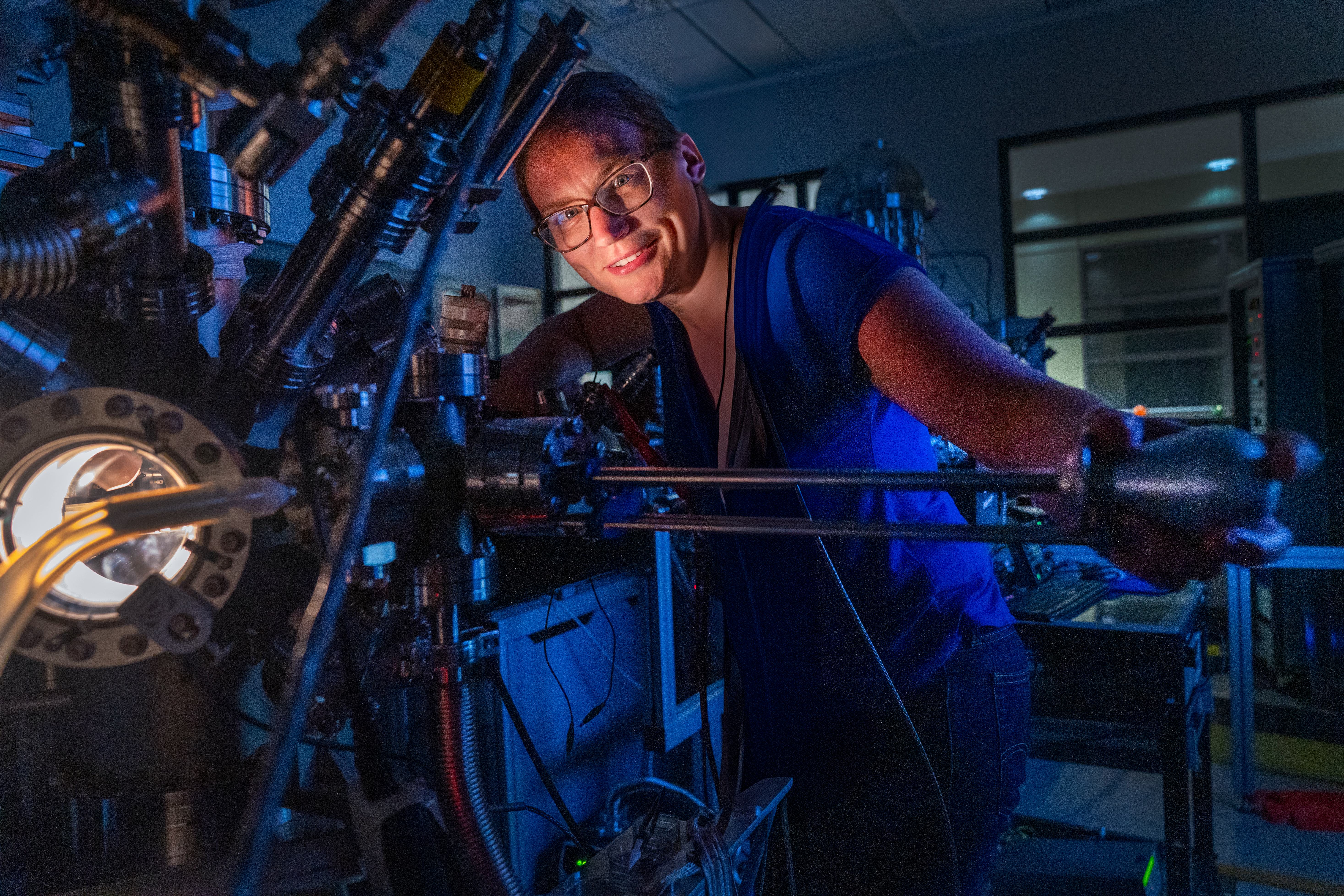
Kristen Burson, associate professor of physics at Grinnell College, uses X-ray photoelectron spectroscopy capabilities at the Center for Functional Nanomaterials in research that aims to develop ideal nano cages for noble gases. (David Rahner/Brookhaven National Laboratory)
Kristen Burson, associate professor of physics at Grinnell College, has spent the past three summers at the U.S. Department of Energy’s (DOE) Brookhaven National Laboratory studying materials that could offer new ways to capture and separate noble gases. Through DOE’s Visiting Faculty Program (VFP), Burson and her students have conducted research at Brookhaven’s Center for Functional Nanomaterials (CFN), gaining access to advanced research tools and expertise while building lasting ties between Brookhaven and Grinnell.
VFP gives college faculty and their students the opportunity to spend 10 weeks collaborating with scientists and engineers at a DOE National Laboratory on research of mutual interest. The program helps faculty strengthen their research while giving students experience contributing to active research projects.
For Burson, the collaboration is continuing beyond the summer program. She will return to Brookhaven this fall as a facility user to study materials at CFN and the National Synchrotron Light Source II (NSLS-II), both DOE Office of Science user facilities. Adding to that momentum, Burson recently received a $300,000 National Science Foundation grant to advance her research on noble gas separation.
Why did you apply for VFP and what’s the experience been like returning for a third time?
What inspired me to apply for VFP was really my collaborator, Anibal Boscoboinik. We had been talking for several years about the possibility of collaborating on some projects because we have shared interests and were able to make it happen for the nano cage project through VFP.
It’s been great being back. I’m really seeing the outcomes of the first two summers, which is what prompted me to come back for a third summer.
Every summer, I’ve had students with me. One of the things I really love about VFP is that students in the program get two mentors: they have me and my collaborator, Anibal. I think that creates really powerful experiences for my students and helps with the longevity of the project because I can continue the work with students back on campus after a big data run.
The first year — and this was pretty amazing to me — both students who came with me ended up winning Goldwater Scholarships the following year. That’s a pretty big deal, to have two Goldwater Scholars come out of the same lab. The two students who came last summer both presented at major conferences, American Chemical Society and American Physical Society, and each received an award for their presentation.
I’m always trying to bring in teams with a combination of physics and chemistry backgrounds. I’m a physicist by training, Anibal has a chemistry background, and our project brings those areas together, so I look for students who can span that range.
I think the students’ success really speaks to both the research and the mentorship. I’ve been really pleased with the way VFP supports one of the priorities I have for my program: providing meaningful research and mentorship experiences for undergraduate students.
Tell us about your research project.
There are two areas where I think this research can have really good applications. One is noble gas separation. Let’s say you wanted to buy neon for a neon sign, or you needed an inert gas for scientific research or a medical application. There are a lot of uses for noble gases, and the industry-standard process for separating them is called cryogenic distillation. It cools the gases to very low temperatures and separates them based on their different boiling points. That process is very energy intensive, so there’s a lot of interest in finding more cost-effective ways to separate noble gases at room temperature.
A second application is mitigation. Some noble gases, like radon, krypton, and xenon, are gases you’d want to capture. Radon is the second-leading cause of lung cancer in the United States after smoking. Iowa, where my home institution, Grinnell College, is located, has a particularly high incidence of radon in basements. In terms of the DOE mission, krypton and xenon are byproducts of nuclear energy production, and removing those byproducts from the reactor atmosphere can increase the safety and efficiency of nuclear energy production.
In both applications, you want something that’s going to capture and hold the gas. For separations, you also want something that can work at room temperature to avoid the cost and energy demands of very low-temperature technologies.
The technology we’re working on uses small cages that are essentially the same size as these noble gases. Often, when you think about separating something or mitigating a chemical you don’t want, you’re thinking about a chemical reaction. But noble gases don’t react, so those chemical methods aren’t going to work. Instead, we have a cage that’s about the same size as the gas, and we can trap the gas inside it.
Some of the questions we’re interested in are: Could this work with different combinations of materials? Could we find cheaper materials to trap and hold the gases? How do the gas size and cage size interact? If I have a big cage, it might be too big to trap the smallest gases because they could just get out. If I have a really small cage, larger gases might not fit. So, which cage sizes capture which gas sizes?
Why is CFN particularly well suited for this research?
I think CFN is a real gem.
It has this whole suite of instruments that I wouldn’t have access to at my home institution, and most institutions don’t have access to this level of equipment or this amount of equipment.
Nearly every characterization tool you would want to characterize a material is here.
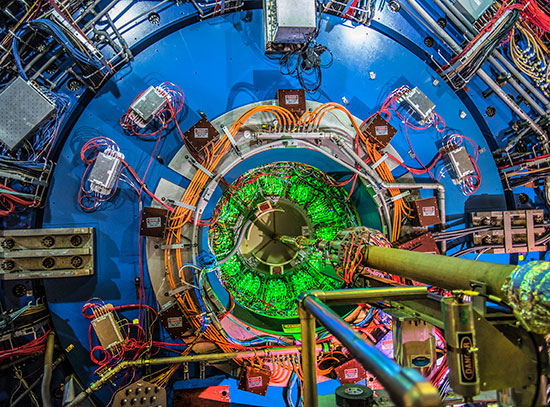
My students and I get to work on this million-dollar X-ray photoelectron spectroscopy system that doesn't exist at my home institution and comes with the scientists that support users at CFN.
Both my collaborator and Brookhaven materials scientist Ashley Head have been incredibly helpful in helping us think through data that we don’t understand, how do we interpret it, how do we improve our data collection techniques so that we’re really getting high-quality data.
There’s a lot of expertise at CFN as well. At my home institution, I’m working at a small liberal arts college, and my colleagues research things like astrophysics, general relativity, and optics, for example. It’s been really wonderful for me to be in an environment with other experts in my subfield.
What do you hope your students remember from their experience with VFP?
That has depended a lot on the student.
I think there are several things. One is that it’s really powerful to work in a professional science environment around Ph.D.s, postdocs, and professional scientists. All of the students who have come through the program have seen how science gets done in a community. Those collaborative relationships are an important part of science, especially in an experimental field.
Getting the chance to learn on high-level equipment is also a rare opportunity so early in your career. It’s been fun for me to watch students develop expertise over the course of the summer. There’s a lot of equipment training in the first month, so when they get to the point where they can say, “Oh, here’s what the next experiment needs to be, and here’s what I want to do today,” that’s a really awesome transition to witness.
The VFP interns also get to participate in all of the professional development opportunities available to other Brookhaven interns, along with the support Brookhaven’s Office of Workforce Development and Science Education provides to make sure everyone has housing and travel arranged and gets off to a good start with their mentor. That level of support is a really powerful part of the program, and it’s not typical of many summer internships my students have experienced.
How has your VFP experience influenced how you teach or mentor students back at Grinnell College?
When I work with students through VFP, I want to make sure they can make the most of the experience when they come to Brookhaven Lab.
All the students who have come with me through VFP have done a semester of work in my lab beforehand. They do things like literature reviews, learn how to make samples, and conduct data analysis, so they’re contributing to the ongoing project during that onboarding semester.
One of the things I’ve seen after VFP is how that knowledge comes back to our lab. After that first summer, the two students who were with me came back and helped teach new students how to do XPS data analysis and shared their familiarity with the literature. So, it’s not just me bringing knowledge back — the students bring their expertise back, too, and that has been really helpful for students who are involved in the project but haven’t been to Brookhaven.
At an institution where faculty are both teaching-focused and research-active, I came into this program with strong student mentoring skills. I think VFP has expanded what I can do back on campus by bringing that additional expertise into our lab.
What has collaborating with Brookhaven Lab taught you or changed about your research?
On the technical side, I’ve learned a lot about X-ray photoelectron spectroscopy, and I think it’s changed the level of research experience I can bring students into, which is a really exciting outcome.
My collaborator and I have also been working on grants, which is an area of growth for me. I was just awarded a major National Science Foundation grant to advance my noble gas research. The grant includes support for extended research visits to Brookhaven Lab.
Having VFP come to fruition has helped lead to things like user proposals. This year, my CFN user proposal and National Synchrotron Light Source II user proposal were both allocated, so we’ll be back during our fall break for beamtime at NSLS-II. That’s pretty exciting. A lot of it has to do with the guidance I’ve gotten from people here about what’s important to think through when writing those types of proposals.
What does it mean to be part of strengthening the connection between your college and Brookhaven Lab?
I think it’s really valuable. One of the things I appreciate about the program is the way that my strengths and the strengths of my institution can complement the strengths that Brookhaven has. That’s a powerful combination, and it has led to positive recognition for the work back at Grinnell.
Brookhaven National Laboratory is supported by the Office of Science of the U.S. Department of Energy. The Office of Science is the single largest supporter of basic research in the physical sciences in the United States and is working to address some of the most pressing challenges of our time. For more information, visit science.energy.gov.
Follow @BrookhavenLab on social media. Find us on Instagram, LinkedIn, X, and Facebook.
2026-23113 | INT/EXT | Newsroom