A Glimpse of the Solar System's Origins: Striking Details on the Molecules Inside a Meteorite
September 16, 2026
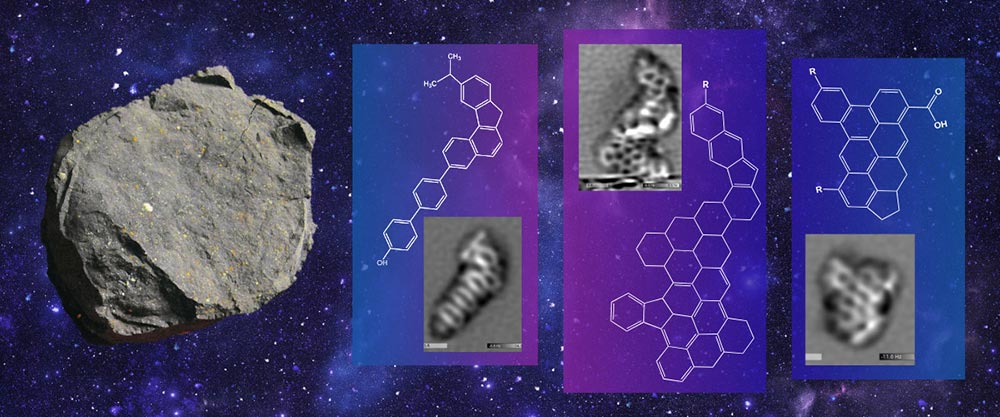
Editor's note: The following news release was issued by the National High Magnetic Field Laboratory (MagLab). Researchers at MagLab and the U.S. Department of Energy’s (DOE) Brookhaven National Laboratory analyzed organic molecules in two meteorites to learn more about the complex chemistry of the early solar system. Brookhaven Lab scientist Percy Zahl of the Center for Functional Nanomaterials, a DOE Office of Science user facility, used high-resolution noncontact atomic force microscopy to image the structures of individual molecules from one of the meteorites. This provided a more detailed look at these extraterrestrial organic compounds. For more information about Brookhaven’s role in this research, contact Peter Genzer (genzer@bnl.gov, 631-344-3174).
TALLAHASSEE, Fla. — Researchers at the National High Magnetic Field Laboratory and Brookhaven National Laboratory have teamed up to get a fresh look at the complex makeup of meteorites and glimpse into our solar system’s past.
 enlarge
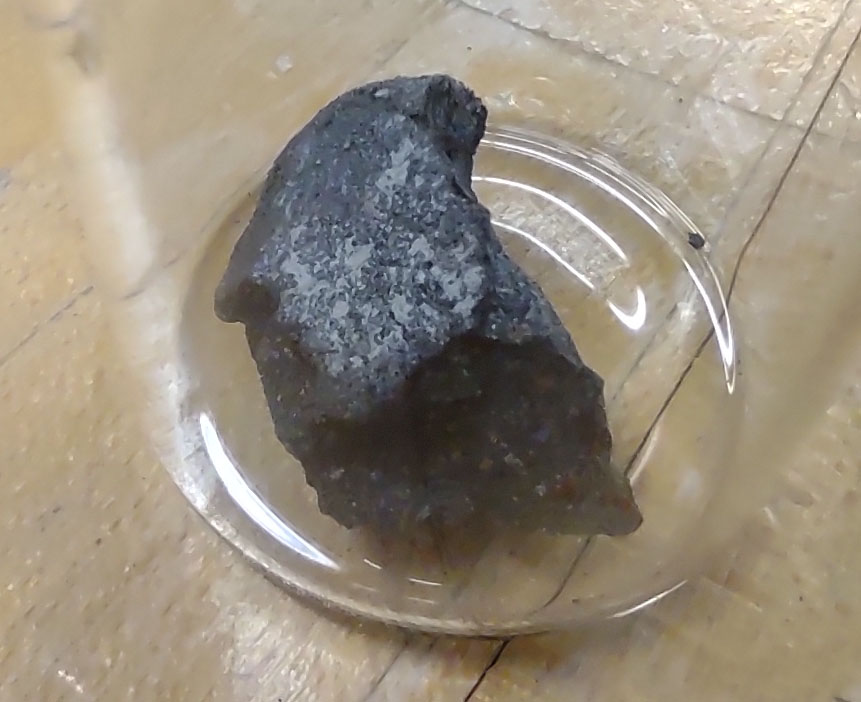
A sample from the Murchison meteorite, which fell in Victoria, Australia in 1969. Credit: Joseph Frye-Jones
Powerful spectrometry found only at the MagLab identified the vast array of organic compounds inside two meteorites, and Brookhaven scientists followed up with stunning images detailing the structure of some of those extraterrestrial molecules. Their research suggests that the chemical foundation for life is deeply woven into the fabric of our universe and broadens our understanding of the cosmic ingredients that rained down on early Earth, potentially kickstarting life as we know it. The study was published in The American Astronomical Society’s Planetary Science Journal.
“This can shed light on how much complex organic material is out in space,” said Joseph Frye-Jones, who led the mass spectrometry research as a Florida State University graduate research assistant and is the lead author on the paper.
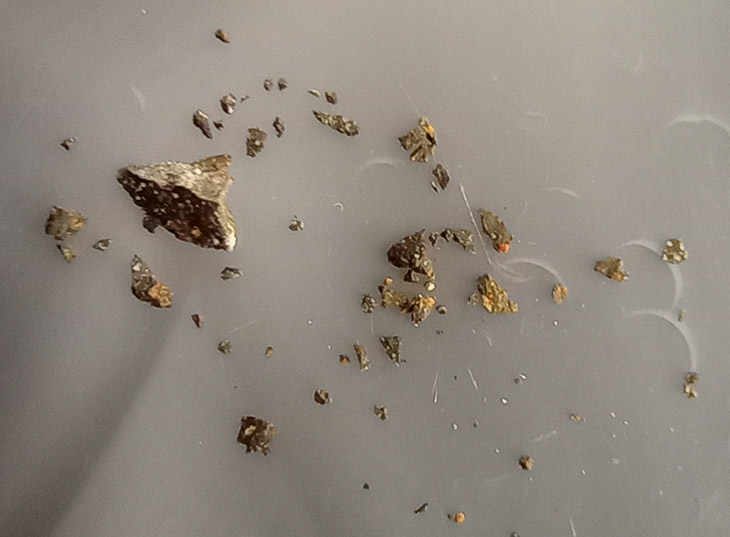
To conduct the research, Frye-Jones obtained fragments of the Murchison meteorite, a billions-of-years-old space rock which fell in Australia in 1969. The piece came from Chicago’s Field Museum . Frye-Jones also received a piece of the Aguas Zarcas meteorite, which fell in Costa Rica in 2019, provided by the Buseck Center for Meteorite Studies at Arizona State University.
 enlarge
Pieces of the Murchison meteorite examined at the National MagLab. Credit: Joseph Frye-Jones
The analysis found a staggeringly large variety of carbon-based molecules, tens of thousands of them, in a small sample of each meteorite. Each of those has the potential to represent several unique molecules, meaning the meteorite is far more chemically complex than anticipated, likely among the most complex materials ever known.
“The Murchison meteorite is at least 5.5 billion years old, one billion years older than Earth, and this is just as complex as petroleum deposits, which are some of the most complex mixtures that we have analyzed in our lab. These findings show just how complex the organic materials in space can be,” said Frye-Jones.
And even though the two meteorites belong to the same cosmic family and look similar on the surface, their chemical fingerprints are vastly different. They share only a small fraction of complex molecules. This tells us that space is not uniform. Different asteroids experienced radically different environments as they formed and the primordial solar system created a vast, diverse organic chemistry matrix.
 enlarge
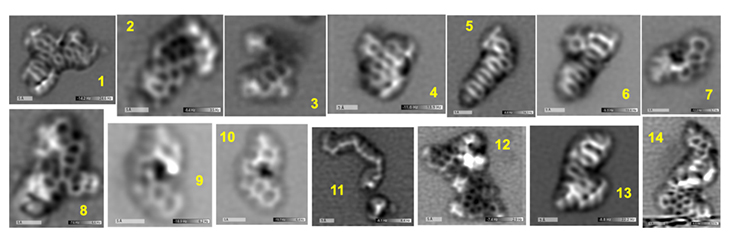
Images of 14 organic molecules from the Murchison meteorite, produced at Brookhaven National Laboratory using high resolution noncontact atomic force microscopy.
“It is giving us a glimpse at the origins of our planet and solar system,” Frye-Jones said.
Much of the previous analysis of the Murchison happened soon after its discovery. The past five decades have brought exciting improvements in techniques and instrumentation, helping Frye-Jones get a much more detailed look at the myriad molecules inside.
“The technique that we are using has been steadily getting better as technology improves. With the highest resolution mass spectrometer in the world, we can look at things that others cannot,” Frye-Jones said.
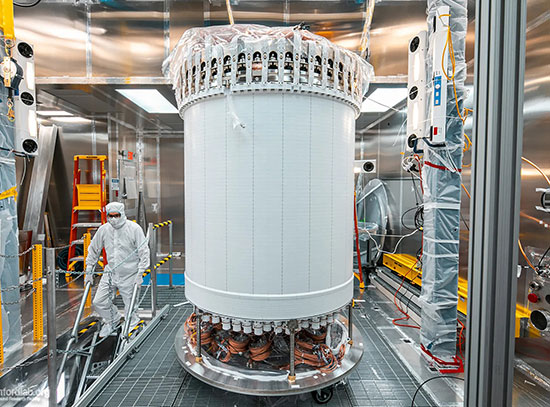
Frye-Jones crushed the meteorite samples, then dissolved the pieces in organic solvents, such as methanol and ethanol, before putting them into the MagLab’s record 21-tesla FT-ICR spectrometer, the highest performing system in the world for ion cyclotron resonance. The instrument allows researchers to identify the chemical makeup of complex mixtures and has been instrumental in analyzing petroleum, forever chemicals, and dissolved organic matter samples.

Percy Zahl (Roger Stoutenburg/Brookhaven National Laboratory)
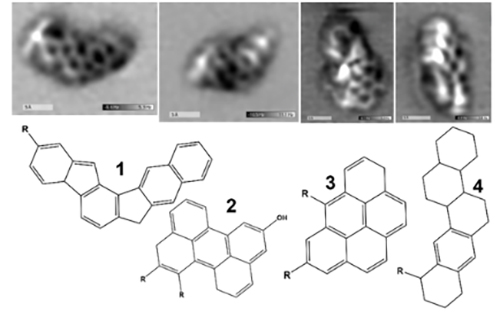
For a more detailed glimpse, the MagLab teamed with Senior Staff Scientist Percy Zahl in the Center for Functional Nanomaterials at Brookhaven National Laboratory to complement their chemical analysis with images of a handful of the meteorite molecules. While mass spectrometry determines a molecule’s chemical formula, the same formula can have many different structures. Zahl performed what’s called high resolution noncontact atomic force microscopy to see the structures of the molecules. The technique hovers an ultra-sharp tip above a surface and measures atomic repulsion to map the molecules. Successfully imaging a few individual molecules of a complex mixture can take several days to several months using the tedious and elaborate technique.
“Mass spectrometry can reveal the molecular formulas hidden within a meteorite, but this takes the analysis one remarkable step further,” Zahl explained. “This is the only method that can actually image the structure of a single molecule. You need an image to get a look at the structure, how things are linked together.”
This is just the third time this kind of microscopy has been used to study meteorite material.
“The image quality achieved here opens the door to much more complete structure identification vs. atom counts only,” Zahl said. “Together, the two techniques offer an exciting new perspective on extraterrestrial chemistry: not only identifying the molecular building blocks preserved in meteorites, but beginning to see what individual molecules from the early Solar System actually look like.”
Zahl has taken to calling this research between the MagLab and Brookhaven the “Stardust Collaboration,” a nod to the origins of the elements and their role as building blocks of planets and life itself. The name reminds us how incredible it is to see images here on Earth of molecules that have been on a journey for billions of years across the universe.
“Astronomy is a hobby of mine, so this is very exciting,” said Zahl. “We see all these organic materials, building blocks of life. It’s kind of like the chicken and the egg, where did they come from? And what does this say about the chances of other life in the universe?”
Other authors on the paper are Martha L. Aguilera, Alan G. Marshall, and Ryan P. Rodgers, all with the National High Magnetic Field Laboratory.
The National High Magnetic Field Laboratory is funded by the U.S. National Science Foundation and the State of Florida.
Brookhaven National Laboratory is funded by the U.S. Department of Energy.
2026-23172 | INT/EXT | Newsroom