RHIC Team Receives Prestigious DOE Secretary Achievement Award
Recognition honors innovators who enabled 25-year exploration of exotic nuclear matter, the sources of proton spin, and the strongest force in nature
September 30, 2026
 enlarge
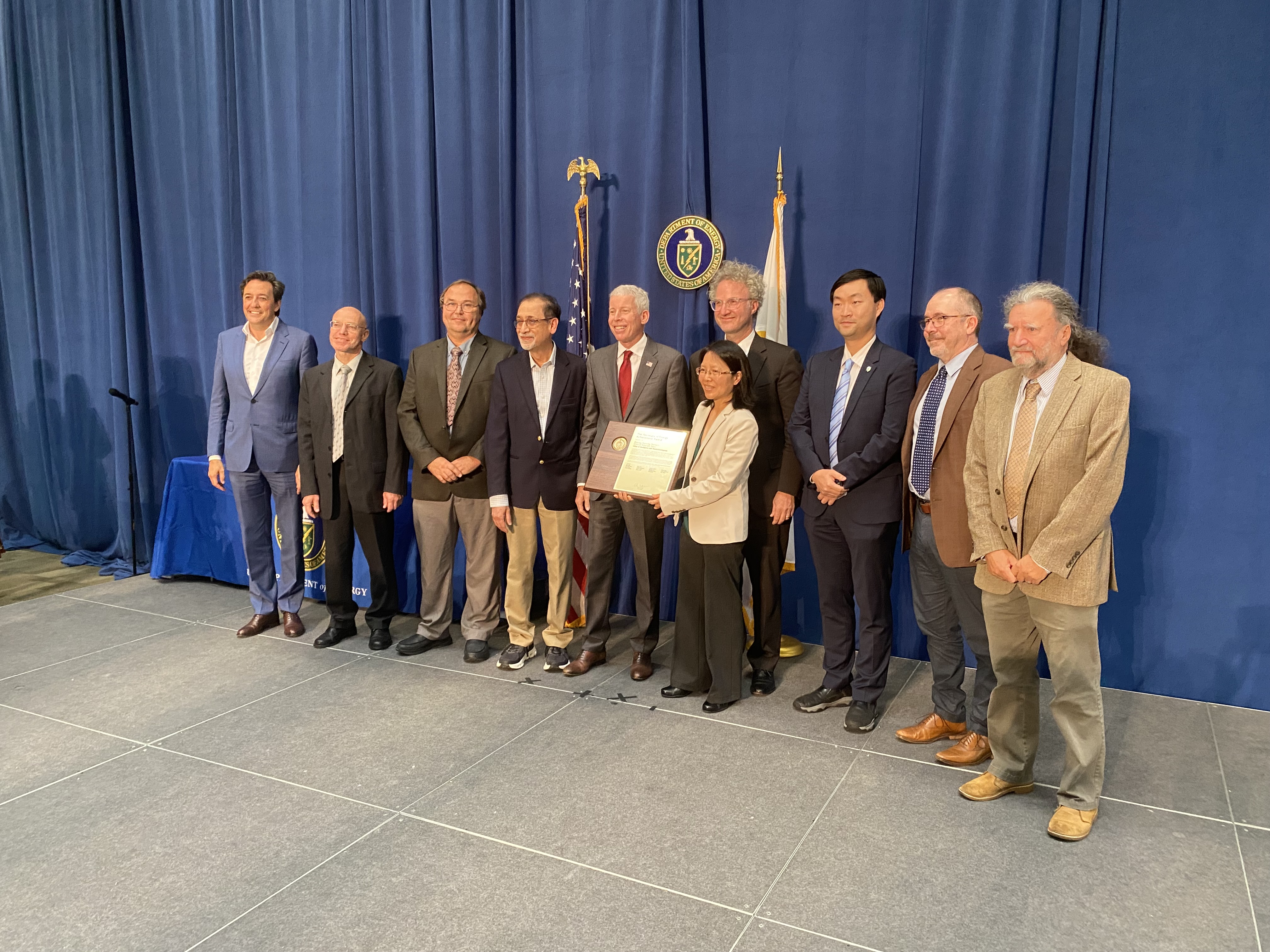
Energy Secretary Chris Wright (center) with Under Secretary for Science Darío Gil (far left) and the RHIC team (from left): Alexander Bazilevsky, Alexei Fedotov, Deepak Raparia, Lijuan Ruan, Peter Steinberg, Jin Huang, David Morrison, and Stephen Peggs. Not shown: Thomas Roser, Michael Blaskiewicz, and Flemming Videbaek.
UPTON, N.Y. — A group of 11 physicists representing the Relativistic Heavy Ion Collider (RHIC) Discovery and Innovation Team at the U.S. Department of Energy’s (DOE) Brookhaven National Laboratory has received a Secretary of Energy Achievement Award for their contributions to RHIC, a flagship DOE Office of Science user facility for nuclear physics research that operated at Brookhaven Lab from 2000 to earlier this year. RHIC is best known for discovering that the matter created in its most energetic collisions of gold ions is a nearly perfect liquid — a surprising discovery about the conditions that permeated the very early universe nearly 14 billion years ago.
 enlarge
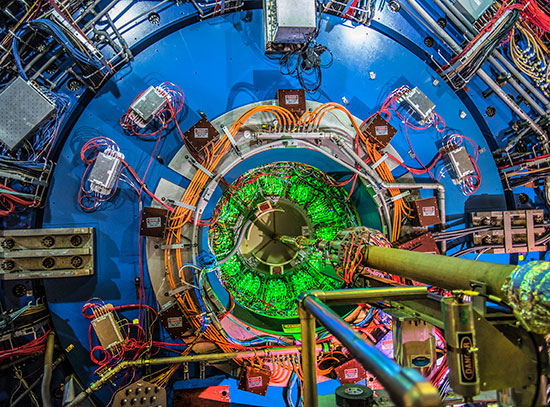
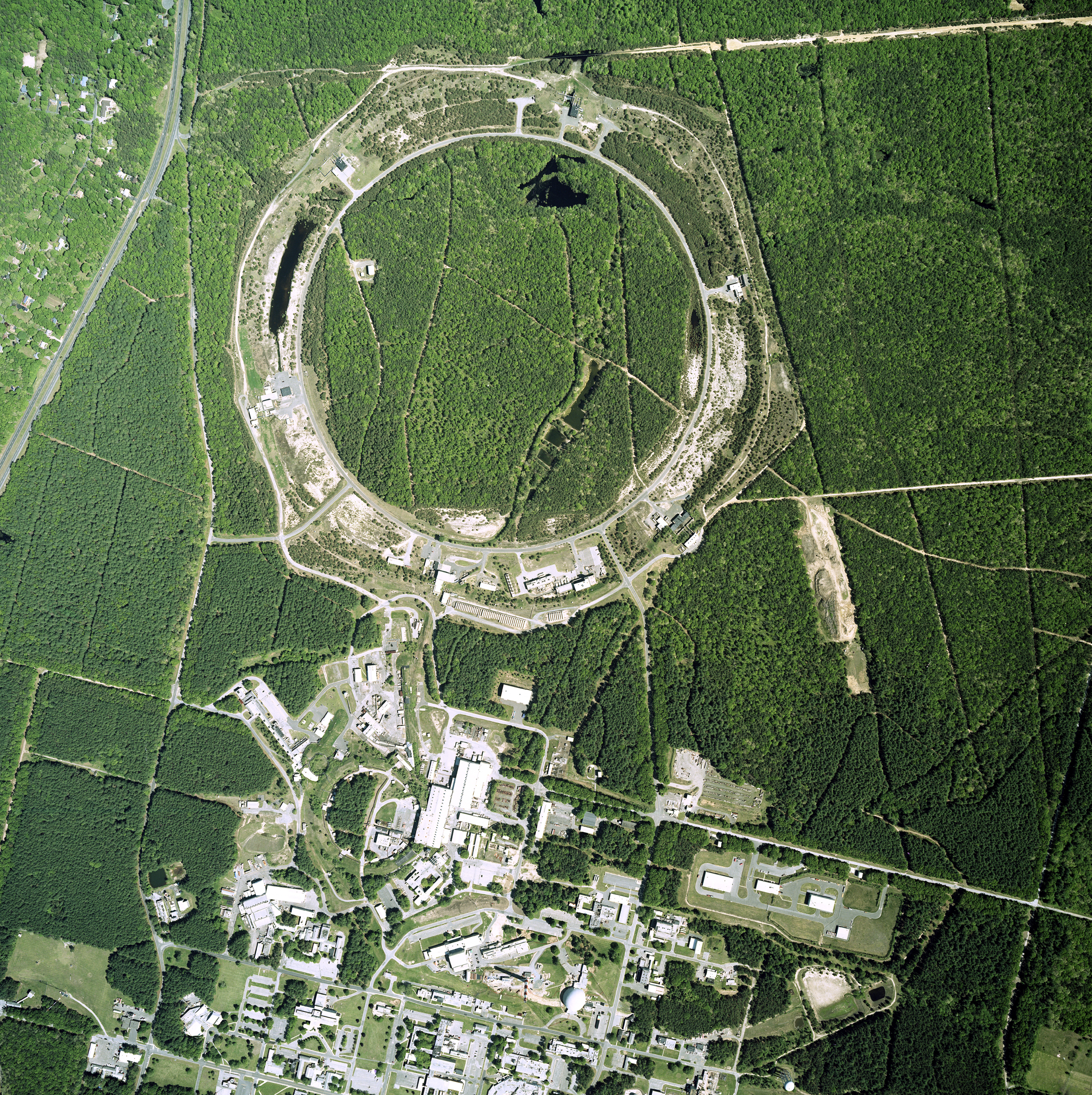
An aerial view of the Relativistic Heavy Ion Collider (RHIC), a 2.4-mile-circumference dual-ring nuclear physics particle collider at Brookhaven National Laboratory. RHIC collides many types of ions — from polarized protons to the nuclei of gold and uranium atoms — to explore fundamental questions about their underlying structure and the properties of the building blocks of matter. (Brookhaven National Laboratory)
The award recipients include accelerator physicists and engineers who designed and built the collider and developed innovative technologies that drastically improved its performance over more than 25 years of successful operations, along with experimental nuclear physicists who led the construction and operation of the particle detectors and the large international collaborations that carried out RHIC’s scientific program. They represent a community of more than 3,500 scientists, engineers, and others who have been part of the RHIC program from its inception in the early 1980s through the final collisions this February.
The RHIC team was one of 49 teams and 11 individuals recognized at the Secretary’s Honor Awards ceremony at DOE headquarters in Washington, D.C. on Monday, September 28, 2026. The achievement award given to teams is among the highest honors given to DOE employees and contractors whose service has gone above and beyond with contributions having lasting impacts on both the Department and the Nation. To receive the award, a group must demonstrate excellent cooperation and teamwork.
“Along with the entire DOE leadership team, I am so proud of the accomplishments of our award recipients. Their commitment to DOE’s mission is an inspiration,” said Secretary of Energy Chris Wright.
The RHIC team’s award citation specifically lists some of RHIC’s impactful discoveries and scientific explorations — and the wide-ranging capabilities that made this science possible. These include:
- The discovery and detailed characterization of the strongly coupled quark-gluon plasma, a form of nuclear matter made of quarks and gluons that existed just after the Big Bang and evolved into the protons and neutrons that make up 99% of visible matter in the universe today.
- The sustained campaign over two and a half decades to explore quantum chromodynamics (QCD) — the theory that describes the interactions of quarks and gluons through the strong nuclear force — under extreme conditions of temperature and density.
- Pioneering precision measurements of the proton’s spin structure that revealed the gluon and antiquark contributions to spin.
- RHIC’s unique characteristics as the world’s first heavy-ion collider, the only spin-polarized proton collider, and the most flexible collider ever built.
- A series of groundbreaking accelerator innovations that were required for and inspired by RHIC’s scientific mission: the ability to collide 49 different ion-beam species and energy combinations; the world's highest-energy polarized proton beams; stochastic cooling of bunched beams; high-intensity and high-brightness hadron sources; and the first demonstration of electron cooling based on radio-frequency acceleration.
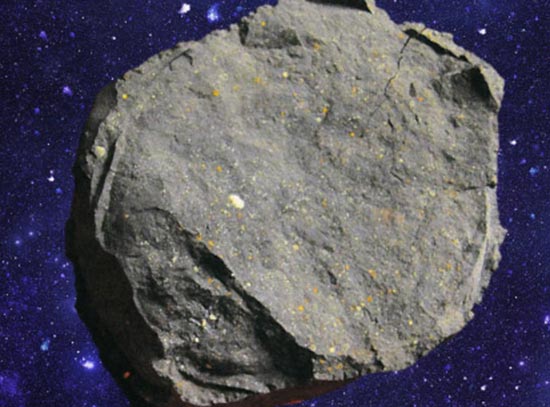
Energetic collisions between gold ions at the Relativistic Heavy Ion Collider (RHIC) create a new state of hot, dense matter known as a quark-gluon plasma that flows like a nearly "perfect" liquid. (Brookhaven National Laboratory)
The citation concludes by recognizing how, collectively, RHIC’s scientific program and technological innovations have advanced the frontiers of nuclear physics and accelerator science.
“This recognition for the RHIC program and the people who made it possible comes at such an important time as we celebrate the successful completion of the RHIC science program,” said Brookhaven Lab Director John Hill. “We were honored to have DOE Undersecretary for Science Dario Gil here for the final RHIC collisions on February 6, to officially turn off this incredibly productive scientific facility and to mark the transition of much of its infrastructure into a brand-new research machine, the Electron-Ion Collider (EIC). As we prepare to embark on a new frontier of discovery, it is a pleasure to honor the achievements of the team that delivered such amazing science from RHIC and look forward to what might come from the Electron-Ion Collider!”
Brookhaven National Laboratory is supported by the Office of Science of the U.S. Department of Energy. The Office of Science is the single largest supporter of basic research in the physical sciences in the United States and is working to address some of the most pressing challenges of our time. For more information, visit science.energy.gov.
Follow @BrookhavenLab on social media. Find us on Instagram, LinkedIn, X, and Facebook.
2026-23190 | INT/EXT | Newsroom