Users' Meeting Turns Insights into Impacts
The 2026 NSLS-II and CFN Users' Meeting explored the tools that will shape how science is performed in the years to come
June 3, 2026
 enlarge
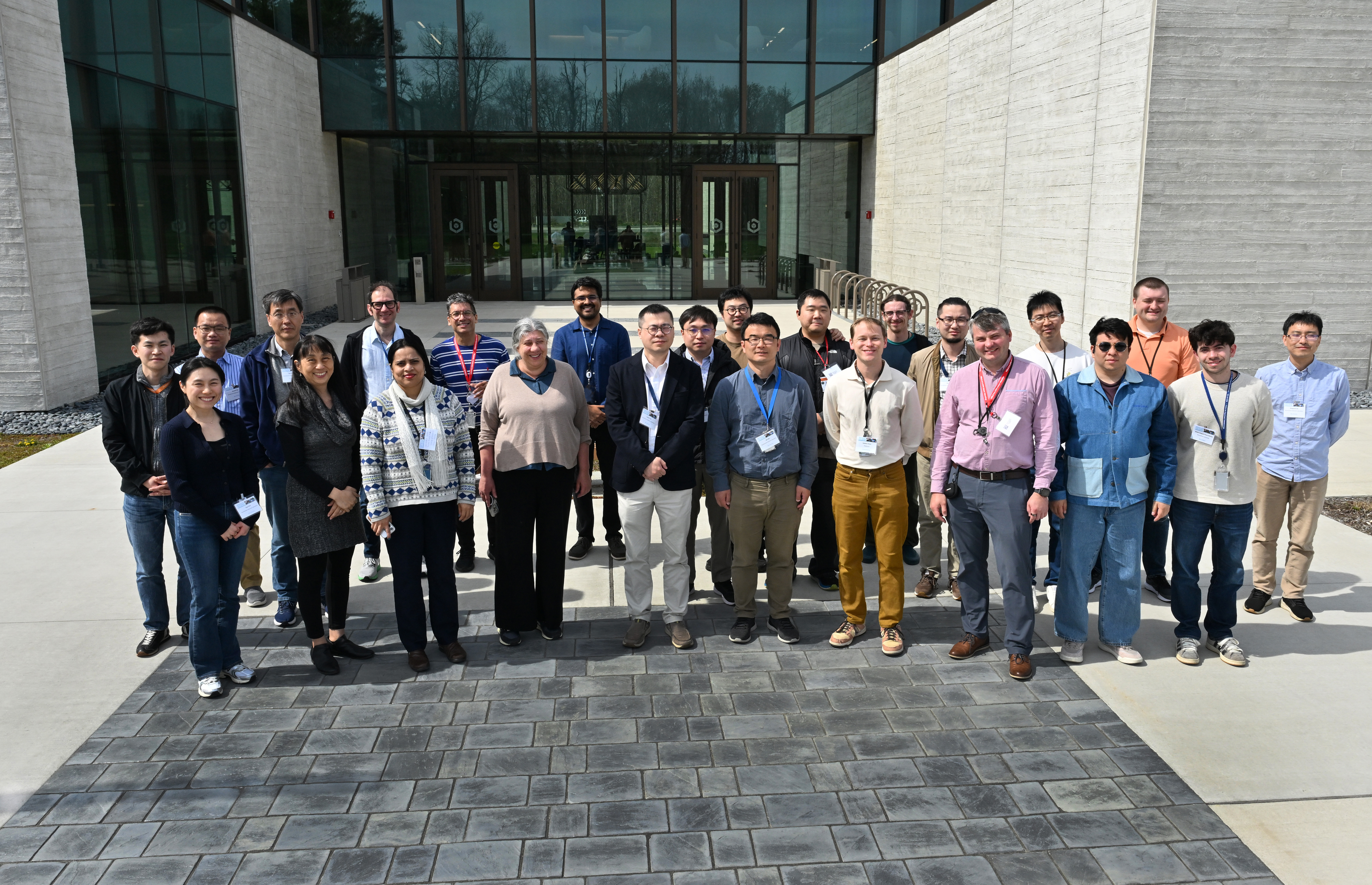
A group of attendees from the AI Showcase Workshop pose for a photo outside of the new Science and User Support Center during a coffee break. (Kevin Coughlin/Brookhaven National Laboratory)
The National Synchrotron Light Source II (NSLS-II) and the Center for Functional Nanomaterials (CFN), two user facilities at the U.S. Department of Energy’s (DOE) Brookhaven National Laboratory, collaborate with a global community of thousands of scientists spanning a wide range of disciplines, institutions, and geographic regions. The annual NSLS-II and CFN Users’ Meeting brings this community together at the Lab to discuss current research and opportunities for the future.
The 2026 meeting, held April 21-23 and May 5-6, featured 14 workshops on key areas of nanoscience and synchrotron science, including an AI showcase. A vendor fair with 33 exhibitors, a poster session including contributions from local high school students, and a comprehensive plenary session rounded out the agenda. The plenary included updates from Lab leadership and the DOE Office of Basic Energy Sciences (BES), a keynote presentation by Oleg Gang of Brookhaven Lab and Columbia University, and an awards session.
Of the 512 registered attendees, 94% participated in person, creating the ideal environment for networking, idea exchange, and collaboration. This energy was especially evident during coffee and lunch breaks, post-workshop discussions, and the offsite banquet, where attendees formed teams and competed in a lighthearted pub-style trivia competition.
Staying up to date
Brookhaven Lab staff joined users at the plenary session, where facility, laboratory, and DOE leadership shared updates, future plans, and broader perspectives. The session opened with remarks from Petra Reinke and Maya Endoh, vice chairs of the NSLS-II and CFN User Executive Committees (UECs), followed by Interim Lab Director John Hill.
“These meetings were always a lot of fun,” said Hill, who was once a user and then director of NSLS-II. “In those workshops, I remember how important the scientific discussions were and how exciting it was to be involved in them. I'm sure you'll all feel similarly in the next couple of days.”
NSLS-II
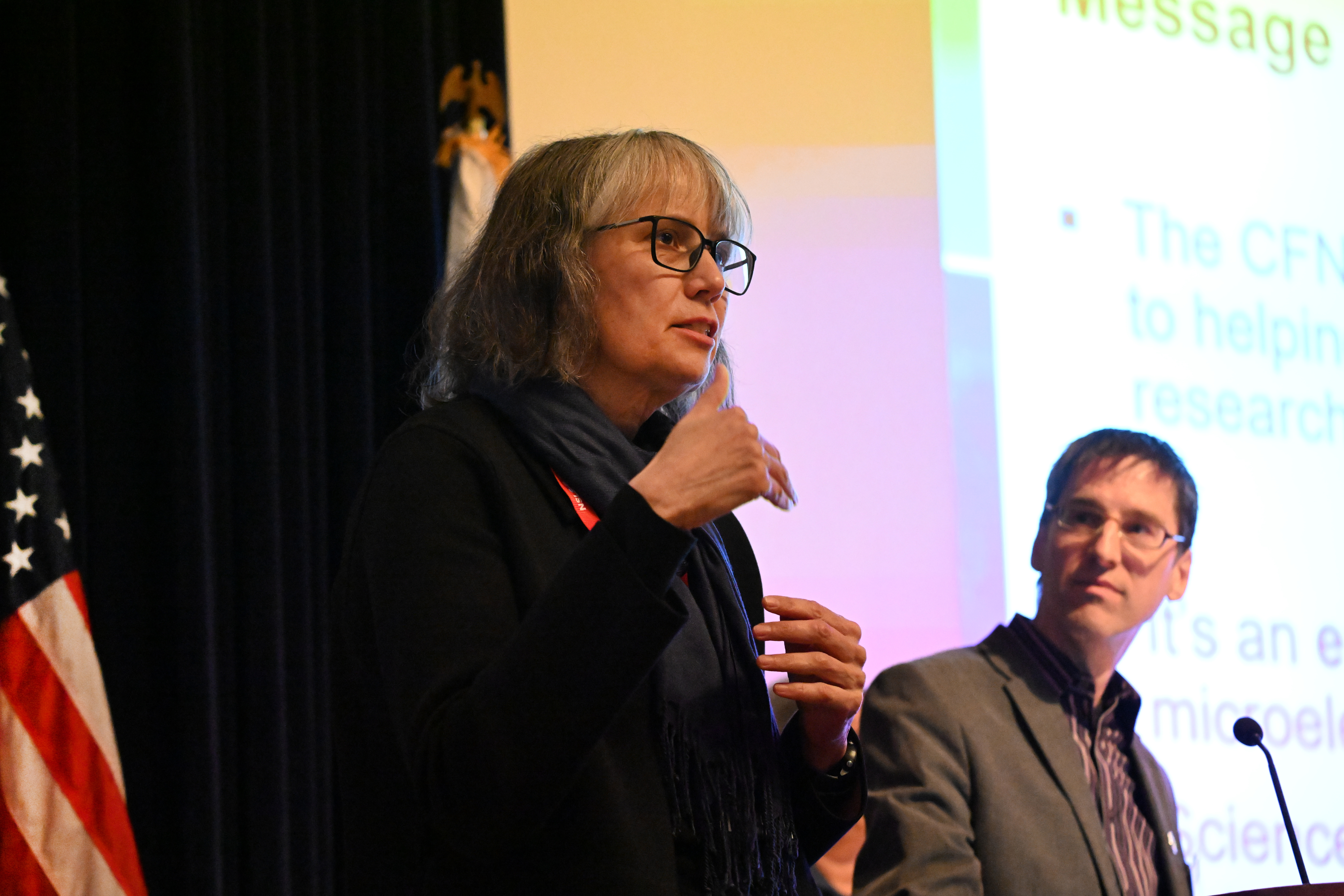
NSLS-II Director Elke Arenholz highlighted recent progress and outlined a vision for the facility’s future. She emphasized continued delivery of impactful science across fields such as biology, materials science, earth science, and quantum information science. While noting that “numbers don’t tell the whole story,” she pointed to strong demand for beam time, increased publication output, and a growing user community.
Arenholz touched on the facility’s shift toward a more AI-enabled, automated, and data-driven model. She described a future in which AI supports experiment planning, beamline optimization, data analysis, and autonomous workflows, while emphasizing that these tools are designed to augment, not replace, beamline staff, ensuring that humans are always in the loop.
“In the same way that we are providing photons and beamlines, we can also provide powerful AI tools to users, and I think that will be very impactful,” Arenholz said.
She also noted that with today’s 29 operational beamlines, NSLS-II is only “half built out,” giving the community opportunities to explore current scientific challenges in new ways. The facility could ultimately double its number of beamlines, with expansion already underway with 10 upcoming beamlines through the NSLS-II Experimental Tools III (NEXT-III) project. Her long-term vision is an end-to-end upgrade of the facility: from a brighter source and improved optics to advanced detectors, realistic sample environments, integrated AI and data infrastructure, and even on-site sample synthesis. She also described a push toward even more multimodal science, combining techniques and capabilities at different beamlines to give users a more complete picture of complex systems and further strengthen NSLS-II’s capabilities in the decade ahead.
CFN
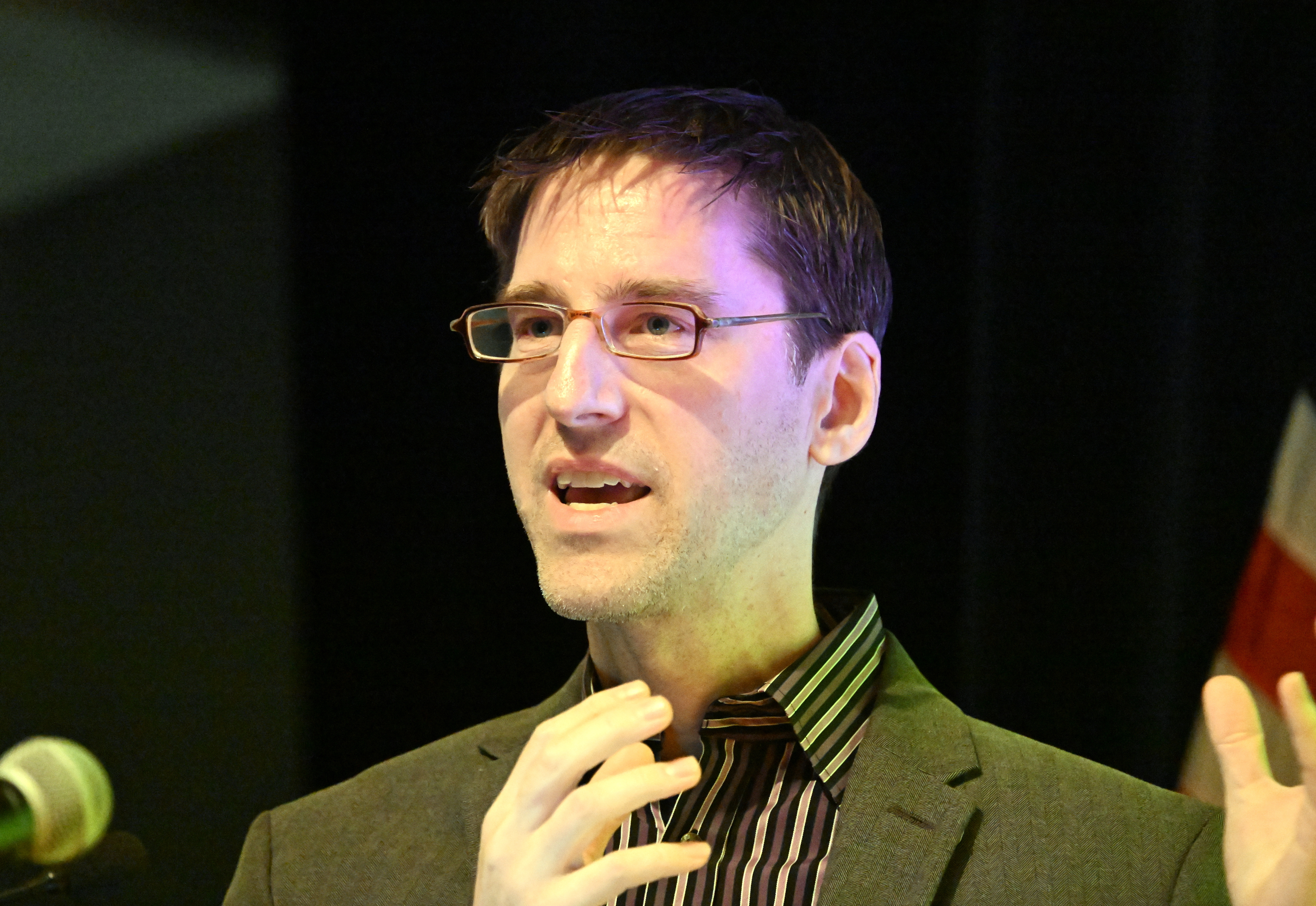
Interim CFN Director Kevin Yager took the stage to outline recent progress at the facility and its future direction. He emphasized that CFN is seeing strong and growing demand from users in the last year, noting that the community remains a healthy mix of on-site and remote users, many of whom are returning after their first visit. He also stressed that students and postdocs are central to CFN’s success and should feel empowered in their role to help shape the facility’s future.
Yager highlighted CFN’s continued investment in people, instruments, and capabilities. He described new staff hires, new tools for operando science, nanotomography, quantum materials research, and sample preparation. He also pointed to CFN’s expanding role in AI-enabled science, envisioning a future in which AI agents help with literature review, experiment planning, instrument operation, and data analysis. In that vision, AI acts as an “exocortex” for scientists, extending human capability rather than replacing it. He closed by emphasizing CFN’s broader commitment to open data, user feedback, and collaboration, calling the facility an accelerator for science and a place where people remain at the center of discovery.
“I think it's an exciting time for nanoscience,” Yager said. “It has been around for a long time, but it keeps reinventing itself.”
DOE BES
 enlarge
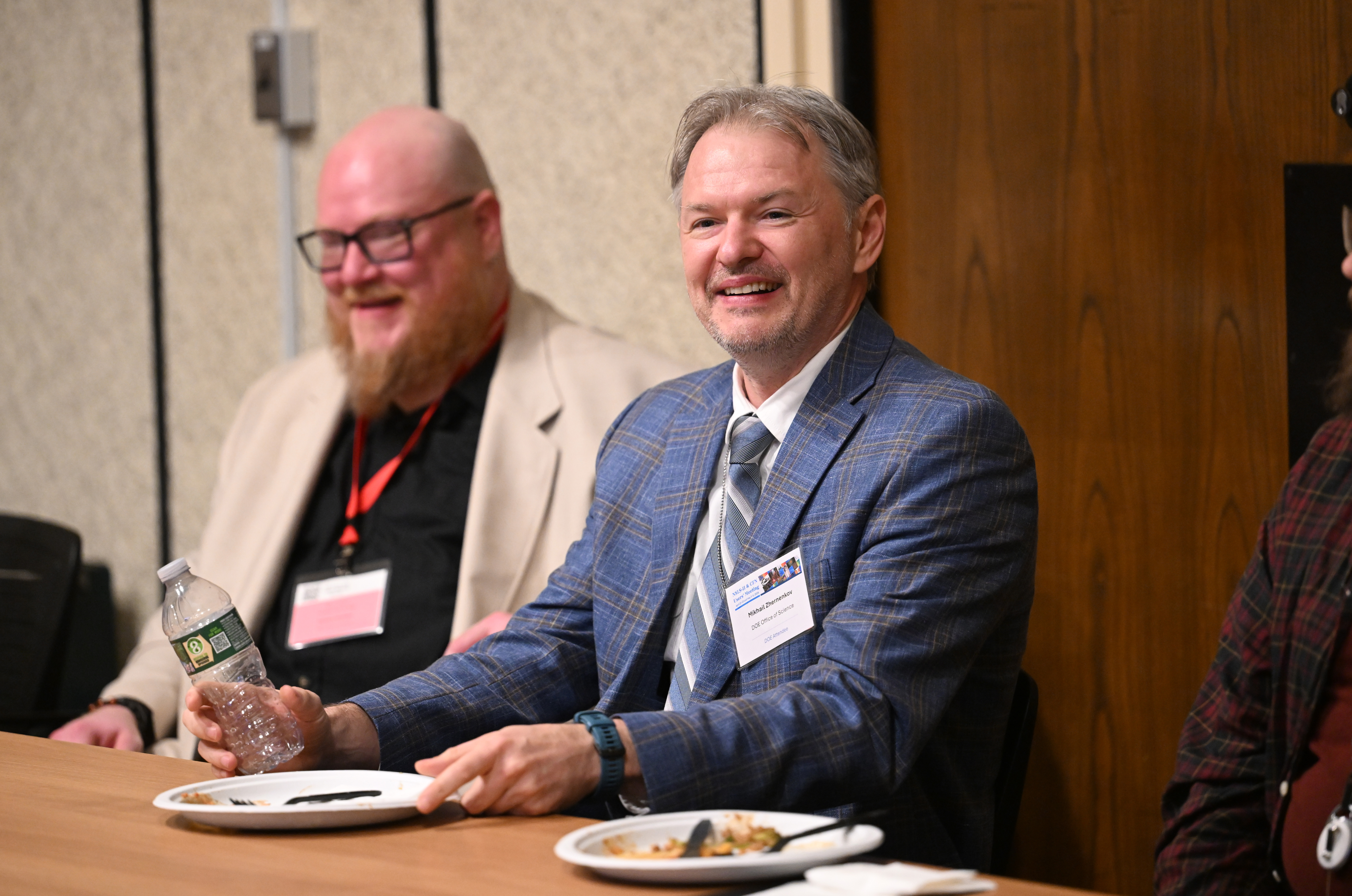
Program manager for X-ray, neutron, and nanoscale science user facilities at DOE BES, Misha Zhernenkov (Kevin Coughlin/Brookhaven National Laboratory)
After a brief Q&A with Arenholz and Yager, Misha Zhernenkov, program manager for X-ray, neutron, and nanoscale science user facilities at DOE BES, introduced himself, noting his longstanding connection to Brookhaven Lab. He summarized a few of the most recent changes at the Office of Science, including updates to its organizational structure. He highlighted several major DOE priorities now shaping the portfolio, especially AI, quantum, and long-term facility planning.
Zhernenkov emphasized that BES remains a central driver of national research through its core research programs, user facilities, and facility-enabling research and development. He noted that BES supports both individual investigators and large collaborative teams, while remaining agile enough to respond to emerging priorities in fields like AI, microelectronics, energy technologies, and quantum information science. He also pointed users to ongoing funding opportunities, including core research calls, Early Career Awards, the Established Program to Stimulate Competitive Research, Energy Frontier Research Centers, and the Genesis Mission.
Zhernenkov then focused on facility investments, discussing how DOE is supporting upgrades and major construction across the complex, including NEXT-III at NSLS-II and the Nanoscale Science Research Centers Recapitalization effort at CFN. He praised both facilities for their strong reliability, growing user demand, and the value of facility partnerships and shared tools.
He closed by stressing that sustained investment, operational excellence, and responsiveness to user needs will be essential for keeping DOE facilities competitive.
“We're staying tuned; we listen to our user community,” Zhernenkov said. “You are the driving force that gives us new ideas, and we are trying to be agile in addressing them as soon and as flexibly as we can.”
Recognizing achievements
To conclude the plenary session, users and staff were recognized for their contributions and achievements within their fields and communities.
 enlarge
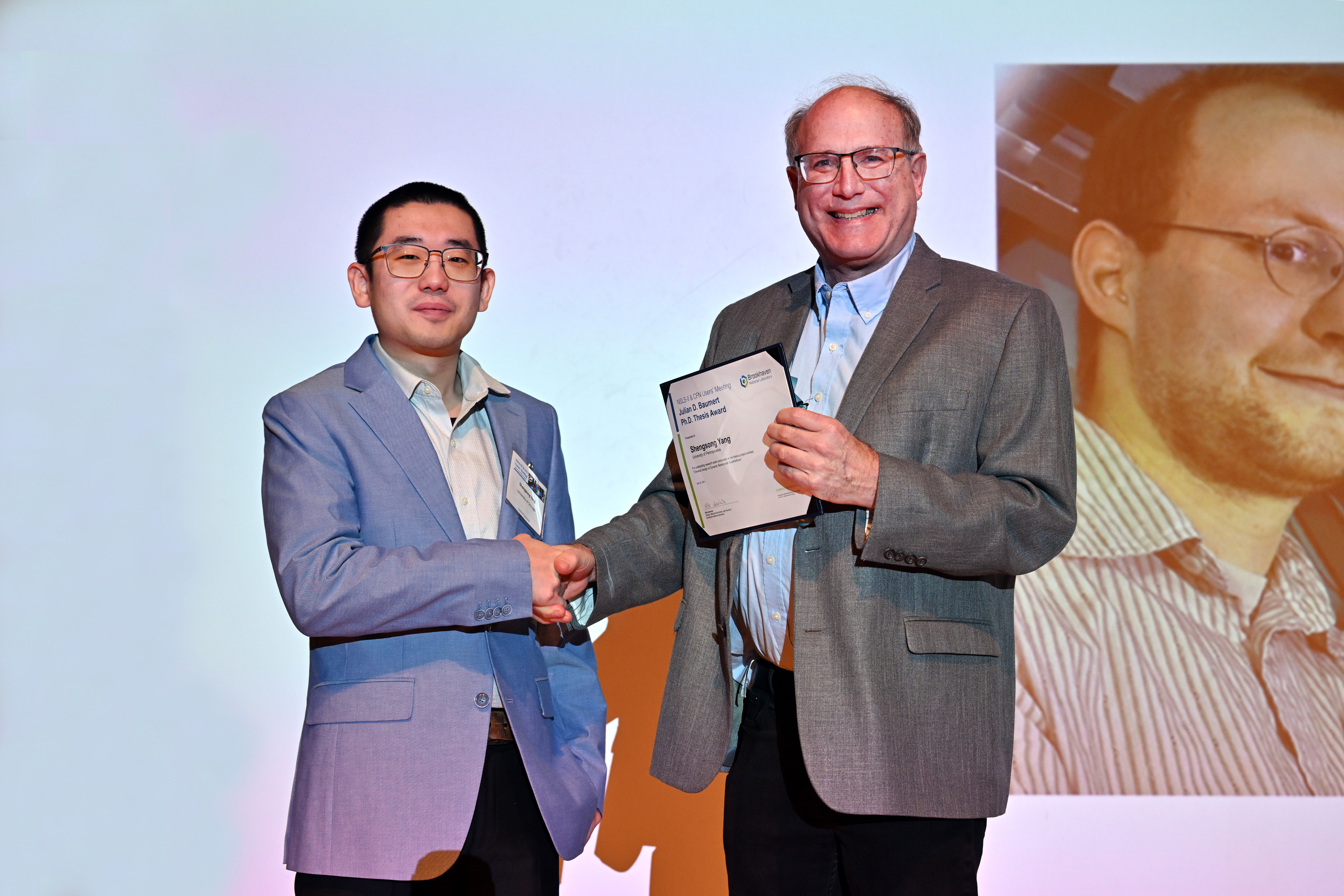
Benjamin Ocko, a beamline scientist at the Soft Matter Interfaces beamline (right) presents postdoctoral researcher Shengsong Yang (left) with the Julian D. Baumert Ph.D. Thesis Award. (Kevin Coughlin/Brookhaven National Laboratory)
The Julian D. Baumert Ph.D. Thesis Award was presented to Shengsong Yang, a postdoctoral researcher in chemistry at the University of Chicago, who earned his Ph.D. in 2024 from the University of Pennsylvania. His dissertation, “Chemical Design of Dynamic Nanocrystal Superlattices,” explores the synthesis, assembly, and transformation of functional nanocrystals. His work included advanced scattering studies at multiple NSLS-II beamlines and characterization at CFN.
The NSLS-II UEC Community Service Award was presented to Erik Johnson, acting deputy director for operations at NSLS-II, in recognition of his many years of leadership and advocacy for the user community. The NSLS-II UEC Outstanding Beamline Scientist Award was presented to Lukas Wehmeier of the Magnetic, Ellipsometric, Time-resolved Infrared and Nanospectroscopies (MET) beamline, honoring his commitment to user support, training, and scientific excellence.
Poster session award winners were also recognized, and the UECs acknowledged outgoing members while welcoming new members as well as members taking on new roles, including newly elected NSLS-II UEC Chair Petra Reinke.
The two UECs thank all exhibitors and sponsors of the 2026 Users’ Meeting, and they look forward to bringing this amazing community together again next year.
Brookhaven National Laboratory is supported by the Office of Science of the U.S. Department of Energy. The Office of Science is the single largest supporter of basic research in the physical sciences in the United States and is working to address some of the most pressing challenges of our time. For more information, visit science.energy.gov.
Follow @BrookhavenLab on social media. Find us on Instagram, LinkedIn, X, and Facebook.
2026-22908 | INT/EXT | Newsroom