AI Shapes the Design of the Electron-Ion Collider
AI-driven tools are transforming accelerator and detector design, will improve performance and enable real-time data analysis
May 18, 2026
 enlarge
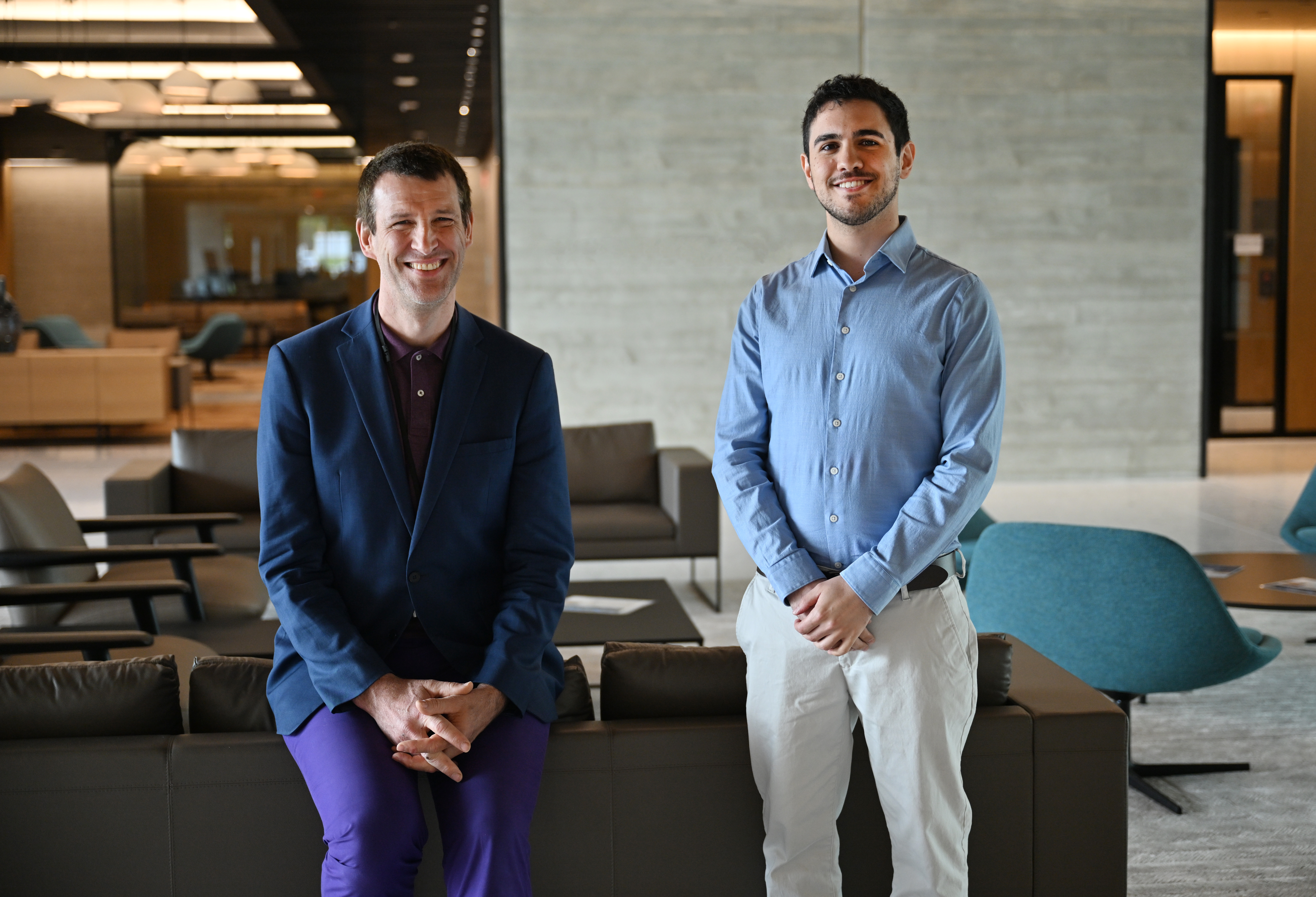
Georg Hoffstaetter de Torquat (left) and Eiad Hamwi (right) are members of EIC-BeamAI, a multi-institutional collaboration developing physics-informed machine learning frameworks that incorporate accurate models of the Relativistic Heavy Ion Collider (RHIC) accelerator complex and beam dynamics, then deploy these tools in the control system to improve optimization, reliability, and automation. Collaborators have already demonstrated this approach in RHIC's pre-accelerators, where machine learning algorithms can maintain beam quality comparable to that achieved by expert human operators. (Kevin Coughlin/Brookhaven National Laboratory)
Artificial intelligence (AI) and machine learning (ML) are shaping major design and research decisions for the planned Electron-Ion Collider (EIC), a next-generation nuclear physics research facility that will collide electrons with protons or nuclei to probe matter’s structure.
The EIC — being built at the U.S. Department of Energy’s (DOE) Brookhaven National Laboratory in partnership with DOE’s Thomas Jefferson National Accelerator Facility (Jefferson Lab) — will reveal the inner structure of matter in unprecedented detail. It is the world’s first collider designed with AI and machine learning integrated into both its accelerator and detector systems.
“EIC is a new facility that can take advantage of AI and machine learning from the start,” said Tanja Horn, a professor of physics at The Catholic University of America, and co-chair of AI4EIC, a working group devoted to developing AI for the EIC. “A wide array of AI tools is now available — perfectly timed for the EIC.”
Brookhaven and Jefferson Lab, along with more than 300 collaborating institutions around the world, are designing the 2.4-mile (3.9-kilometer) ring-shaped accelerator, with two beams circulating in opposite directions at nearly the speed of light. A house-sized particle detector, ePIC, will act as a high-speed 3D camera to capture what happens when these beams — each about the width of a human hair — collide.
The EIC will reuse key components of the Relativistic Heavy Ion Collider (RHIC), a DOE user facility at Brookhaven Lab that completed operations in February 2026. Building on RHIC’s foundation, the project’s scientists, engineers, and collaborators are combining decades of expertise with AI-enabled systems to optimize both the design — and the future operation — of this new DOE Office of Science user facility.
“AI will be embedded across the accelerator that produces collisions between electrons and ions, the detector that captures data from those collisions, and the systems that record, share, and analyze that data,” said Abhay Deshpande, associate laboratory director for nuclear and particle physics at Brookhaven Lab and the EIC science director. “The goal is to ensure that the EIC is ready with AI-enabled systems that speed the path to discovery when it turns on in the mid-2030s.”
The AI tools developed to enhance the EIC may also have impacts on how other future facilities built for science or broader applications are designed, optimized, and run for years to come.
 enlarge
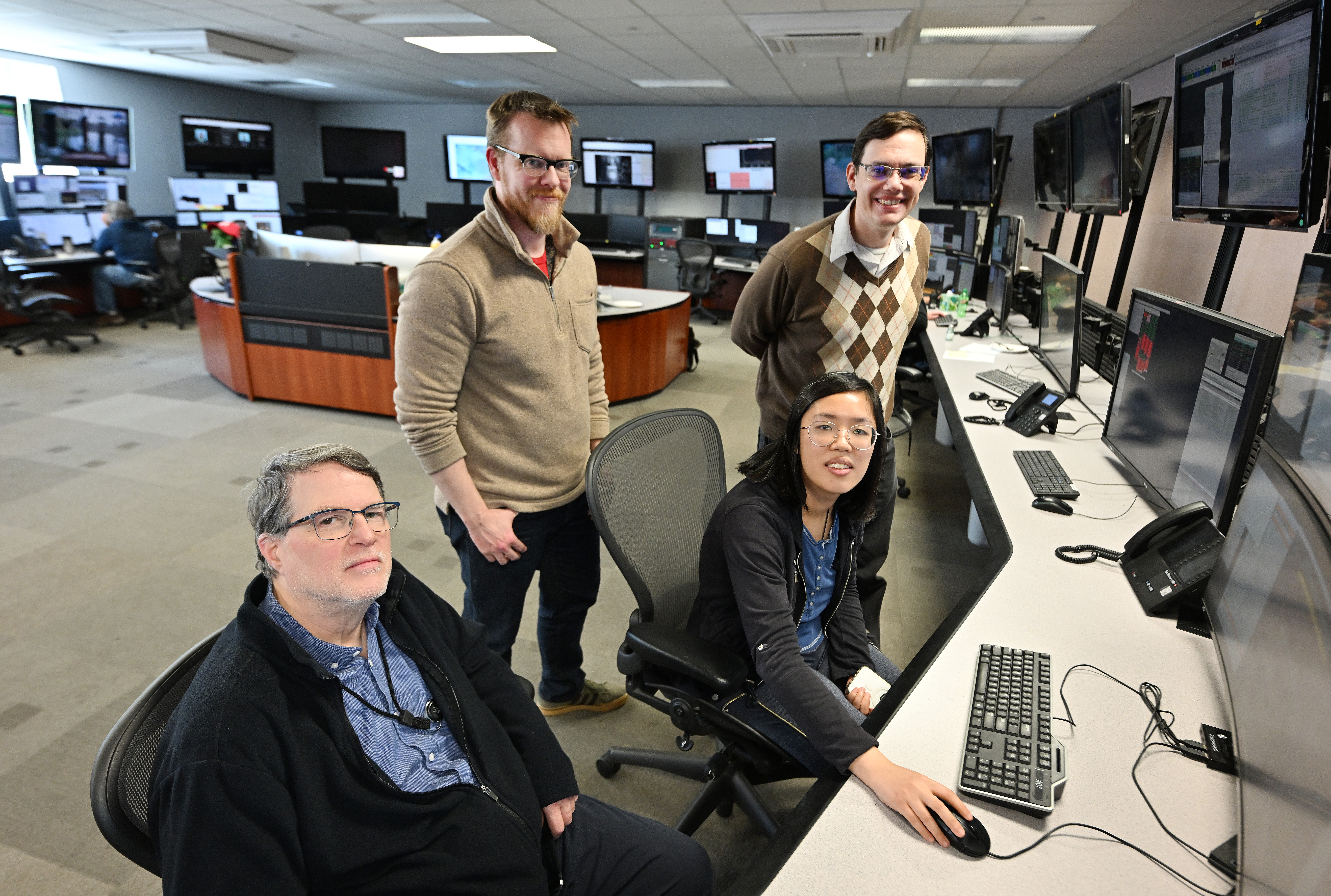
Kevin Brown (left), Vincent Schoefer, Weijian (Lucy) Lin, and Levente Hajdu, pictured here in the Main Control Room of the recently retired Relativistic Heavy Ion Collider, are members of the EIC-BeamAI collaboration. This group is developing and testing AI tools, such as machine learning, using real accelerator systems at Brookhaven Lab to inform the design of the future Electron-Ion Collider. (Kevin Coughlin/Brookhaven National Laboratory)
Using AI to optimize accelerator performance
AI has long been used to improve accelerator operations, particle identification, and data analysis at facilities such as RHIC and the Large Hadron Collider at CERN, the European Organization for Nuclear Research. In earlier facilities, however, these AI capabilities were often added years after construction. For the design of the EIC, teams such as the EIC-BeamAI collaboration are developing and testing AI tools, such as machine learning, using real accelerator systems at Brookhaven Lab — enabling faster, more precise tuning from the outset.
“What’s exciting is that machine learning lets us operate accelerators in ways we simply couldn’t before,” said Kevin Brown, a physicist at Brookhaven Lab who served as head of control systems for RHIC and its injector accelerators. “We’re not just tuning machines — we’re teaching them how to tune themselves.”
By “tuning,” Brown refers to adjusting tens of thousands of parameters that keep beams stable and maximize collisions — a complex task traditionally managed through constant manual adjustments.
“It’s very difficult for a human being to keep on top of all these settings and beam characteristics all the time,” said Georg Hoffstaetter de Torquat, a Cornell University professor with a joint appointment at Brookhaven Lab. “With machine learning, what we write is essentially computer supervision — the system monitors conditions and adjusts controls automatically.”
 enlarge
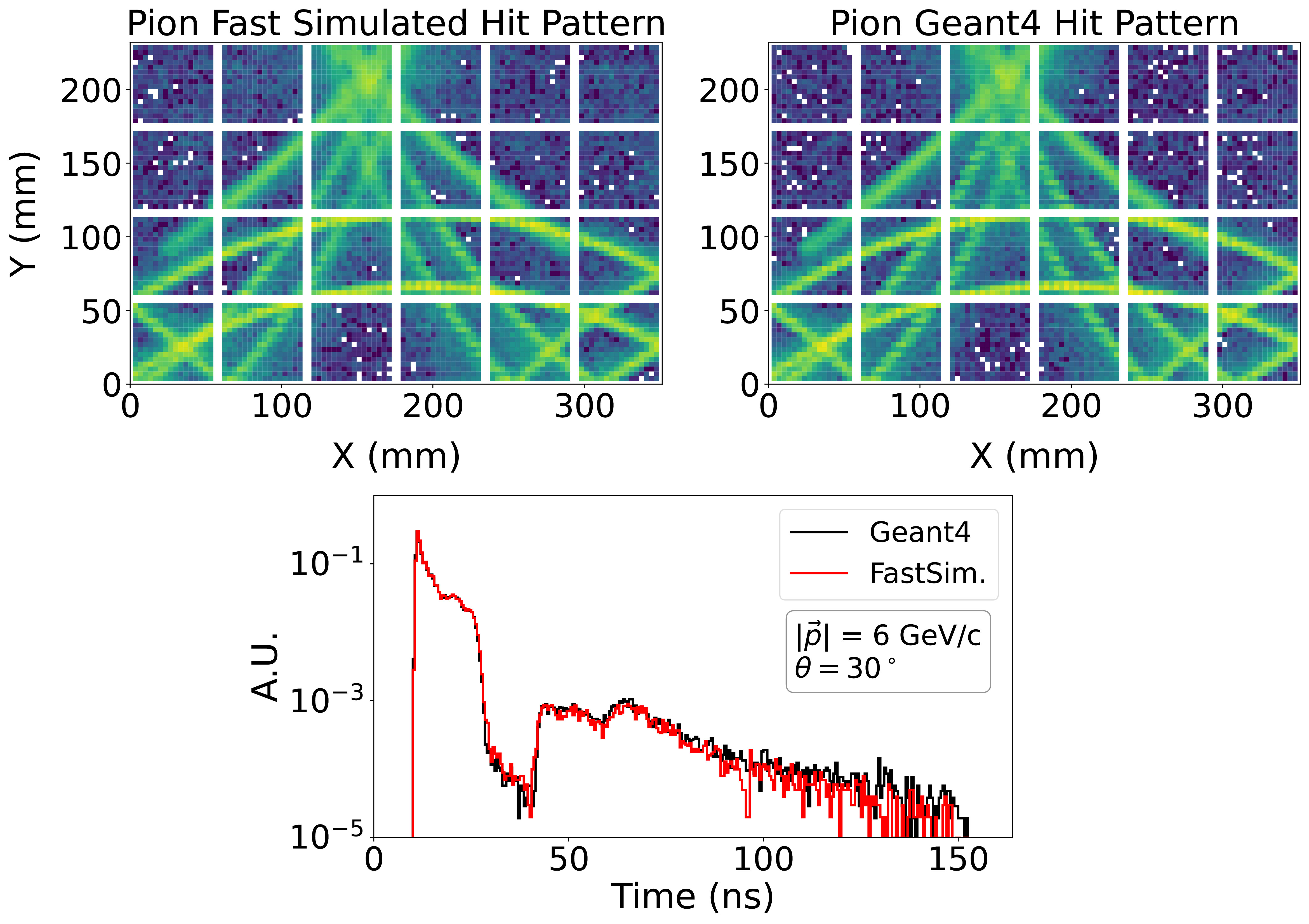
AI-assisted simulations can quickly reproduce the kinds of signal patterns particles leave in a detector, helping scientists test detector designs and analyze collision data more efficiently. These images compare two ways of simulating how a pion, a type of particle, would appear in a detector. The Geant4 image on the right is the reference simulation. Geant4 is the standard detailed detector simulation widely used in particle physics, producing highly accurate but slow simulations, while the AI-assisted version, as shown on the left, is designed to produce similar detector patterns much faster. (Image courtesy of Cristiano Fanelli)
To train these self-tuning models, scientists rely on real accelerator data. The EIC will use decades of operational data from RHIC to train and validate AI tools. BeamAI collaborators have already demonstrated this approach in RHIC’s pre-accelerators, where machine learning algorithms can maintain beam quality comparable to that achieved by expert human operators.
“And the routine can run all the time,” Hoffstaetter said. “It’s like having an operator dedicated to the task continuously.”
These systems also generate a “digital twin” — a virtual model that mirrors the accelerator in real time, allowing scientists to test adjustments without interrupting operations.
“As the system optimizes, it learns parameters of the real accelerator, like the misalignment of magnets,” Hoffstaetter said. “That makes future adjustments even better.”
Researchers emphasize that AI enhances, rather than replaces, human expertise. Operators can monitor AI-driven changes in real time, while built-in safeguards ensure systems operate within safety limits.
“Machine learning has the potential to make operation safer,” Hoffstaetter said. “A digital twin, for instance, can identify unusual magnet behavior and prompt a shutdown before the machine is at risk.”
Optimizing detector design with AI
AI’s role at the EIC extends beyond controlling beams in the accelerator. Scientists are also applying these tools to design the massive detector where collisions occur.
Scientists design detectors by modeling their geometry digitally and running simulations of particle collisions to evaluate performance. They iteratively refine these designs before construction begins — a process that traditionally requires millions of computationally intensive simulations.
“The Electron-Ion Collider (EIC) is a new facility that can take advantage of AI and machine learning from the start. A wide array of AI tools is now available — perfectly timed for the EIC.”
— Tanja Horn, a professor of physics at The Catholic University of America, and co-chair of AI4EIC
To streamline this work, EIC collaborators are applying AI and machine learning to automate key parts of the workflow. One leading effort is the DOE-supported project AI-Assisted Detector Design for the Electron-Ion Collider (AID2E), a collaboration among Brookhaven Lab, The Catholic University of America, Duke University, Jefferson Lab, and William & Mary.
“We are building a framework that allows AI to assist the design of large-scale detectors,” said Cristiano Fanelli, associate professor of data science and director of technology at William & Mary, the lead principal investigator of AID2E, and co-convener of the AI4EIC working group. “These systems involve complex optimization problems that are difficult for humans to explore efficiently but well suited to AI-assisted approaches.”
Researchers are training algorithms to predict how design changes affect the detector’s ability to identify particles, allowing them to explore many configurations in a fraction of the time required for full simulations.
“AI can identify optimal solutions, but only within the objectives and constraints defined by physicists,” Horn said.
By combining physics expertise with AI-assisted optimization, researchers can more efficiently refine detector design while reducing computing costs and energy use.
Enabling real-time data analysis and event reconstruction
Once the detector is built, the challenge shifts from design to data — capturing and interpreting an enormous stream of collision events as they occur.
“We’re trying to develop algorithms that can handle data flying at you at a rate of 500,000 collisions per second,” Horn said. “It’s an interesting challenge.”
These collisions generate complex signals and background noise that can obscure key information. Traditional approaches rely on fixed rules and manual tuning, but the EIC will use AI-driven systems to filter and prioritize data in real time.
 enlarge
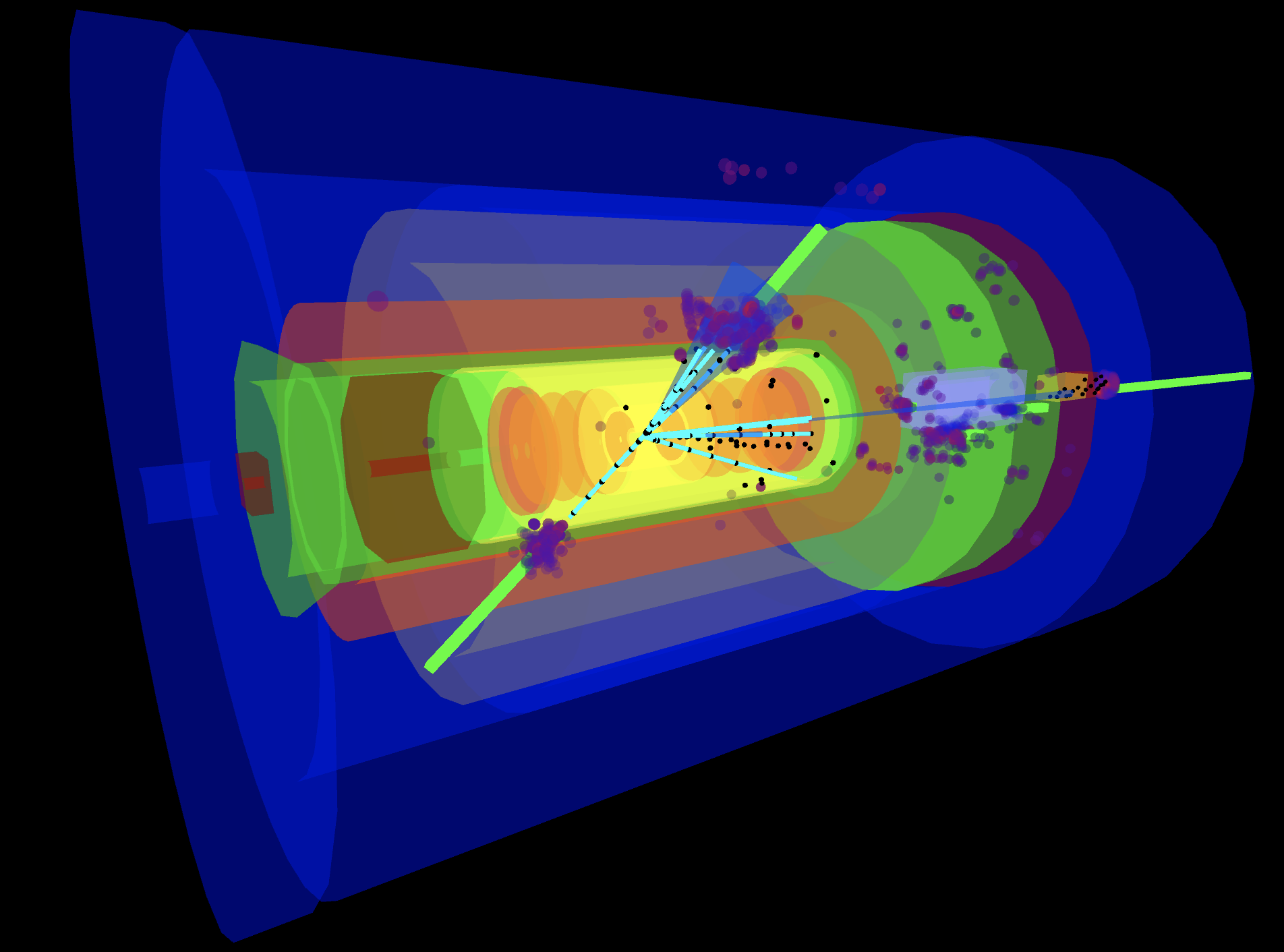
The EIC detector, known as ePIC, will use cutting-edge technologies to detect particles created in collisions between high energy electrons and protons or ions — the nuclei of larger atoms — moving close to the speed of light. These collisions generate complex signals and background "noise" that can obscure key information. Traditional approaches rely on fixed rules and manual tuning, but the EIC will use AI-driven systems to filter and prioritize data in real time. This image shows simulated particle hits and tracks. (Sean Preins/VIRTUE)
The facility is expected to produce data streams of up to 100 gigabits per second — comparable to tens of thousands of high-definition video streams running simultaneously — requiring a powerful readout network that can process data almost as quickly as it is generated.
“We want a fast response to flag information,” said Alex Jentsch, a staff scientist at Brookhaven Lab who specializes in detector systems and is part of the AID2E collaboration. “Machine learning can help us disentangle interesting things from things we don’t care about.”
Beyond filtering data, AI is also transforming how scientists reconstruct collision events. Deep learning models translate the tiny traces particles leave behind as they pass through the detector into detailed information about their energy and momentum, improving both the speed and accuracy of event reconstruction.
“Deep learning is uniquely suited to modeling complex, high-dimensional detector responses directly from data,” Fanelli said. “It complements established methods and human expertise to improve reconstruction and analysis.”
Together, these AI-driven approaches improve how detectors are developed and how collision data are processed, allowing researchers to extract insights more quickly.
“We are contributing to a broader effort across nuclear and particle physics to advance near real-time data analysis,” Fanelli said.
As the first collider designed for the AI era, the EIC represents a new model for how science is done — shaping the design of future research facilities for decades to come.
Brookhaven National Laboratory is supported by the Office of Science of the U.S. Department of Energy. The Office of Science is the single largest supporter of basic research in the physical sciences in the United States and is working to address some of the most pressing challenges of our time. For more information, visit science.energy.gov.
Follow @BrookhavenLab on social media. Find us on Instagram, LinkedIn, X, and Facebook.
2026-22923 | INT/EXT | Newsroom