Brookhaven Lab Intern Uses Artificial Intelligence to Train Robots
Jasmin Lin shares her takeaways from internships exploring humanoid robots and embodied artificial intelligence
June 5, 2026
 enlarge
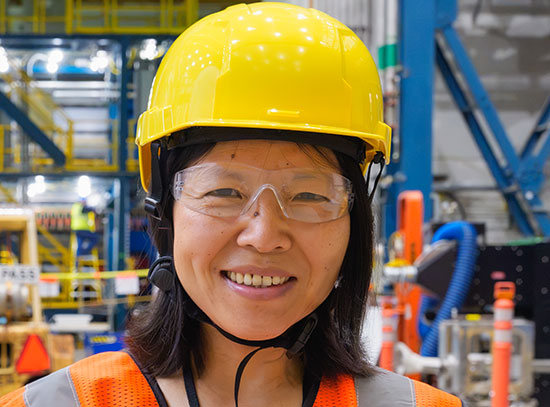
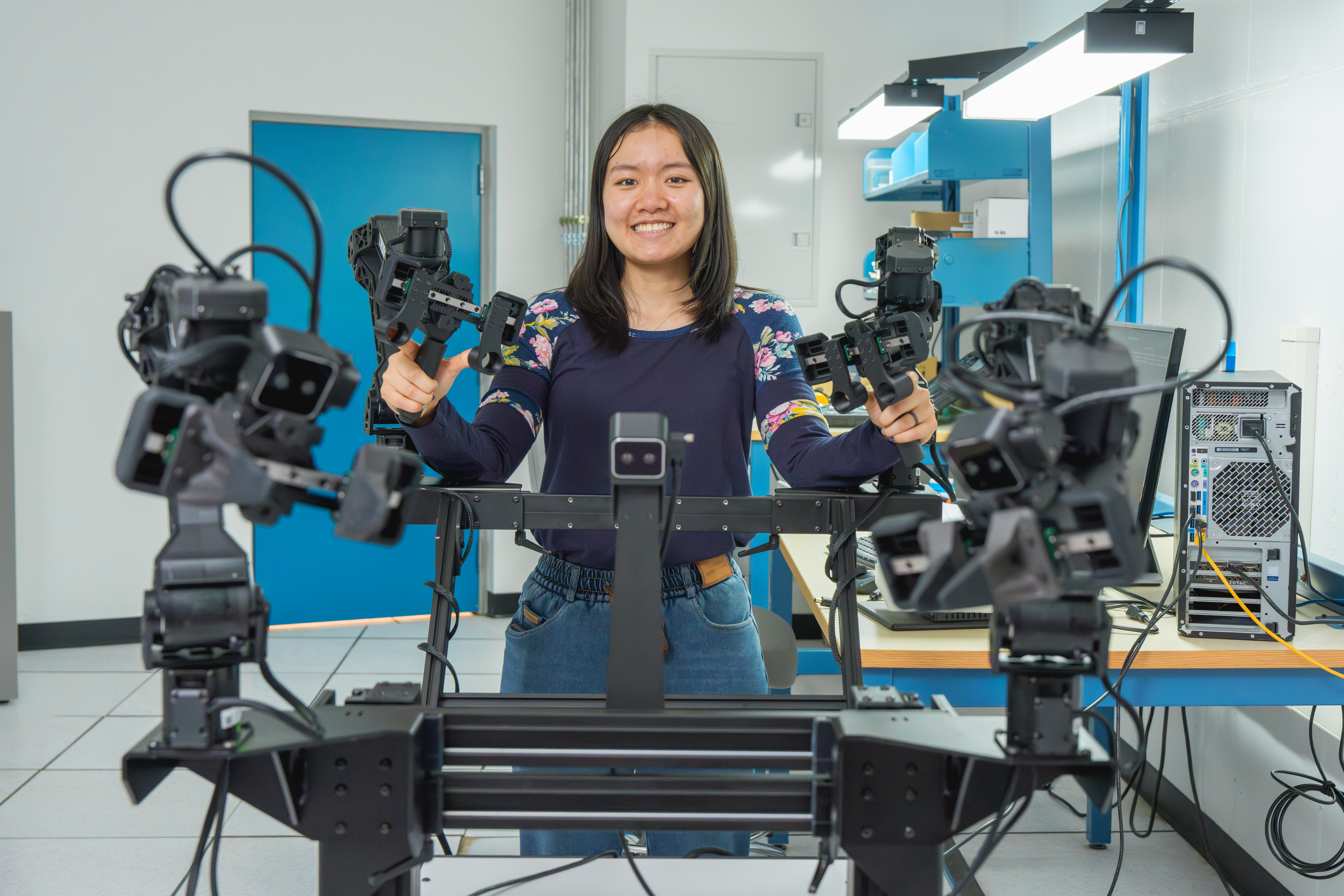
Jasmin Lin operates a robot in the Scientific Embodied Agents Lab (SEAL) at Brookhaven National Laboratory. SEAL serves as a testbed for embodied AI initiatives. (Timothy Kuhn/Brookhaven National Laboratory)
Jasmin Lin didn’t set out to study artificial intelligence (AI) and robotics, but her path has led her there. Now pursuing a master’s degree in bioinformatics at Brandeis University after earning her undergraduate degree in biology at Stony Brook University, Lin expanded her interests through hands-on research experiences at the U.S. Department of Energy’s (DOE) Brookhaven National Laboratory. She first joined the Lab as a Science Undergraduate Laboratory Internships (SULI) participant, then returned as a Supplemental Undergraduate Research Program (SURP) intern, both with mentors from the Artificial Intelligence group within Brookhaven’s Computing and Data Sciences Directorate. Along the way, Lin has explored the rapidly expanding world of humanoid robots and embodied AI, contributing to research that advances AI applications that support the Lab’s scientific goals and as well as DOE’s Genesis Mission to accelerate AI innovation and discovery. Lin recently shared what she learned at Brookhaven Lab and offered tips for future interns.
You previously joined Brookhaven Lab as a Science Undergraduate Laboratory Internships (SULI) participant. What did you research during your time with the program, and what did you gain from that experience?
My first SULI term ran from January to May 2025 with Wei Xu. My project then was more focused on computational biology. I integrated virtual reality (VR) with a plant digital twin. A digital twin is a dynamic, real-time digital model of a physical system that continuously updates alongside the real counterpart. I ended up making a whole pipeline that connected VR interaction with a 3D Gaussian Splatting model of a plant in Unity using C# and Python. Using the VR hand controllers, I was able to point and click the model to pull up original images that were used to generate that exact gaussian at the point of intersection. This was my first experience using AI within the AI department.
Even though I’ve only been working with AI for a year, my user experience has steadily improved. I have found it to be more reliable with fewer hallucinations and irrelevant responses.
Embodied AI refers to artificial intelligence systems that are situated in and learn through interaction with an environment using a body. In this case, we’re using robots . I started exploring with training humanoid robots in simulation. That was a huge twist because I come from a biology background, but it was a lot of fun. In this project, I learned how reinforcement learning policies work and how there are many different ways to train robots. I used the SKRL reinforcement learning library to investigate humanoid robot locomotion, a fundamental component of coordinated humanoid movement. This project laid the groundwork for my further exploration into embodied AI.
What was it like presenting your project on humanoid robots at the New York Scientific Data Summit last year?
I submitted my paper from my summer SULI project to the New York Scientific Data Summit, and that was my first-ever conference and research paper. I was very nervous during my presentation since I was surrounded by so many amazing scientists and people from industry, but I was also very confident in myself because my experience here at Brookhaven Lab helped a ton. In preparation, I spoke to my SULI mentor at that time, Wei Xu, and I used online resources to make sure I was delivering the right information to everyone.
 enlarge
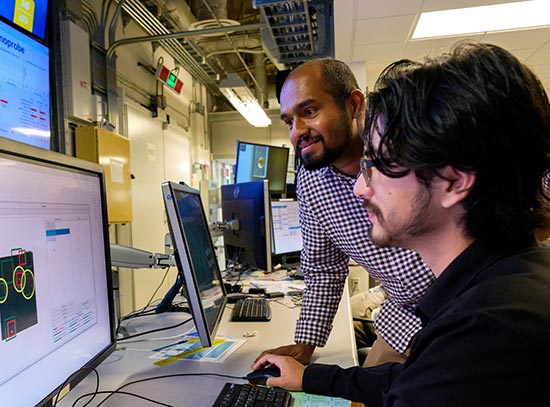
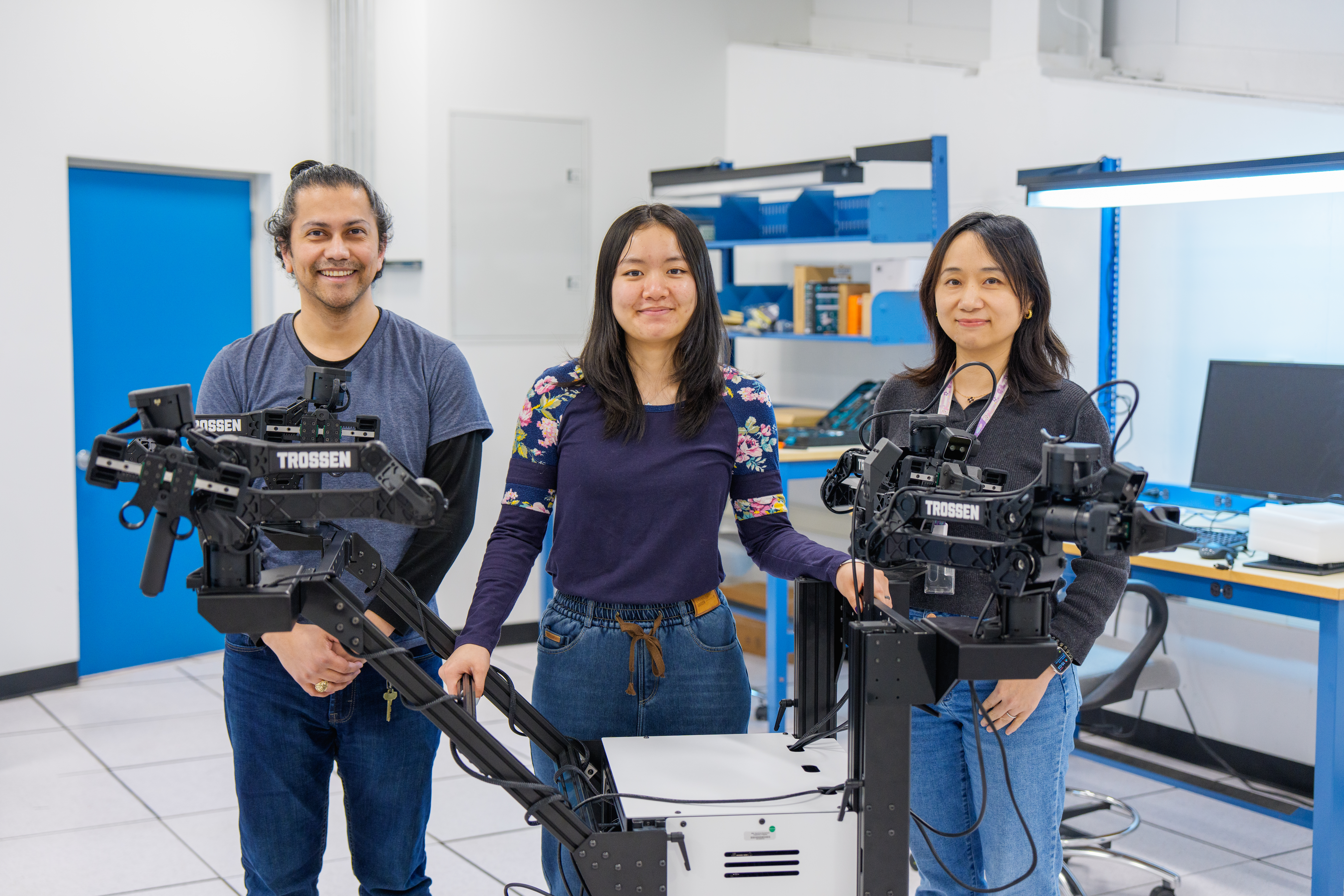
Carlos Soto, left, Jasmin Lin, and Wei Xu in the Scientific Embodied Agents Lab (SEAL). Lin collaborated with mentors Soto and Xu from the Artificial Intelligence group within Brookhaven's Computing and Data Sciences Directorate during her internships at Brookhaven Lab, often conducting research at SEAL. (Timothy Kuhn/Brookhaven National Laboratory)
You returned to Brookhaven Lab through the Science Undergraduate Research Program (SURP). What were your research goals?
I’m continuing a SURP project I started in the fall with my mentor Carlos Soto — that’s when I fully shifted into embodied AI. I’m in the Scientific Embodied Agents Lab (SEAL), and our mission is to assist user facilities around Brookhaven Lab, such as the National Synchrotron Light Source II (NSLS-II). For example, we are in the beginning stages of looking into how we can reduce down time at NSLS-II. If maintenance or repairs require workers to go into the accelerator tunnel, the facility must turn off the X-ray beam. But if we can train a robot to go into the accelerator tunnel, that would prevent the need to turn off the beam and reduce down time.
I’m connecting vision-language-action policies — AI models that help robots see, understand instructions, and act — with a physical robot. I’ve deployed them both onto the real robot and also into simulation. I trained the robot to be able to pick up a 3D mockup of a mother board and then put it into a box all autonomously. We’re hoping to branch into more complex tests. Currently I’m integrating VR for teleoperation of the robot in simulation.
What do you find so interesting about artificial intelligence, and why do you want to continue learning about it?
It’s definitely a big twist from my current study, which is bioinformatics. I still love biology, but I also really love coding. Artificial intelligence is very adaptive, and I use it to understand the research I’m doing. I like that it helps me bring my ideas to fruition sooner because of its efficiency. Rather than having to single out articles and read them one-by-one, I’m able to query databases to help find the articles and use AI chatbots to summarize and elaborate on topics within them, kind of like a teacher-student relationship. I love that there’s a lot we can explore because it’s relatively new, especially with a shift and focus on embodied AI right now.
A lot of the work that we do in general as people is very manual — that’s reflected in my undergrad studies in biology where we enter all the data into Excel manually and then generate a graph, then do all the analyses by hand. Now with AI being more specialized in different fields, we can speed that up and be so much less time-consuming. With embodied AI, we can do that with physical things, too. Most of all, I really like the idea of contributing to something that will eventually be used in the future.
What’s a standout moment for you from your time as an intern at Brookhaven Lab?
It’s definitely seeing success with the physical robot. Troubleshooting robotics is really difficult because whenever there’s an issue, you can’t really pinpoint where it starts from. There’s hardware in the robot, there’s software in the robot, and there’s also software on the computer connection and deployment of the AI model that we’re using.
The first major obstacle took many days in our lab just trying to figure it out. Finally seeing the robot doing anything was so satisfying to me. And that definitely opened the door to a lot more research for us.
What would you tell other students who are thinking about applying for programs like SULI and SURP?
I remember when I came to Brookhaven Lab last January — the first day after I got my badge — I was walking around and felt like I had imposter syndrome because I was surrounded by so many brilliant interns. I felt like I was behind and that I had to do a lot more to be ahead of where I was. But after talking to other interns, I’ve come to realize that everyone feels that way in the beginning. The projects are always going to be very specialized because of the research being done. Don’t be disheartened by that. It’s okay to not understand what you’re doing at first, because you’ll eventually get it. That’s the purpose of learning and research. I would also say: Be comfortable with your mentors. Mentors are people too. I love interacting with my mentors. We talk a lot about just human stuff outside of our research, and it helps me look forward to coming into the lab and definitely reduces burnout. I also enjoy talking to the other scientists within the department. I’ve learned so much from being here, not just about AI but also about science and research in general.
Students who are new to these kinds of experiences should also try to step outside of their comfort zone and ask for help. Talk to all the scientists around you — not just your mentors — and you’ll see how much you can grow from the opportunity!
NSLS-II is a DOE Office of Science User Facility at Brookhaven Lab.
Brookhaven National Laboratory is supported by the Office of Science of the U.S. Department of Energy. The Office of Science is the single largest supporter of basic research in the physical sciences in the United States and is working to address some of the most pressing challenges of our time. For more information, visit science.energy.gov.
Follow @BrookhavenLab on social media. Find us on Instagram, LinkedIn, X, and Facebook.
2026-22956 | INT/EXT | Newsroom