Belle II Accumulates the World's Largest Y(4S) Dataset
For more precise searches for new physics beyond the Standard Model
June 5, 2026
Editor's note: The following news release was originally issued by Japan’s High Energy Accelerator Research Organization (KEK), home of the SuperKEKB electron-positron collider and the Belle II physics experiment. The U.S. Department of Energy’s Brookhaven National Laboratory is the host laboratory for U.S. contributions to Belle II. Brookhaven Lab provides a large fraction of computing resources for Belle II, leads unique data analysis efforts for the experiment, and helped design and produce superconducting magnets for the SuperKEKB collider. To learn more about Brookhaven’s contributions, visit the Lab’s Belle II website. Reporters interested in interviewing Brookhaven Lab Belle II scientists should contact Stephanie Rucco, srucco@bnl.gov, 631-344-8671.
About the Belle II Experiment
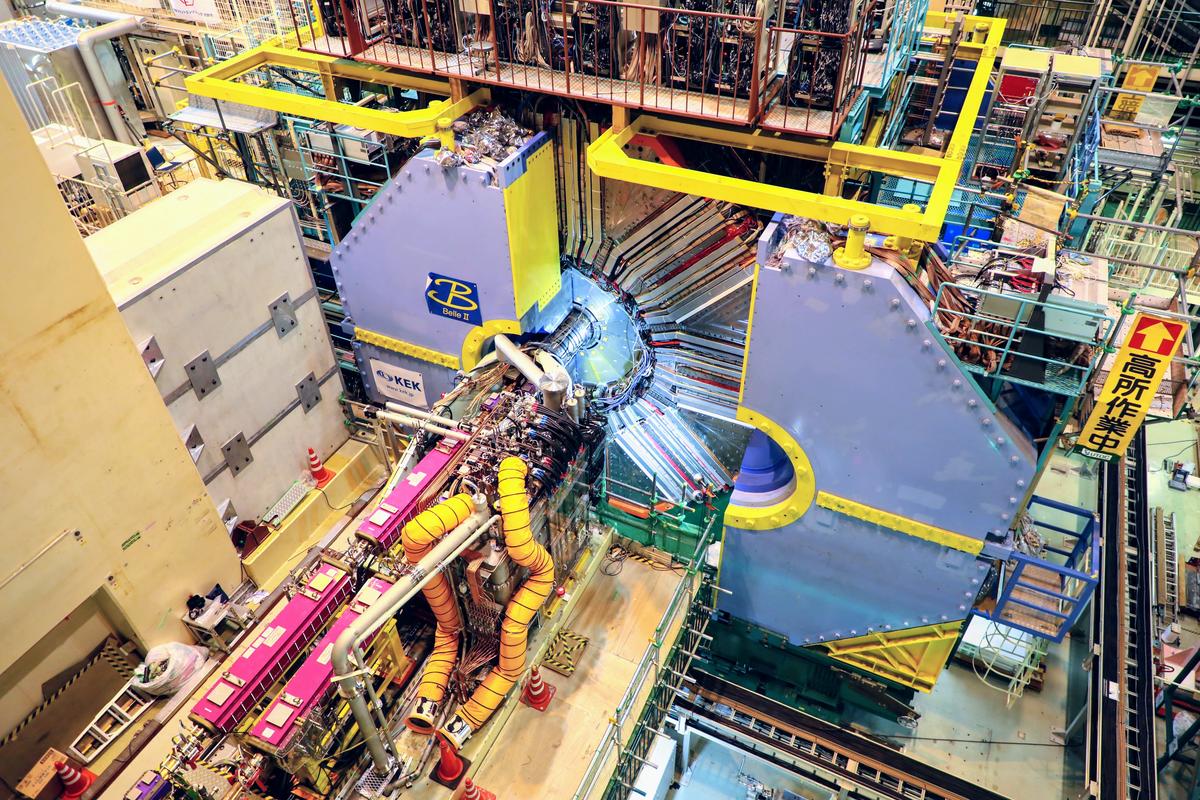
The Belle II experiment at the SuperKEKB electron-positron collider, KEK's flagship project based at the Tsukuba campus, is a large-scale accelerator-based experiment to search for new physics beyond the Standard Model of elementary particles. The Belle II collaboration consists of more than 1,200 members from 28 countries and regions.
Similar to its predecessor KEKB, SuperKEKB accelerates electron and positron beams using a linear accelerator (LINAC), fills them into separate storage rings, and brings them to collide inside the Belle II detector. Based on this, it is designed to achieve the world's highest luminosity through the novel "nano-beam" collision scheme, in which extremely small beam sizes at the interaction point yield a drastically high collision rate. SuperKEKB and Belle II have been in operation since 2019, aiming to accumulate high integrated luminosity and deliver groundbreaking physics results.
World's Largest Dataset
The B-meson dataset accumulated by Belle II at the Υ(4S) became the world's largest on May 17, surpassing that of the Belle experiment. As of June 4, the integrated luminosity at Υ(4S) has reached 757 fb−1. Together with additional datasets collected at energies different from that of Υ(4S), 86 fb-1 at 10.52 GeV and 19 fb-1 at and around 10.75 GeV, the total integrated luminosity of Belle II has reached 862 fb-1 and is still increasing.
The new peak instantaneous luminosity, 5.2×1034 cm-2s-1, was recorded on March 19 this year, approximately 2.5 times the Belle record (cm-2s-1 means the number of collisions for one-square-centimeter cross-section reaction per second, the unit for instantaneous luminosity). Furthermore, data this year have been accumulated at an average rate of about three times faster than Belle’s best year.
 enlarge
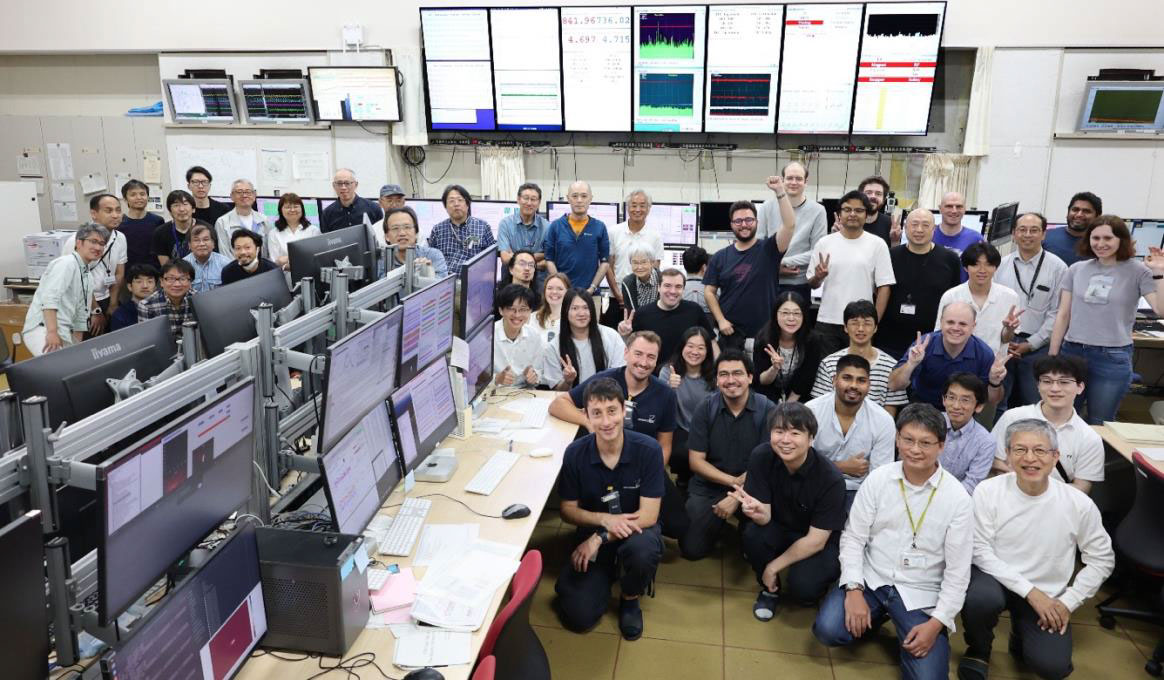
SuperKEKB and Belle II researchers, celebrating the accumulation of the world's largest Υ(4S) dataset. (Belle II Collaboration/KEK)
Prospects
By acquiring the world-leading dataset, Belle II has cleared a pivotal milestone toward a new era. Detailed analyses of the accumulated dataset are expected to enable a series of searches that open the door to exciting physics discoveries.
SuperKEKB and Belle II aim to ultimately accumulate 50 ab-1 of integrated luminosity, which is approximately 50 times that of Belle. To achieve this goal, continuous improvements in accelerator and detector performance will be pursued, including a planned upgrade of both the accelerator and the detector around 2032.
Contact Information
Research Contact
High Energy Accelerator Research Organization (KEK)
Institute of Particle and Nuclear Studies (IPNS)
Prof. Mikihiko Nakao
Tel: 029-864-5200 ext. 4691
e-mail: mikihiko.nakao@kek.jp
Press Contact
High Energy Accelerator Research Organization (KEK)
Public Relations Office
Tel: 029-879-6047
e-mail: press@kek.jp
2026-22996 | INT/EXT | Newsroom