Brookhaven Lab Awarded 7 Genesis Mission Projects
The research projects will use artificial intelligence to advance national priorities
July 22, 2026
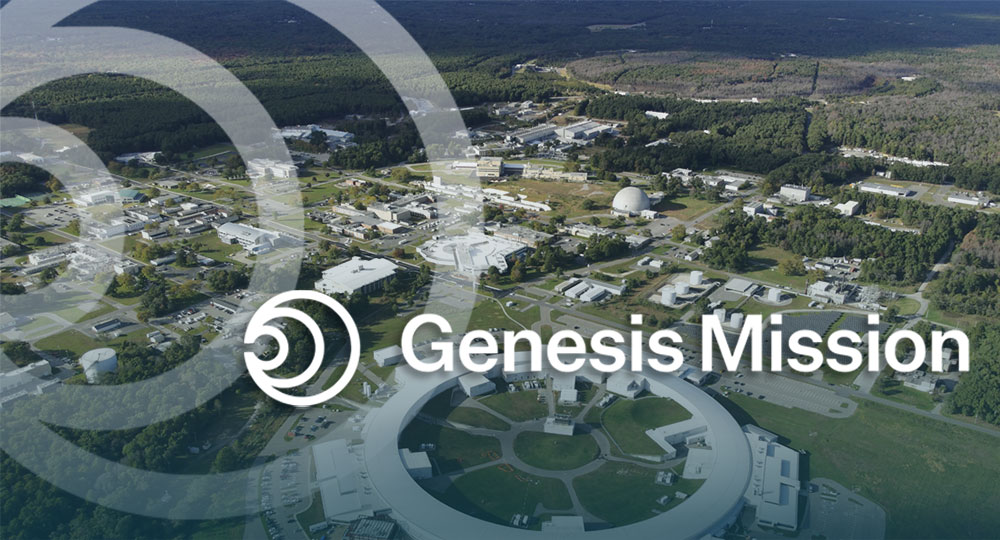
UPTON, N.Y. — Seven innovative research projects led by the U.S. Department of Energy’s (DOE) Brookhaven National Laboratory have been selected by DOE to receive funding through the Genesis Mission Phase I Request for Application (RFA). The awards to Brookhaven Lab support groundbreaking artificial intelligence (AI) research for microelectronics, nuclear and high energy physics, computational science, and atmospheric science.
The RFA awards were announced today by DOE at the Genesis Mission Summit in Washington, D.C. Hendrik Hamann, chief AI scientist for Innovation, Science, and Security at Brookhaven Lab and joint appointee at Stony Brook University, presented at the summit.
“We are very excited by DOE’s decision to award Brookhaven seven Genesis Mission projects. This reflects our deep expertise in AI, the breadth of our capabilities, and the ingenuity of our teams,” said Brookhaven Lab Director John Hill. “These projects, together with those we are partnering on, will support DOE’s vision to advance national priorities by integrating AI with world-class science.”
The Genesis Mission is a historic national initiative led by the U.S. Department of Energy, which is building the world’s most powerful integrated science discovery platform. By uniting government, industry, academia, and philanthropy, it is accelerating breakthroughs in energy, scientific discovery, and national security through a new platform that combines AI, supercomputing, quantum systems, and advanced scientific instruments.
Brookhaven Lab is advancing the goals of the Genesis Mission by improving AI for science and society. Now, with seven Phase I RFA projects awarded to the Lab, Brookhaven Lab is further positioned as leader in AI research and this historic mission from DOE.
The goal of the Phase I RFA awards is to identify promising pathways toward transformative scientific capabilities and establish a foundation for future investment and scale. Project teams will design and demonstrate research workflows that integrate AI with scientific investigation, while rigorously evaluating whether those approaches can accelerate discovery, improve predictive capabilities, enhance experimentation, or generate new scientific insights.
The Brookhaven-led projects are:
- An Automated, Multimodal-AI-Enabled Cloud Chamber for Constraining Cloud Microphysical Processes in Earth System Models — By controlling an advanced cloud chamber with an AI framework, scientists will create specific cloud conditions on demand, easily maintain those conditions, and collect more reliable data.
- MARS: scaling Multi-Agent Reinforcement learning for Scientific hypothesis generation — This project will connect multiple AI agents, each trained on complex scientific tasks such as reading literature and analyzing data, to a network that will generate better research hypotheses than today’s AI models can.
- Deployable Cavity Coupled Cold Atom Quantum Sensing Platform Driven by Agentic AI — Scientists will develop an AI-controlled quantum sensing platform to automatically tune and stabilize sensors for high energy physics experiments in real time.
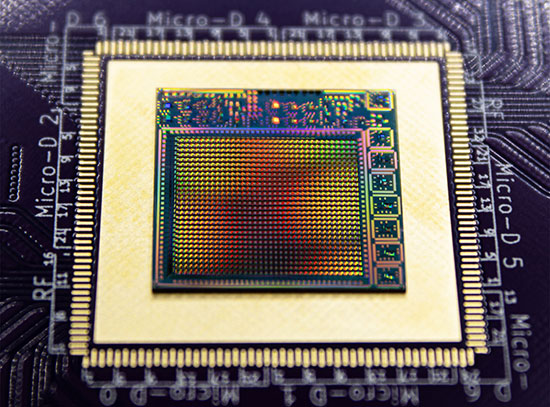
- From Materials to Circuits: An AI-Native EDA Framework for Physics-Based Microelectronics Co-Design — Researchers will use AI to speed up the design of custom computer chips for scientific instruments, such as particle detectors, quantum sensors, and fusion diagnostics.
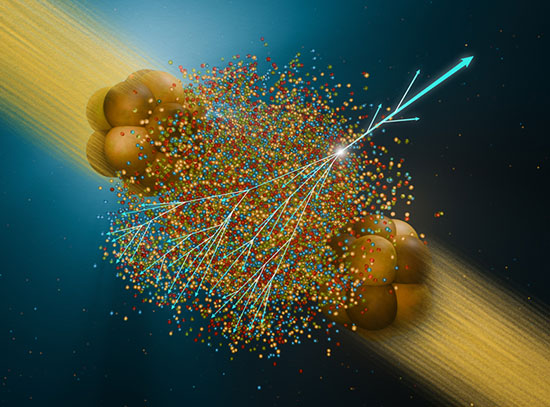
- Transforming Computing Cyber infrastructure for Collider Experiments to AI Based Computing and AI-ready Data — To manage the ever-increasing volume of data produced by particle colliders, reduce operator workload, and speed up discoveries, researchers will build AI into the computing infrastructure at the Electron-Ion Collider and the Large Hadron Collider.
- AI-Driven, Self-Learning Digital Twins for Robust Operation of Particle Accelerators — Researchers will build AI-enabled, virtual representations of particle accelerators that can predict status conditions and learn from live data to make complex operations more reliable.
- Cross-Domain Scientific Reasoning through Composable Foundation Models — The Genesis Mission is producing new AI models at an accelerating pace, and this project will connect those models into one continuously improving reasoning system to accelerate discovery and collaboration across the Mission.
All seven of the Brookhaven-led projects are supported by the DOE Office of Science. Beyond these Brookhaven-led projects, the Lab is contributing to 29 additional projects led by other National Laboratories, research universities, and private industry.
Brookhaven National Laboratory is supported by the Office of Science of the U.S. Department of Energy. The Office of Science is the single largest supporter of basic research in the physical sciences in the United States and is working to address some of the most pressing challenges of our time. For more information, visit science.energy.gov.
Follow @BrookhavenLab on social media. Find us on Instagram, LinkedIn, X, and Facebook.
2026-23041 | INT/EXT | Newsroom