Sambamurti Lecture: Creating Hottest Fluid with a Single Photon
July 22, 2026
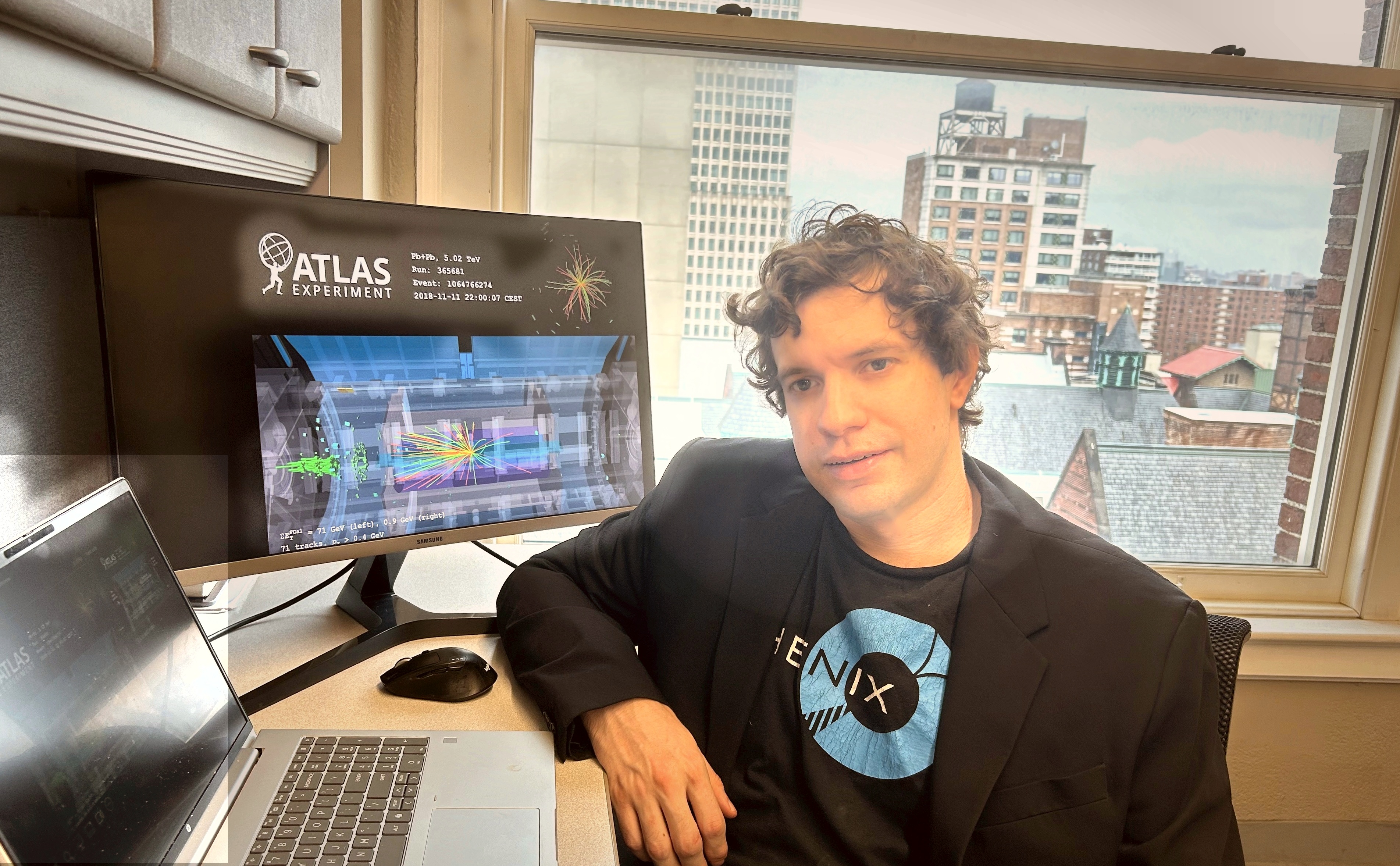
The hottest matter ever created exists for only a tiny fraction of a second, yet it behaves like an almost perfect liquid. This remarkable state of matter, known as the quark-gluon plasma, filled the universe just millionths of a second after the Big Bang. Remarkably, scientists have been able to routinely recreate and study this primordial soup by smashing together atomic nuclei at nearly the speed of light.
Blair Seidlitz, a physicist at Columbia University and collaborator on quark-gluon plasma experiments at the Relativistic Heavy Ion Collider (RHIC) at the U.S. Department of Energy’s (DOE) Brookhaven National Laboratory, will give an overview of this research in the 2026 Sambamurti Memorial Lecture. The talk will be held on Thursday, July 30, at 1:30 p.m. EDT.
Attendees can join:
- In the large seminar room of the Physics Department (Bldg. 510)
- On Zoom (check back for link)
For many years, most physicists believed that the “perfect” liquid quark-gluon plasma could only emerge in the largest and most violent nuclear collisions. The energy deposited by these collisions creates thousands of new particles that flow collectively with almost no resistance. Recent discoveries, however, have challenged this picture. Data from RHIC, a DOE Office of Science user facility for nuclear physics research, suggest that collisions of much smaller systems that produce only tens of particles may also exhibit the same collective fluid-like behavior.
Seidlitz’s talk will describe yet another new frontier: using a single particle of light, a photon, to create and study one of the smallest droplets of this hottest fluid ever observed. He will also describe how the Electron-Ion Collider (EIC) — a new nuclear physics research facility under construction at Brookhaven Lab — will be a factory for photon-ion collisions with the potential for exhibiting fluid-like behavior.
The talk will include descriptions of the modern particle detectors, precision measurements, and international collaborations that enable physicists to explore matter under the most extreme conditions found anywhere in the universe — and how those explorations are bringing humanity closer to understanding how the fundamental building blocks of nature behave.
About the speaker
Seidlitz earned his Ph.D. in physics from the University of Colorado, Boulder in 2022, for work on the ATLAS experiment at the Large Hadron Collider, and a Bachelor of Science in engineering physics from the University of Wisconsin, Madison in 2014. In 2022, he joined Nevis Laboratory at Columbia University as a postdoctoral research scientist, working on both ATLAS and the sPHENIX experiment at RHIC. In March 2025, the American Physical Society awarded him the 2024 Dissertation Award in Hadronic Physics "for developing the experimental access of high-multiplicity photo-nuclear interactions and a novel investigation of collective phenomena in this system.”
About the Sambamurti Memorial Lecture
The Sambamurti Memorial Lecture was established in 1992 to commemorate the work of Aditya Sambamurti, a young Brookhaven physicist who died of cancer in 1992 at age 31. Each year, an outstanding young physicist whose professional interests overlap those of Sambamurti is selected to deliver the lecture.
Brookhaven National Laboratory is supported by the Office of Science of the U.S. Department of Energy. The Office of Science is the single largest supporter of basic research in the physical sciences in the United States and is working to address some of the most pressing challenges of our time. For more information, visit science.energy.gov.
Follow @BrookhavenLab on social media. Find us on Instagram, LinkedIn, X, and Facebook.
2026-23065 | INT/EXT | Newsroom