Future Scientists Get a Head Start on Electron-Ion Collider Science
Long Island high school students explore particle physics through coding, collaboration, and an EIC-inspired escape room challenge
November 24, 2026
 enlarge
Students work together to solve an Electron-Ion Collider-themed escape-room puzzle about the collider's detector. (Kevin Coughlin/Brookhaven National Laboratory)
UPTON, N.Y. — More than 20 Long Island high school students got an early look this summer at the science behind one of the nation's most ambitious physics projects — complete with a puzzle-filled escape room challenge inspired by the future Electron-Ion Collider (EIC).
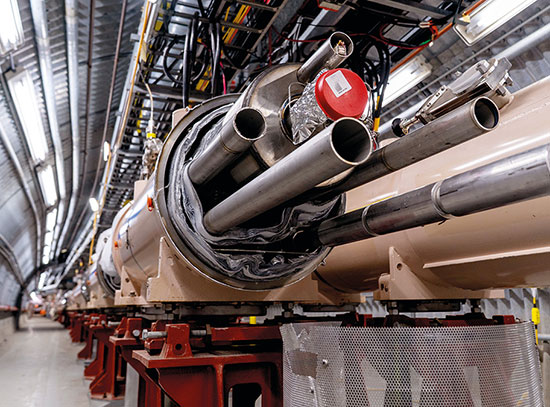
The EIC, a next-generation particle accelerator being built at the U.S. Department of Energy’s (DOE) Brookhaven National Laboratory in partnership with DOE’s Thomas Jefferson National Accelerator Facility (Jefferson Lab), will collide electrons with protons and atomic nuclei to give scientists unseen views of the quarks and gluons that make up nearly all visible matter.
Teacher-nominated students from Nassau and Suffolk County schools participated in “Let’s Smash the Proton!” as part of Brookhaven Lab’s STEM-Prep Summer Institute, a three-week program that introduces high school students to science, technology, engineering, and mathematics (STEM) fields through hands-on activities and interactions with scientific and technical staff across the Lab.
“Through programs like STEM Prep, we’re opening doors for local students to explore groundbreaking research, discover new interests, and envision themselves as part of the Lab’s scientific future,” said Aleida Pérez, manager of Workforce Development & Science Education (WDSE), which oversees STEM Prep.
This summer’s program consisted of three week-long courses devoted to physics, biochemistry, and environmental science technologies.
 enlarge
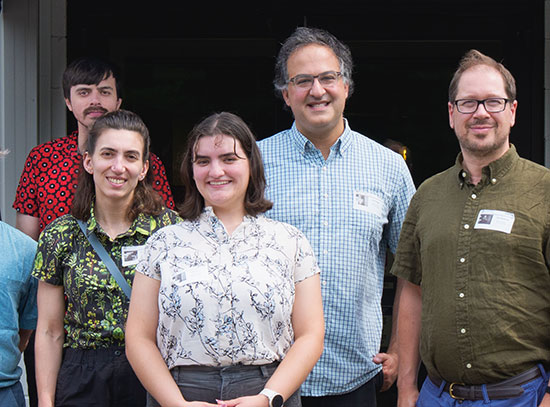
High school students attend a "Let's Smash the Proton!" course during Brookhaven Lab's STEM-Prep Summer Institute, where they explored the science behind the Electron-Ion Collider. (Kevin Coughlin/Brookhaven National Laboratory)
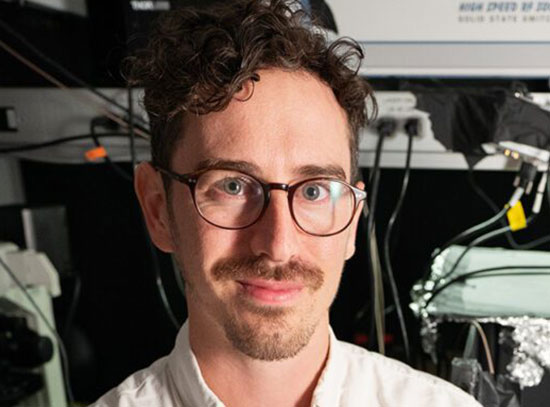
Rithya Kunnawalkam Elayavalli, an assistant professor of physics at Vanderbilt University, and Jennifer James, a graduate student at Vanderbilt University, taught the EIC physics course, which consisted of one week of classroom instruction and hands-on activities.
“It is important for the future of U.S. research leadership and the scientific workforce that we engage with today’s high school students,” Kunnawalkam Elayavalli said. “I want to see local students become scientists and, perhaps one day, collaborators on the EIC.”
Kunnawalkam Elayavalli originated the EIC science course as a postdoc at Yale University. Inspired by its success, Kunnawalkam Elayavalli launched an expanded program at Vanderbilt University in 2022 with the Nashville school district, a collaboration that provides opportunities for rising public high schoolers.
Since bringing the course into the community, Kunnawalkam Elayavalli has seen the number of students participating in the program double.
Introducing students to the nation’s scientific and engineering challenges that lie ahead early on is a win-win.
“The success of the EIC depends on the availability of a well-educated, computationally robust scientific workforce — and it gives younger generations something to aim for,” Kunnawalkam Elayavalli said.
From quantum mechanics to Python
During their physics course, students underwent a crash course in quantum mechanics, field theory, and the Standard Model — the best current theory describing the fundamental particles that make up all matter and the forces that govern how they interact — before introducing them to Python, a programming language scientists can use to perform calculations and visualize data, including particle collision simulations.
 enlarge
Students activate a model of the Electron-Ion Collider during an escape room hands-on activity during the STEM-Prep Summer Institute at Brookhaven National Lab. (Kevin Coughlin/Brookhaven National Laboratory)
The goal was not for students to master particle physics in a few days, Kunnawalkam Elayavalli said, but to give them enough foundational knowledge to begin making connections among complex concepts.
Both teachers and students agree the course is not easy — but are happy to recommend it to their peers.
“Doing coding, trying to solve complicated problems, was hard,” said Jazmin Evans, who completed the course as a freshman at Longwood High School in Middle Island, New York. “But the other students were very intelligent and had a deep knowledge of the science. It was interesting to talk with them.”
Despite the complexity of the subject, Kunnawalkam Elayavalli said the students were up for the challenge.
“The goal of this course is to provide a source of fascination and not focus on complete understanding, which only happens after a lot of coursework,” Kunnawalkam Elayavalli added. “What we hoped for, and saw with the students, is that fascination will naturally lead to curiosity. It is that innate sense of curiosity that drives research progress.”
An escape room with a scientific twist
The students put their new knowledge to use in an EIC-themed “escape room” challenge developed by scientists in Brookhaven Lab’s Physics Department.
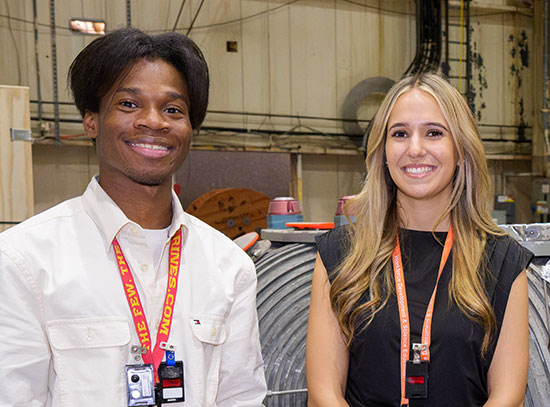
Physicists Jihee Kim, Xiaoxuan Chu, Gabriel Garcia, and Dener De Souza Lemos — early career professionals themselves — devised puzzles tied to the EIC science mission.
“I think the escape room game gave students a chance to experience the logic behind a large scientific project rather than simply learning individual facts about the EIC. Students learned to work as a team.”
— Brookhaven Lab physicist Xiaoxuan Chu
They were joined by other scientific staff and Physics Department college interns in guiding students through the exercise.
The students began in a mock “main control room,” the central location where operators and scientists monitor, operate, and coordinate the accelerator and its supporting systems.
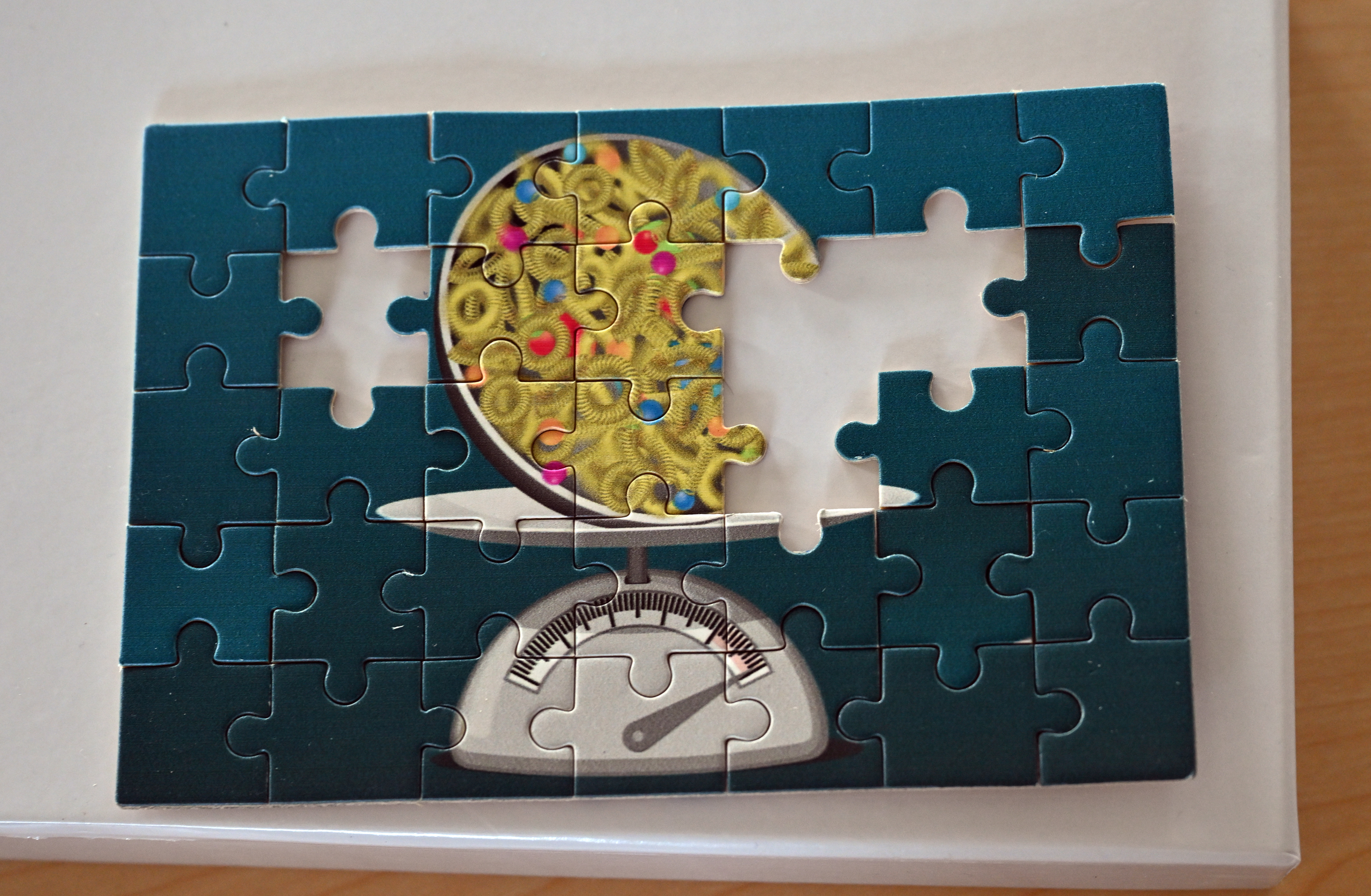
Garcia set the stage by telling them their scientific mission. Suddenly, an alert sounded, and the students raced to solve a series of interconnected challenges. Under the pressure of a blaring alarm, the students searched the room for hidden puzzle pieces, assembling them to reveal the mass of a proton — and a three-digit code that unlocked a box containing their next instructions. Divided into two teams in separate rooms, they tackled crossword puzzles about the EIC's detector, sharing clues and answers to solve challenges neither team could complete alone.
Reunited for the final challenge, students calculated the energy of a particle collision to crack one last code. Inside the final lockbox was a battery that powered a model of the collider. With the flip of a switch, simulated particle collisions lit up the model, signaling a successful escape.
 enlarge
Students assembled a puzzle representing a proton as they explored how the Electron-Ion Collider will help scientists investigate the origin of the proton's mass. (Kevin Coughlin/Brookhaven National Laboratory)
“I think the escape room game gave students a chance to experience the logic behind a large scientific project rather than simply learning individual facts about the EIC,” Chu said. “Students learned to work as a team. At the beginning, they were not very used to collaborating and tended to approach the puzzles individually. Teamwork is essential in nuclear physics, particularly where large scientific projects are carried out through collaboration.”
"Activities like this are a wonderful opportunity to excite the general public about EIC science,” said Elke Aschenauer, co-associate director for EIC experimental program. “They also expand the EIC experimental community by building up a STEM pipeline early.”
Abhay Deshpande, associate laboratory director for Nuclear and Particle Physics and EIC science director, said the students’ enthusiasm stood out.
“The students had very interesting and exciting questions,” Deshpande said. “This is what motivates us.”
Brookhaven National Laboratory is supported by the Office of Science of the U.S. Department of Energy. The Office of Science is the single largest supporter of basic research in the physical sciences in the United States and is working to address some of the most pressing challenges of our time. For more information, visit science.energy.gov.
Follow @BrookhavenLab on social media. Find us on Instagram, LinkedIn, X, and Facebook.
2026-23238 | INT/EXT | Newsroom