The Electron-Ion Collider Is Driving Physics and Training Scientists
How America's upcoming particle collider is shaping the next generation of physics and physicists alike
November 17, 2026
 enlarge
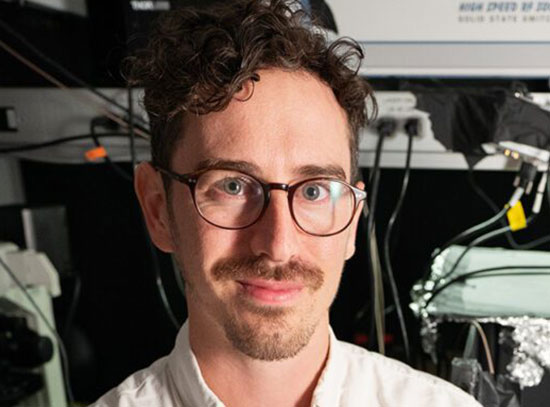
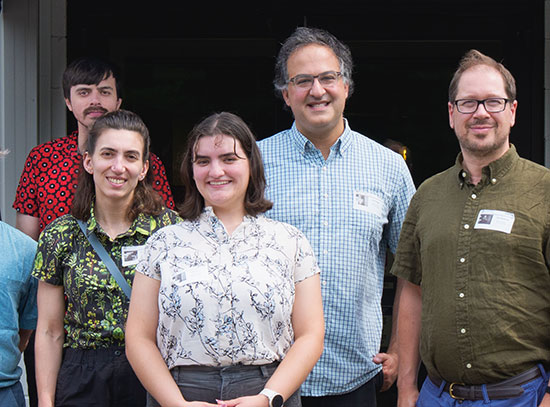
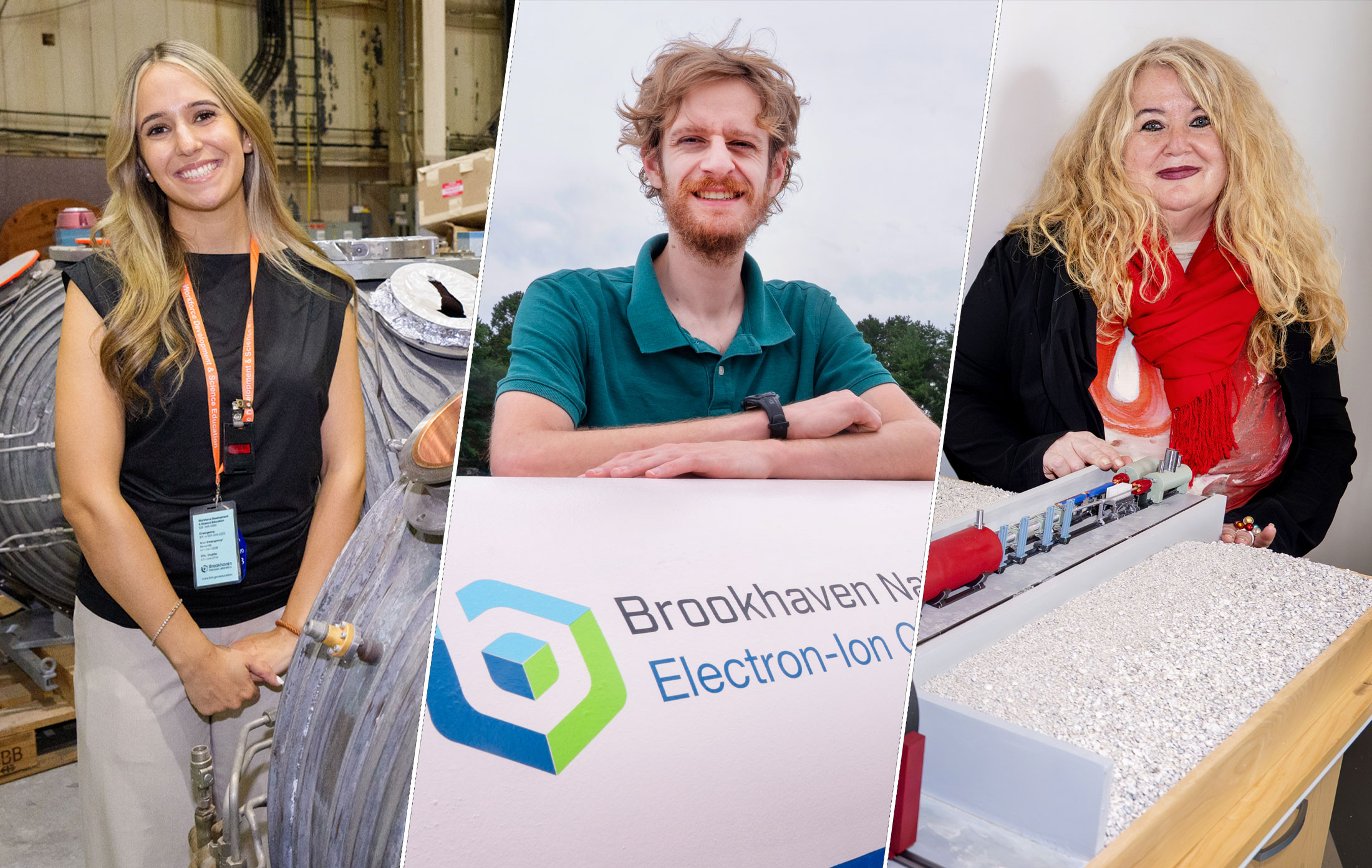
Summer intern Valerie Varkonyi, early-career scientist William Bergan, and co-associate director for the Electron-Ion Collider experimental program Elke Aschenauer represent three generations of EIC collaborators. (Timothy Kuhn/David Rahner/David Rahner/Brookhaven National Laboratory)
The Electron-Ion Collider (EIC) is set to change the field of physics forever. Through a groundbreaking global effort, this first-of-its-kind discovery machine will be constructed at the U.S. Department of Energy’s (DOE) Brookhaven National Laboratory in partnership with DOE’s Thomas Jefferson National Accelerator Facility. The EIC will build on a quarter century of research from the Relativistic Heavy Ion Collider (RHIC), a DOE Office of Science user facility for nuclear physics research at Brookhaven Lab, to help scientists puzzle out the secrets of visible matter in more detail than ever before. The collider is about a decade away from uncovering mysteries about the subatomic particles that make up everything from butterflies to faraway galaxies, but the project has already started training the next generation of scientists, technicians, and engineers.
Deciphering the strongest force in the universe
 enlarge
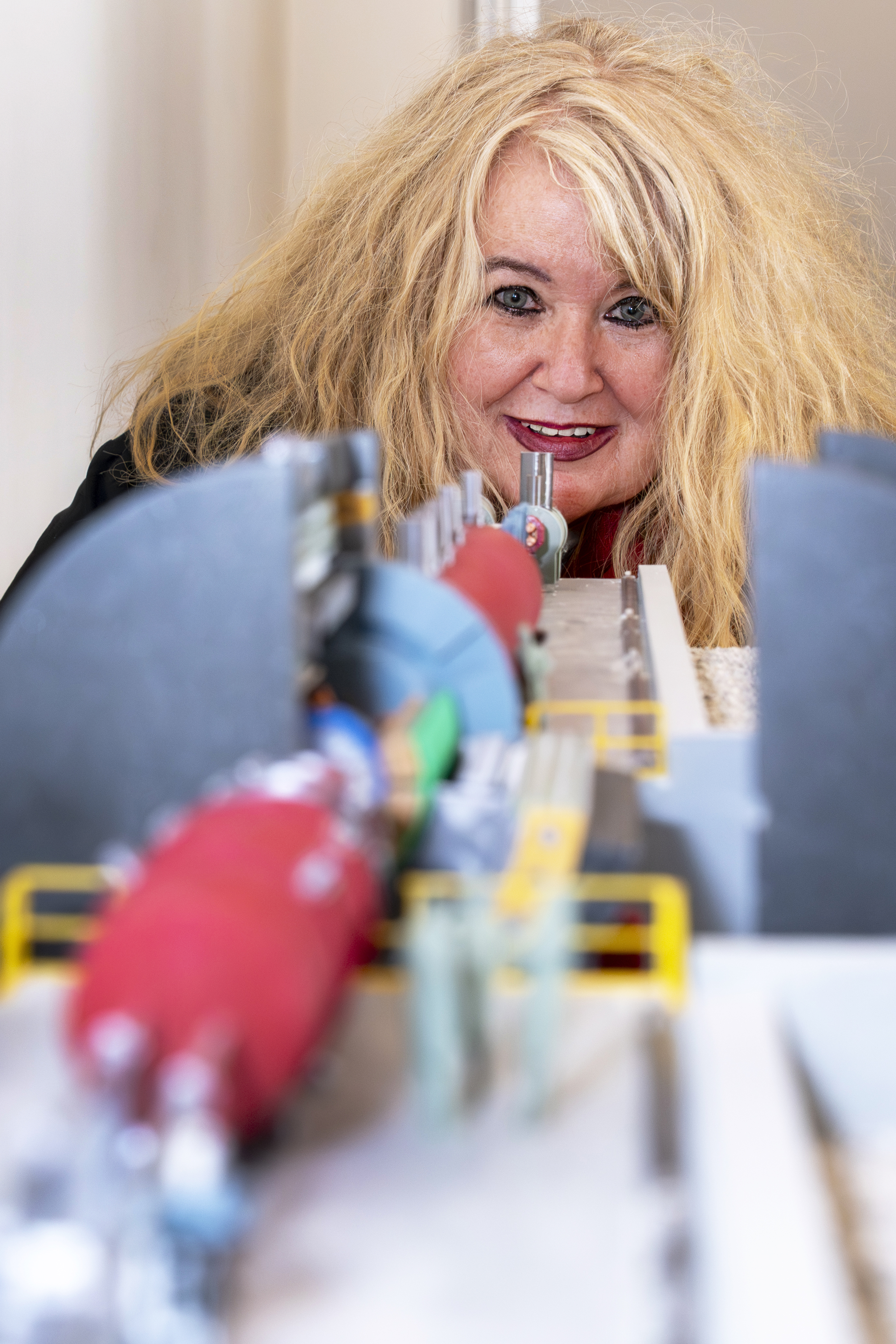
Elke Aschenauer, co-associate director for the Electron-Ion Collider (EIC) experimental program at Brookhaven Lab, looks at a model of ePIC, the EIC's future particle detector. Electron and ion beams will collide inside ePIC, and its many layers of sensors will pick up the resulting data for scientists to analyze. (David Rahner/Brookhaven National Laboratory)
The EIC’s investigations of matter at the smallest possible scale will advance physics in a big way. The EIC’s scientific goals expand on the results of RHIC, which ended its operations after a bittersweet last run in February of this year. RHIC smashed ions together at nearly the speed of light to recreate conditions that existed just after the Big Bang, enabling scientists to learn about the building blocks of matter in their initial state. For instance, RHIC data disproved the theory that the early-universe mess of free particles, called the quark-gluon plasma (QGP), would behave like a gas. Instead, researchers learned that the QGP is a perfect liquid with almost no viscosity.
The EIC is the next step in this journey, literally building off RHIC’s infrastructure and leading to new discoveries. The collider will use high-energy electrons as a precision probe to look inside the proton and enable scientists to come to a deeper, more detailed understanding of visible matter.
Using electrons to look at small objects has become standard practice in scientific research. An electron microscope, for example, sends beams of electrons through a material to see how individual atoms are arranged. At the EIC, scientists will take electrons’ potential to the extreme by colliding polarized electrons with polarized ions. These collisions will cause electrons to emit light particles, called photons, that reveal subatomic structures more than 100 million times smaller than the atom.
Particle collisions are messy. Smashing ions together produces a firework-like spray of cris-crossing tracks left by thousands of particles streaming out of those collisions. This approach provides ample data about the miniscule pieces that make up the universe but loses information about how those particles were originally arranged and how they interact. The EIC will preserve those details.
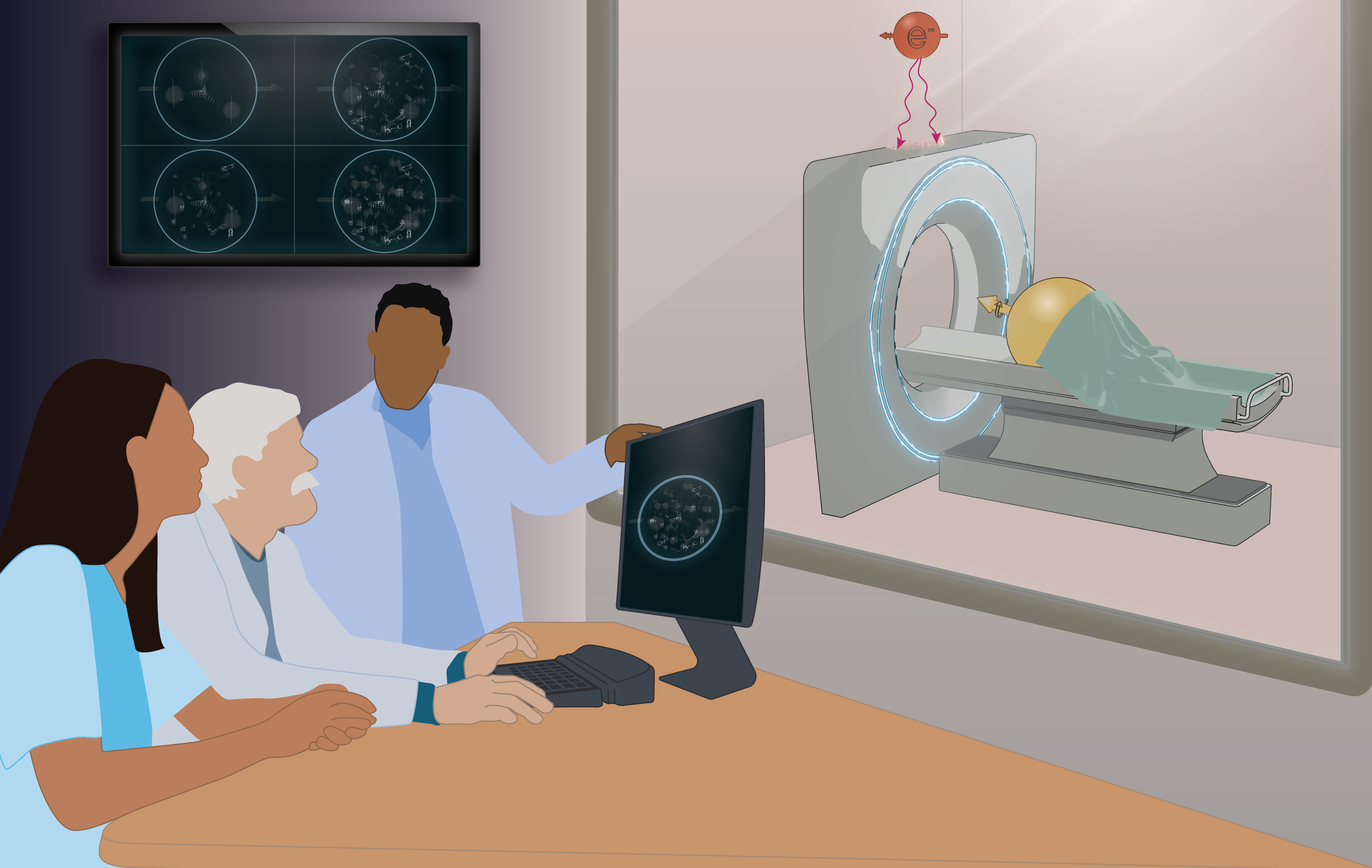
The EIC will function like a CT scan for atoms. The experiment’s detector, called ePIC, will detect particles created in the electron-ion collisions to construct images from various angles. Scientists can then recombine those images to visualize the proton’s internal structure.
Cleanly slicing up the proton will give physicists an unprecedented view of its even-smaller building blocks, quarks and gluons. Gluons are the particles that carry the nuclear strong force, the strongest force in the universe that acts as the “glue” holding the nucleus together. RHIC taught scientists a lot about the individual properties of quarks and gluons but there are still some unsolved mysteries about how they all fit together.
“The Electron-Ion Collider will provide answers to fundamental questions that have stumped physicists for decades, including the origins of the proton’s mass and spin,” said Elke-Caroline Aschenauer, EIC co-associate director for the experimental program. “We know a great deal about the proton already — but almost all of what we know comes from one-dimensional measurements. The EIC will enable us to get a full, 3D reconstruction of the proton’s interior.”
 enlarge
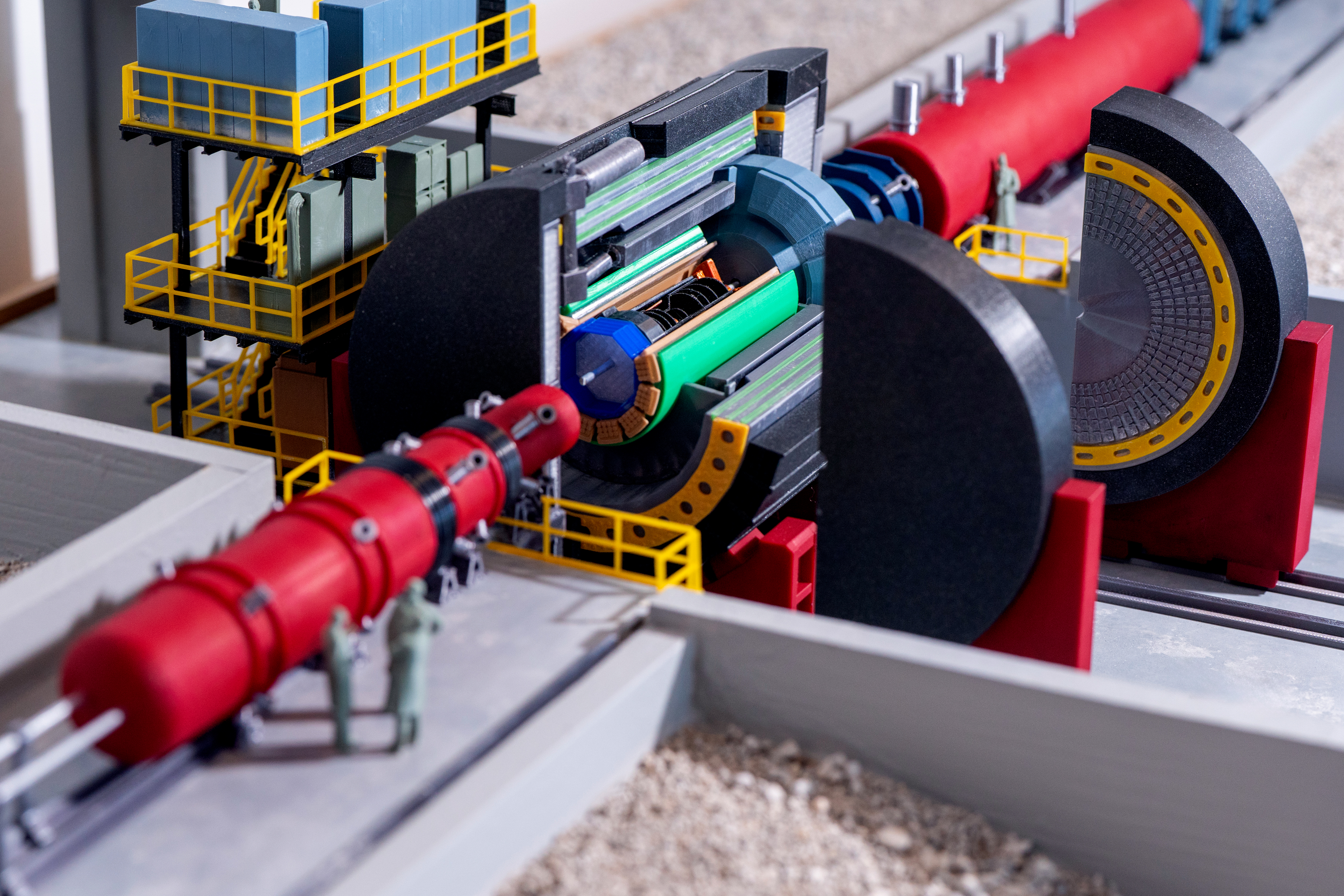
This 3D-printed model in the lobby of the Electron-Ion Collider (EIC) building at Brookhaven Lab represents ePIC, the EIC's future particle detector. The detector will surround the collision point of electron and ion beams so that its many layers of sensors can collect data for scientists to analyze. (David Rahner/Brookhaven National Laboratory)
About 99% of the proton’s mass remains unexplained, and the origin of a large portion of its spin is similarly unclear. The quarks that make up the proton have their own mass and spin, but not nearly enough to explain the total mass and spin of the proton.
Additionally, gluons themselves are very strange particles. Unlike the photon — another force-carrier particle that governs electromagnetism instead of the strong force — a gluon can interact with itself and other gluons. Quantum Chromodynamics (QCD), the overarching theory describing the interactions of quarks and gluons, states that gluons can split to create two gluons. As this splitting occurs, more and more gluons appear in the proton.
But what is the limit? The proton has a finite size, so there simply cannot be infinite gluons. QCD also predicts that the gluons start recombining when space gets tight. The hope is that the EIC can show scientists when, why, and how this recombination happens. Measurements from RHIC may have already hinted at this moment of recombination, but a hint isn’t enough.
“When you measure something, you have to be sure that what you find is not a result of how you’ve measured it but is instead really a property of what you’re probing,” Aschenauer said. “The EIC will give us far more certainty of the physics that RHIC has hinted toward.”
Finally, researchers are also curious about how the quarks and gluons are arranged inside the proton, and how these properties change when the proton is in a bound state — inside the nucleus — versus when it is free. Answering these questions will help complete scientists’ understanding of the strongest force in nature.
With the potential to complete the ongoing puzzle of quarks and gluons, the EIC will be a game-changing facility for fundamental physics.
 enlarge
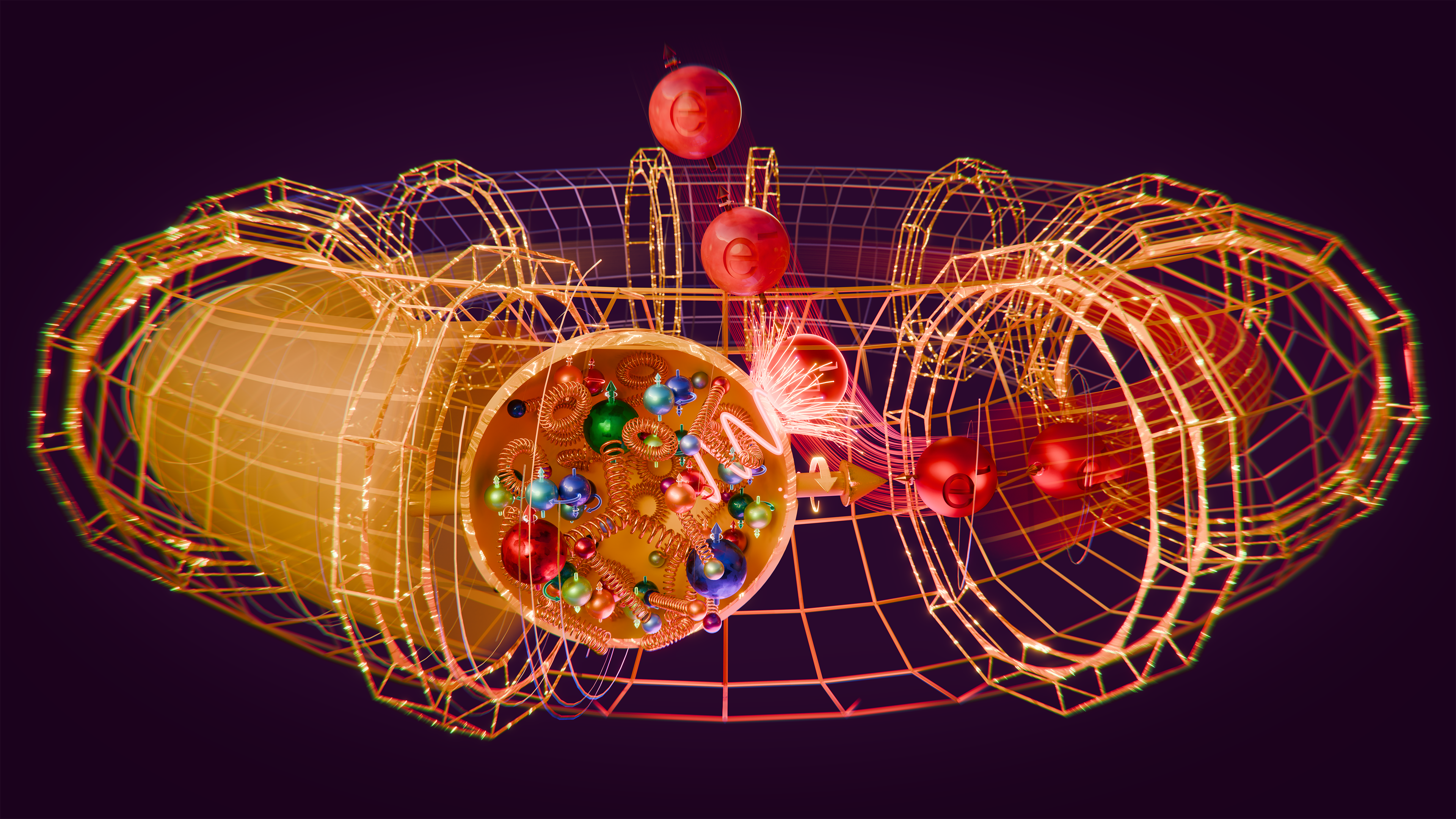
This is an artist's rendition of an electron-proton collision inside the Electron-Ion Collider at Brookhaven Lab. Spin-aligned electrons collide with a proton to reveal information about the arrangement and behavior of the quarks and gluons inside. (Valerie Lentz/Brookhaven National Laboratory)
Passing on the torch
Building a next-generation machine like the EIC from the ground up is an extraordinary effort. But to the scientists, engineers, and technicians who will make it happen, the challenge is the best part.
“If it is both scientifically and technically an extremely challenging project, of course it is extremely exciting to work on it,” Aschenauer said. Part of the challenge — and the thrill — is the sheer novelty of the project. Many of the new technologies being developed will require an immense amount of creativity and trial-and-error. But with that toil comes the reward of being able to see a project through potentially its whole lifetime. “It’s very rare to do this, because projects like the EIC are so long that you very often don’t have the chance to start from the beginning and see it to the end,” she said.
 enlarge
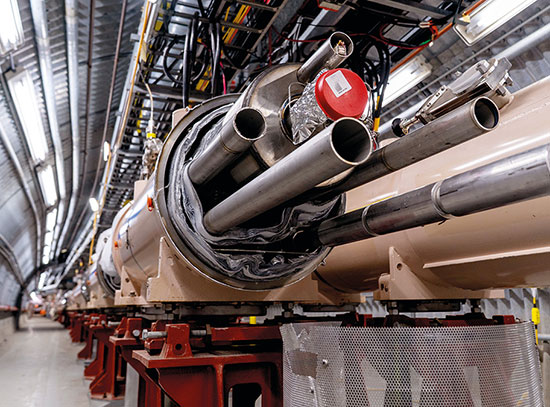
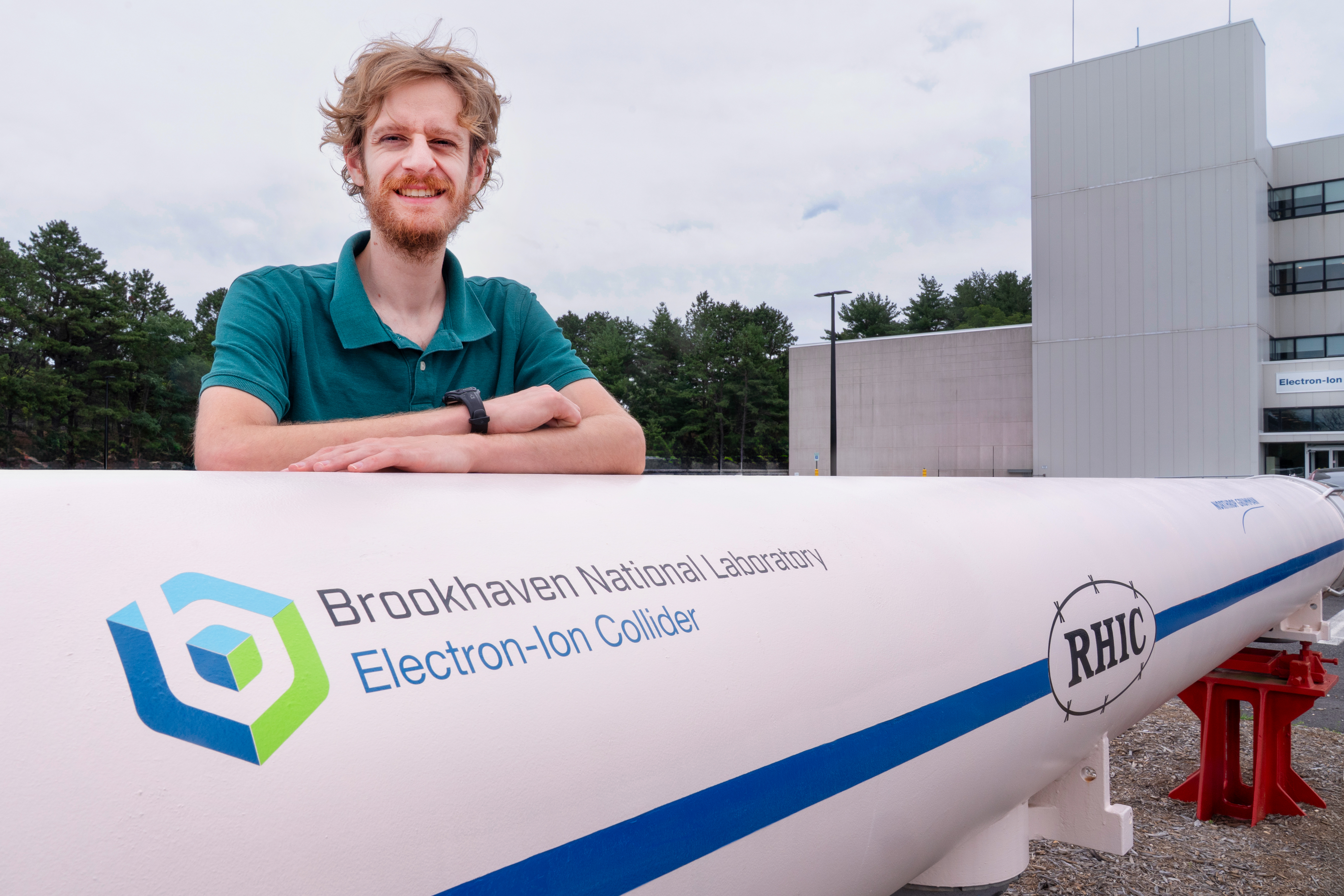
Will Bergan, an early-career accelerator scientist at Brookhaven Lab, leans on a cryostat outside of the Electron-Ion Collider (EIC) building where he works. Cryostats like these — and the magnets inside of them — were originally used for the Relativistic Heavy Ion Collider and will be repurposed for the EIC. (David Rahner/Brookhaven National Laboratory)
That is what makes the beginnings of the EIC so special. As the project moves into full swing and ushers in the next era of physics research, it is also creating a platform for multiple generations to come together for a once-in-a-lifetime exchange of ideas and expertise.
Decades ago, many young researchers began their careers during RHIC’s construction, contributing to every stage of the collider’s development and witnessing every challenge and triumph along the way. Now, some of them are passing their expertise on to early career staff who will follow a similar career path with the EIC: helping design and develop a new collider, carrying out experiments at that very facility, and seeing the discoveries those efforts lead to.
“It’s exciting, starting your career right as the project itself is also starting up,” said William Bergan, an early-career accelerator physicist at the EIC. He is helping to develop an additional machine to accelerate electrons, called a rapid cycling synchrotron, and working on a simulation to predict the collision rate in the first few years of operation. “I count myself extremely fortunate to be able to learn from the folks here who have a lot of experience with running RHIC and other machines.”
In exchange for the career opportunities the EIC will provide, early career scientists bring fresh perspectives that are critically important to developing the EIC. The machine will be the first of its kind, incorporating eight individual world’s-first technologies.
For example, the Lab needs to construct a new electron accelerator that can preserve the polarization of electrons. Essentially, the electrons going into the EIC need all of their spins pointing in the same direction. This polarization lasts a limited amount of time, so there also needs to be a mechanism that can refresh the de-polarized electron bunches with polarized ones every 20 minutes.
This has never been done before, so “it’s a fun problem,” Bergan said.
 enlarge
An anthropomorphized proton receives a CT scan as scientists — including a mentor and their student — look on. This graphic illustrates the analogy of the Electron-Ion Collider acting like a CT scan for ions, taking two-dimensional image "slices" for scientists to reconstruct into a 3D picture of the proton's internal structure of quarks and gluons. (Valerie Lentz/Brookhaven National Laboratory)
While it’s exciting to be involved in the EIC from its very beginnings, it also adds a layer of pressure.
“The whole time I’m thinking, ‘okay, I better get this right,’ because there’s a good chance that I’m going to be in the control room 10 years from now, kicking myself if I do it wrong,” Bergan said.
Until then, Bergan and the Lab’s other accelerator physicists have countless ways to prepare for the EIC. Any given workday can consist of theoretical calculations, running simulations, or doing experimental work. That variety is where Bergan thrives, and what initially drew him to the EIC.
“Brookhaven is doing interesting physics and accelerator science that isn’t being done anywhere else,” he said. “There’s a lot of expertise here, and it’s good to share that with as many people as possible to drive the field forward.”
Inspiring future experts
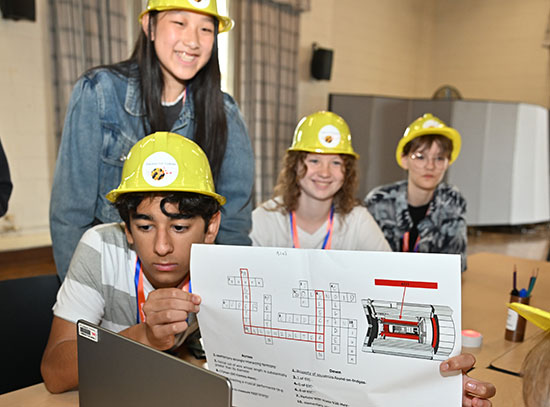
Students are an integral part of this younger generation of physicists, technicians, and engineers. Year-round, but especially during the summer months, hundreds of student interns get involved in various research projects at the Lab, including the EIC. They come from a wide variety of backgrounds and experiences, so they can contribute fresh perspectives and countless new ideas to the project. But most of all, their presence is vital to the longevity and survival of the collider.
 enlarge
Prince-David Malendele and his summer intern Valerie Varkonyi stand next to spares of the 197-megahertz radiofrequency cavities taken out of the Relativistic Heavy Ion Collider tunnel. Valerie is helping to develop parts of these cavities for the Electron-Ion Collider, which are used to accelerate the particles in the collider. (Timothy Kuhn/Brookhaven National Laboratory)
“They’re absolutely necessary,” Bergan said. “This project will be around for decades, and we need to train people who will be able to come in and do improvements on the accelerator and help get it running to its full capabilities. If we don’t do that, then we’re not going to have the expert workforce we need in 10 or 20 years.”
At the same time, getting involved in the EIC is also a valuable experience for the students and their careers. It’s an irreplaceable opportunity that can teach hands-on skills that can be hard to come by in a traditional educational setting.
“Working on the EIC will teach them how to write scientific code, for example. But most importantly, the EIC will teach them how to think deeply about problems that will be applicable wherever they end up going,” Bergan said.
EIC summer intern Valerie Varkonyi, an undergraduate student studying mechanical engineering at Stony Brook University, confirmed that the ability to solve problems independently is one of the most valuable skills she’ll be taking away from her experience.
“My mentor always pushes me to create and find solutions on my own and learn how to play around with the numbers. And that’s something that you don’t exactly learn in school,” Varkonyi said.
Varkonyi, who is helping to develop part of a radiofrequency cavity — a component of the machine that accelerates the particles — has also been learning various technical skills, including how to confidently use a variety of computer programs, that are useful for countless different fields of research and industry. By sitting in on meetings and interacting with her mentor and his colleagues, Varkonyi also gets to see all the little details that go into a monumental project like the EIC.
“The most exciting part is getting a glimpse at how much goes into just one miniscule part of this operation,” Varkonyi said. “Everyone is working on something different, but there’s still this great connection of everyone striving towards the same goal.”
Summer interns Robert Desjardins, Jackeline Antelo, Valerie Varkonyi, and Chanpisey Ung talk about their experience being involved in the Electron-Ion Collider project at Brookhaven Lab. Besides being excited about contributing to such a monumental project in its early days, they say they are also grateful for the valuable skills they get to take away from their research. (Timothy Kuhn/Brookhaven National Laboratory)
Varkonyi says it is especially inspiring to be surrounded by so many young scientists who are just starting their careers at the EIC. Their presence gives her and her peers the ability to imagine themselves at the Lab in the future. “It makes me think, ‘Wow, anyone can do this. We can all do it.’”
Inspiring students and early career scientists to contribute toward monumental research endeavors like the EIC is exactly what these projects, and the future of physics and accelerator science, need. Completing the EIC and realizing its science goals will require contributions from generations of scientists, engineers, and technicians across Brookhaven Lab and the world. There are more than 300 institutions from 40 different countries involved in the EIC’s global collaboration.
“What’s really fantastic about big projects like the EIC is that you work and make friends with people from all around the world,” Aschenauer said. “It’s a wonderful opportunity to broaden your horizons.”
As EIC contributors share their knowledge across generations and oceans, they’re driving physics forward.
Brookhaven National Laboratory is supported by the Office of Science of the U.S. Department of Energy. The Office of Science is the single largest supporter of basic research in the physical sciences in the United States and is working to address some of the most pressing challenges of our time. For more information, visit science.energy.gov.
Follow @BrookhavenLab on social media. Find us on Instagram, LinkedIn, X, and Facebook
2026-23215 | INT/EXT | Newsroom