HPC Unites: Brookhaven Lab Heads to Chicago for SC26
November 13, 2026
 enlarge
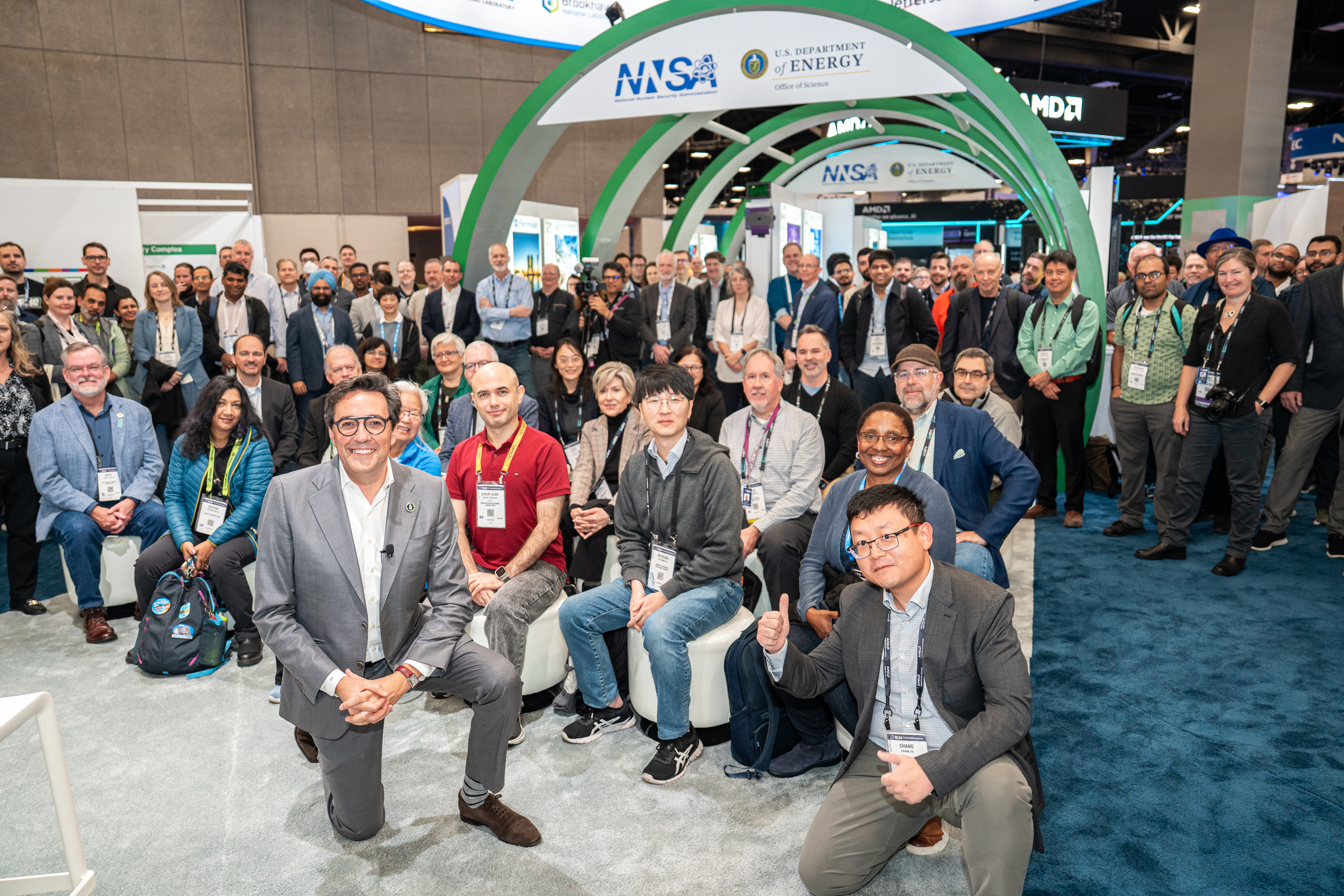
Special events, including last year's "fireside chat" with Department of Energy (DOE) Under Secretary for Science Darío Gil (pictured center left), draw many to the DOE booth at SC, including Brookhaven Lab CDS Associate Laboratory Director, Nicholas D'Imperio, and CDS Deputy Director, Adolfy Hoisie, who are among the crowd. (Lillie Elliot/SC Photography)
This month, Chicago’s scenic lakefront becomes the nexus for the people and technologies connecting science to discovery as the 38th annual International Conference for High Performance Computing, Networking, Storage and Analysis, better known as SC26, convenes at McCormick Place on November 15-20, 2026.
As part of this annual convergence of global researchers, engineers, and industry leaders, scientists from the U.S. Department of Energy’s (DOE) Brookhaven National Laboratory, including its Computing and Data Sciences directorate, will be on hand to showcase their cutting-edge computing research.
These contributions range from Super Intelligence (SI) efforts supported by DOE’s Genesis Mission to tools and methods for designing more efficient computing systems. Featured talks and demonstrations with Brookhaven Lab researchers also will be hosted at DOE Booth 4829 on the exhibition floor.
The following highlights Brookhaven Lab’s research and collaborations at SC26. All times are Central Standard Time (CST).
Brookhaven Lab@SC26
Sunday, Nov. 15, 2026
Workshops
Fine-Tuning Foundation Models for Micro-CT Image Segmentation Using HPC Platforms
Session: XLOOP 2026: The 8th Annual Workshop on Extreme-Scale Experiment-in-the-Loop Computing
9:35 a.m. – 9:50 a.m. | Location: W179b
Brookhaven Lab co-authors: Daniel Allan and Nghia Vo
The team adapts foundation models to identify structures in three-dimensional X-ray images. The work combines specialized training methods with large computing resources to support near-real-time analysis of synchrotron datasets.
 enlarge
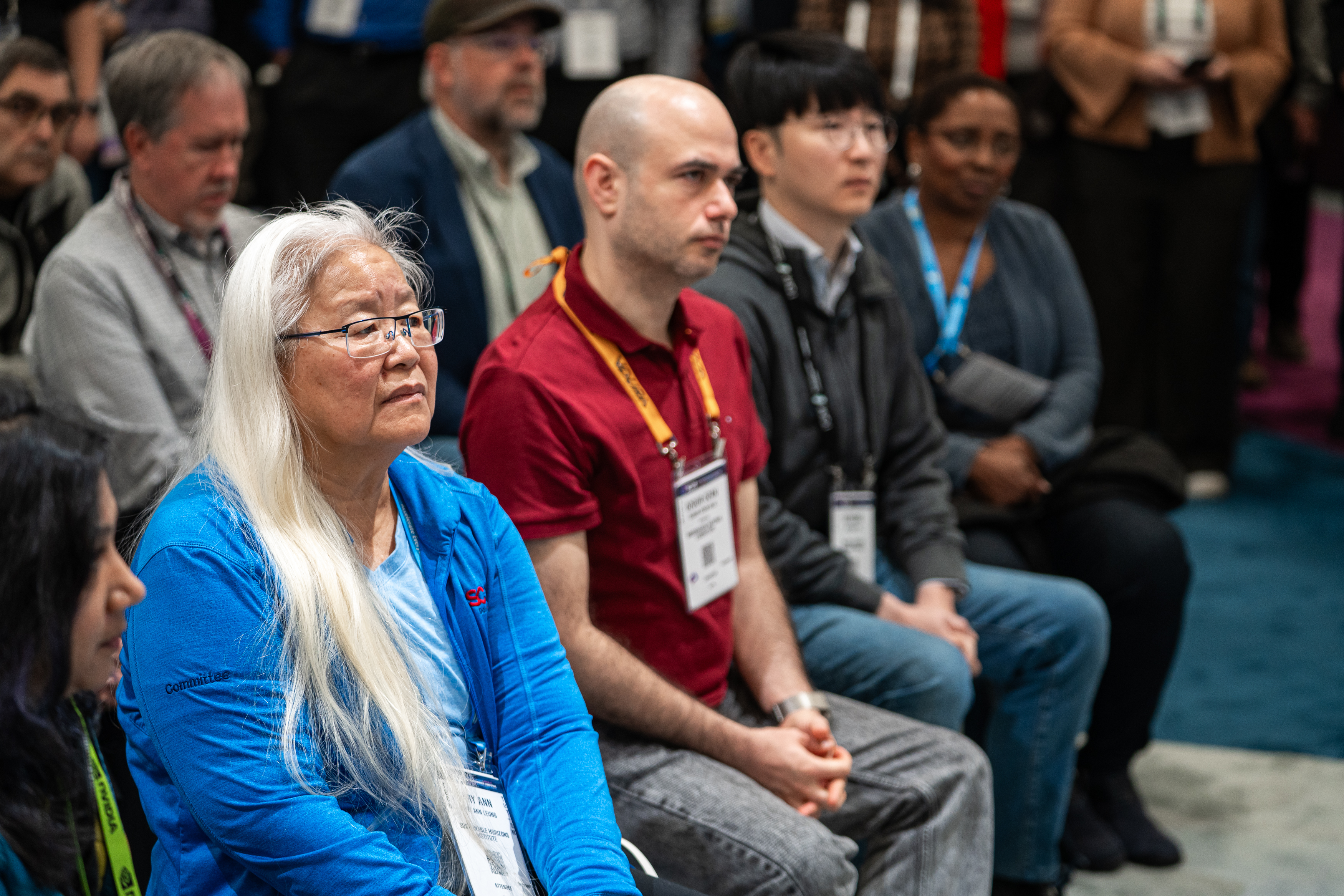
(Second from left): Ozgur O. Kilic, a computational research scientist with the Computing and Data Sciences directorate, watches Dr. Darío Gil's presentation in the DOE booth at SC. (Lillie Elliot/SC Photography)
LightshowAI-Agent: An MCP-Based Agentic Framework for Real-Time and Reproducible X-Ray Absorption Spectral Analysis at Scientific User Facilities
Session: AI4S: 8th Workshop on Artificial Intelligence and Machine Learning for Scientific Applications
11:30 a.m. – 11:50 a.m. | Location: W183a
Brookhaven Lab co-authors: Ozgur O. Kilic, Sairam Sri Vatsavai, Anton Yanaky, Xiaohui Qu, Christopher Kelly, Chuntian Cao, Kari Barry, Daniel Allan, Lu Ma, Stuart Wilkins, Sara E. Mason, Meifeng Lin, Adolfy Hoisie, and Deyu Lu
LightshowAI-Agent coordinates the steps needed to interpret X-ray absorption measurements, connecting scientific databases, predictive models, and analysis records. The team will demonstrate the approach using data from the National Synchrotron Light Source II (NSLS-II), a DOE Office of Science User Facility at Brookhaven Lab.
Emblase: Using Tiled as an AI-Ready Data Access Service for Live Scientific Workflows
Session: XLOOP 2026: The 8th Annual Workshop on Extreme-Scale Experiment-in-the-Loop Computing
11:40 a.m. –11:55 a.m. | Location: W179b
Brookhaven Lab co-authors: Venkateswaran Shekar, Yevgen Matviychuk, Eliot Gann, and Daniel Allan
Emblase connects live experimental data with SI analysis and scientist-facing tools. Developed for an NSLS-II scattering workflow, it uses American Science Cloud (AmSC) computing resources, created under DOE’s Genesis Mission, while keeping data and analysis results accessible through Tiled, a common scientific data interface.
DMSim: Configurable Data Management Simulation Framework for Scientific Computing Grid
Session: PMBS26: The 17th International Workshop on Performance Modeling, Benchmarking, and Simulation of High Performance Computer Systems
3:50 p.m. – 4:10 p.m. | Location: W181a
Brookhaven Lab co-authors: Kuan-Chieh Hsu, Raees Ahmad Khan, Sairam Sri Vatsavai, Tasnuva Chowdhury, Ozgur O. Kilic, Sankha Dutta, David Park, Yihui Ren, Shinjae Yoo, Alexei Klimentov, and Adolfy Hoisie
DMSim allows researchers to test how data placement and transfer policies affect distributed scientific computing. Historical records from the Worldwide LHC Computing Grid help evaluate the framework’s treatment of data movement and delays.
Monday, Nov. 16, 2026
Workshops
HOLOS: A Gradient-Descent-Based Design-Space Exploration Framework for Hierarchical AI Accelerator Systems
Session: AI on HPC: Performance Engineering, Challenges and Opportunities
4:48 p.m. – 5 p.m. | Location: W183b
Brookhaven Lab co-authors: Sairam Sri Vatsavai, Lingda Li, and Adolfy Hoisie
HOLOS helps researchers explore hardware and software choices for accelerator systems. By modeling performance, area, and energy together, the framework narrows the search for efficient designs for large language models.
Tuesday, Nov. 17, 2026
Research Posters | 10 a.m. – 5 p.m. | Location: Skyline Ballroom North Pre-Function
A-OASIS: Building an AI-Coupled Atmosphere-Ocean Foundation Model
Brookhaven Lab co-authors: Nia Maheshwari, Guang Zhao, and Wei Xu
A-OASIS explores whether one foundation model can learn interactions among the atmosphere, ocean, and land. Initial results establish training feasibility, while validation of its forecasting capability remains a next step.
Characterizing GPU Performance in AI Inference with Power Metrics
Brookhaven Lab co-authors: Mohammad Atif, Sankha Dutta, and Meifeng Lin
The study examines how GPU hardware and software choices affect the speed and energy use of large language model inference. Its measurements can explain trade-offs between higher throughput and lower power consumption.
Wednesday, Nov. 18, 2026
DOE Featured Speaker
Unifying Experimental Facilities and Heterogeneous Computing via the American Science Cloud
10:45 a.m. | Location: DOE Booth 4829
Speaker: Meifeng Lin, Brookhaven National Laboratory
Lin will discuss Brookhaven Lab’s work connecting experimental facilities with computing through AmSC, part of DOE’s Genesis Mission. Video demonstrations will illustrate approaches to autonomous experimentation and coordinated scientific workflows.
Demonstrations
AmSC Scientific User Facility Infrastructure Partnership: Cross-Facility Data Movement and Analysis for Nuclear Physics Experiments
1 p.m. | Location: DOE Booth 4829, Demonstration Station 1
Host: Mohammad Atif, Brookhaven National Laboratory
A streaming demonstration connects nuclear physics data with distributed computing, exploring analysis without intermediate storage.
SwarmSlicer: AI-Driven Design of Sensor-Network-GPU Slicing in 6G Wireless Networks for Distributed Autonomous Cyber-physical Testbeds
3 p.m. | Location: DOE Booth 4829, Demonstration Station 1
Host: Ozgur O. Kilic, Brookhaven National Laboratory
SwarmSlicer demonstrates isolated paths from sensors to computing resources through an experimental 6G wireless network.
American Science Cloud Scientific User Facilities Infrastructure Partnership
5 p.m. | Location: DOE Booth 4829, Demonstration Station 1
Brookhaven Lab team members include Daniel Allan, Meifeng Lin, and Yevgen Matviychuk (with collaborators from seven DOE National Laboratories).
The demonstration links experimental facilities with shared computing, data, and SI services for scientific workflows.
Brookhaven National Laboratory is supported by the Office of Science of the U.S. Department of Energy. The Office of Science is the single largest supporter of basic research in the physical sciences in the United States and is working to address some of the most pressing challenges of our time. For more information, visit science.energy.gov.
Follow @BrookhavenLab on social media. Find us on Instagram, LinkedIn, X, and Facebook.
2026-23273 | INT/EXT | Newsroom