


Hybrid Quantum Processors: A Roadmap for Combining Qubits and Oscillators
C2QA researchers developed a quantum processor framework that combines qubits with oscillators — and links hardware capabilities to software
May 28, 2026
 enlarge
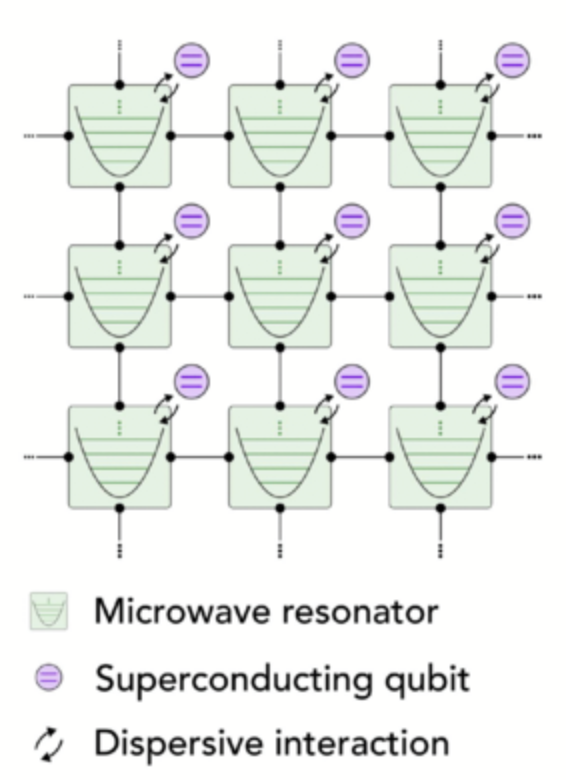
A schematic hybrid processor made of superconducting microwave resonators coupled to individual qubits. Adjacent microwave resonators are coupled via microwave-controlled beam splitters.
Scientific Achievement
C2QA developed a detailed framework for hybrid quantum processors combining qubits with quantum oscillators, defining instruction set architectures and abstract machine models for co-design of hardware and software in superconducting, trapped-ion, and neutral-atom platforms.
Significance and Impact
Hybrid oscillator-qubit processors are a powerful new computing paradigm, with advantages for simulations in chemistry, materials science, and field theory. This work charts a roadmap to develop and benchmark this approach to large-scale quantum computation.
Research Details
- Developed bosonic quantum error correction codes and logical instruction sets for hybrid oscillator-qubit hardware
- Substantial reduction in circuit complexity compared to qubit-only hardware for bosonic simulations
- Extended quantum signal processing to hybrid systems, with applications in quantum Fourier transform and lattice gauge theory
Collaborating Institutions
- Massachusetts Institute of Technology
- Yale University
- Brookhaven National Laboratory
- University of Toronto
- Pacific Northwest National Laboratory
Publication
Liu Y., Singh S., Smith K.C., Crane E., Martyn J.M., Eickbusch A., Schuckert A., Li R.D., Sinanan-Singh J., Soley M.B., Tsunoda T., Chuang I.L., Wiebe N., and Girvin S.M., "Hybrid Oscillator-Qubit Quantum Processors: Instruction Set Architectures, Abstract Machine Models, and Applications", PRX Quantum 7, 010201 (2026).
https://doi.org/10.1103/4rf7-9tfx
Acknowledgements
This research was funded by the U.S. Department of Energy, Office of Science, National Quantum Information Science Research Centers, Co-design Center for Quantum Advantage (C2QA) under Contract No. DE-SC0012704 (Basic Energy Sciences, PNNL FWP 76274). C2QA led this research. S.S. and S.G. acknowledge support by the Army Research Office (ARO) under Grant No. W911NF-23-1-0051. J.S.-S. was supported in part by the Army Research Office under the CVQC project W911NF-17-1-0481. J.S.-S. and Y.L. were supported in part by NTT Research. Y.L. acknowledges startup funding support from North Carolina State University. A.S. acknowledges funding from the U.S. Department of Energy, Office of Science, National Quantum Information Science Research Centers, and Quantum Systems Accelerator. J.M.M. acknowledges support from the National Science Foundation Graduate Research Fellowship under Grant No. 2141064. M.B.S. was supported by the Yale Quantum Institute Postdoctoral Fellowship and the Office of the Vice Chancellor for Research and Graduate Education at the University of Wisconsin-Madison with funding from the Wisconsin Alumni Research Foundation. I.L.C. was supported in part by the NSF Frontier Center for Ultracold Atoms (Grant No. PHY-2317134). The authors acknowledge helpful discussions with Jacob Curtis, Michael DeMarco, Shruti Puri, Yongshan Ding, Robert Schoelkopf, Cindy Regal, Baptiste Royer, Timothy Stavenger, and Ang Li, and thank Luke Bell for helpful discussions and verification of some of the key equations presented in the compilation section.
2026-22976 | INT/EXT | Newsroom