


Radiation Bursts Reveal Limits of Gap Engineering
A promising technique for mitigating radiation-induced errors in quantum chips wasn't as effective as expected
July 20, 2026
 enlarge
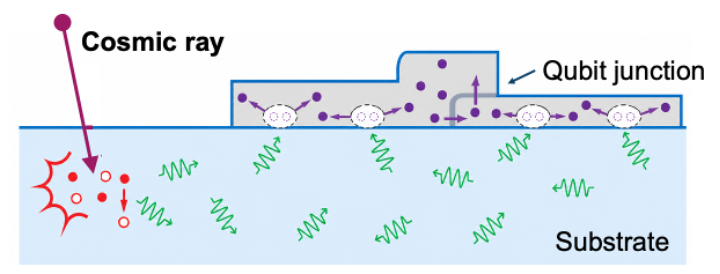
High-energy impacts generate phonons that create quasiparticles, which increase qubit relaxation by tunneling across the junction.
Scientific Achievement
C2QA researchers at Yale found that superconducting gap engineering reduces radiation-induced quasiparticle bursts in transmon qubits by only 5x, rather than the expected 10,000x. The team identified slow phonon escape from the substrate as a key limiting factor.
Significance and Impact
Ionizing radiation creates correlated errors across multiple qubits, threatening large-scale quantum error correction. This work identifies larger superconducting gap differences and improved substrate thermalization as practical strategies for protecting future quantum processors.
Research Details
- Substrate heats to ~90 mK during radiation bursts
- Substrate stays hot for ~6 msec, 10x longer than the quasiparticle recombination time
Collaborating Institutions
- Yale University
Publication
Nho, H., Connolly, T., Kurilovich, P. D., Diamond, S., Bøttcher, C. G. L., Glazman, L. I., and Devoret, M. H.
Recovery Dynamics of a Gap-Engineered Transmon after a Quasiparticle Burst
Physical Review Letters 136, 050601 (2026).
DOI: 10.1103/ql6q-wfpn
Acknowledgements
This research was sponsored by the Army Research Office (ARO) under Grants No. W911NF-22-1-0053 and No. W911NF-23-1-0051; by DARPA under Grant No. HR0011-24-2-0346; and by the U.S. Department of Energy (DOE), Office of Science, National Quantum Information Science Research Centers, Co-design Center for Quantum Advantage (C2QA), under Contract No. DE-SC0012704. Fabrication facilities were supported by the Yale Institute for Nanoscience and Quantum Engineering (YINQE) and the Yale University Cleanroom.
2026-23067 | INT/EXT | Newsroom