


Toward Practical Quantum Simulation of Particle Scattering
C2QA researchers developed quantum algorithms for simulations considered too computationally demanding for classical computers
May 28, 2026
 enlarge
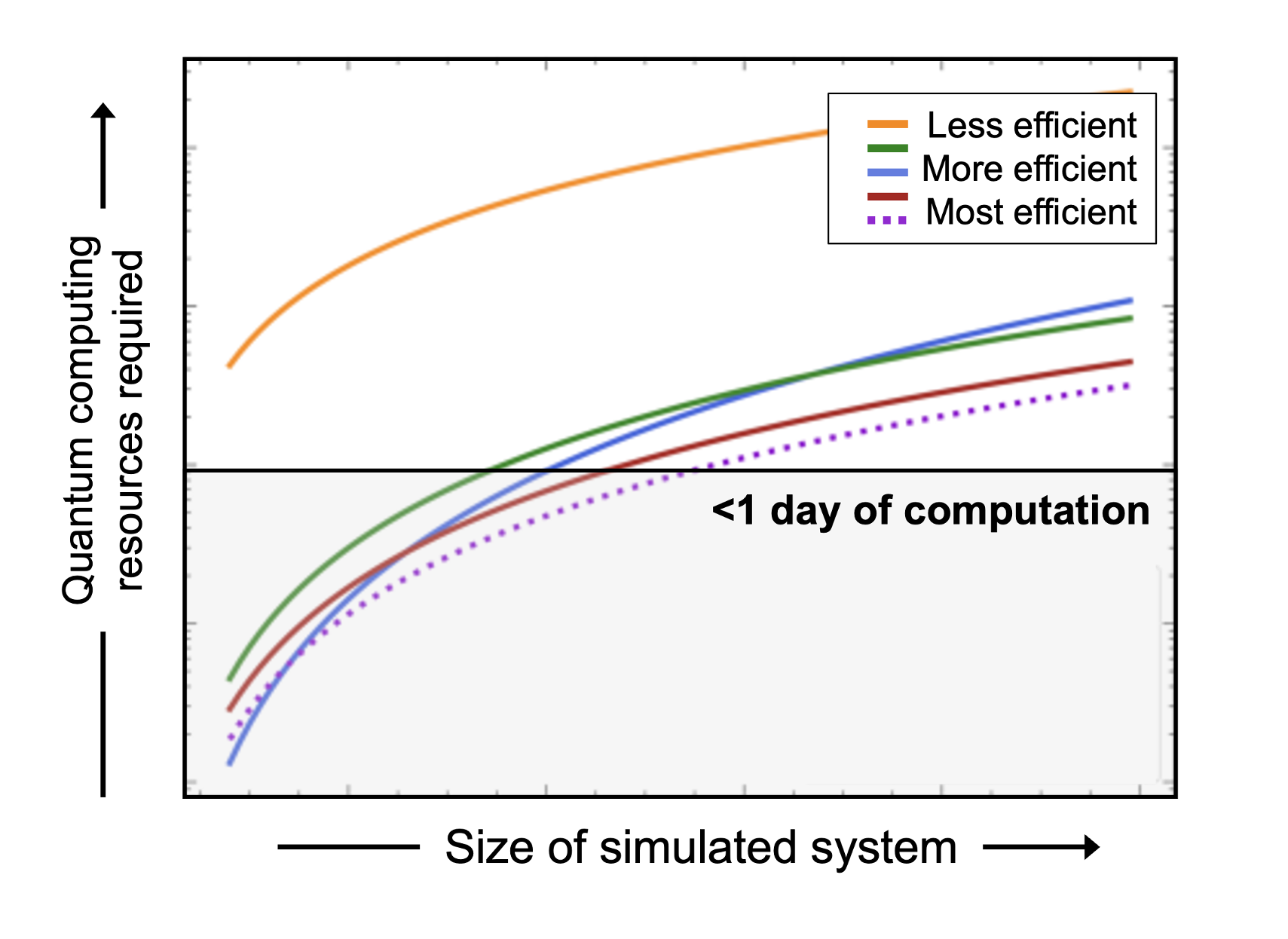
Five quantum algorithms for simulating particle scattering, compared by computational cost. The most efficient approaches require less than a day runtime on a near-future fault-tolerant quantum computer.
Scientific Achievement
C2QA led a team that developed quantum algorithms and methods to simulate particle scattering in scalar quantum field theories in 1D, providing concrete resource estimates for running these simulations on large-scale fault-tolerant quantum computers.
Significance and Impact
Quantum field theories are classically intractable problems central to high energy and nuclear physics. This work shows that meaningful scattering simulations may be achievable with four million physical qubits and one day of runtime, bringing that goal within reach.
Research Details
- Developed and compared quantum simulation algorithms to identify the most efficient approaches
- Estimate ~10¹² T-gates and ~4 million physical qubits for realistic simulations using surface codes
Collaborating Institutions
- University of Toronto
- NASA Ames Research Center
- Brookhaven National Laboratory
- Stony Brook University
- Pacific Northwest National Laboratory
Publication
Hardy A., Mukhopadhyay P., Alam M.S., Konik R., Hormozi L., Rieffel E., Hadfield S., Barata J., Venugopalan R., Kharzeev D.E., and Wiebe N., "Scattering Processes from Quantum Simulation Algorithms for Scalar Field Theories," PRX Quantum 7, 010343 (2026).
https://doi.org/10.1103/3krb-wwfx
Acknowledgements
This work was primarily supported by the U.S. Department of Energy, Office of Science, National Quantum Information Science Research Centers, Co-design Center for Quantum Advantage (C2QA) under Contract No. DE-SC0012704. A.H. acknowledges support from a NSERC Graduate Fellowship. M.S.A., E.R., and S.H. acknowledge support from the U.S. Department of Energy, Office of Science, National Quantum Information Science Research Centers, Superconducting Quantum Materials and Systems Center (SQMS) under Contract No. DE-AC02-07CH11359. M.S.A. and S.H. acknowledge support from USRA NASA Academic Mission Services under Contract No. NNA16BD14C with NASA, with this work funded under the NASA-DOE interagency agreement SAA2-403602 governing NASA's work as part of the SQMS center. R.K. acknowledges support by the U.S. Department of Energy, Office of Basic Energy Sciences, under Contract No. DE-SC0012704. R.V. is supported by the U.S. Department of Energy, Office of Science, under Contract No. DE-SC0012704. We thank Erik Gustafson, Vladimir Korepin, Robert Pisarski, Julia Wildeboer, and Ted Yoder for useful discussions. We thank Marton Lajer both for discussion and for providing the data for the reproduced figures.
2026-22979 | INT/EXT | Newsroom