Transformation of RHIC to EIC Begins
Work starts to remove and repurpose accelerator and detector equipment from the Relativistic Heavy Ion Collider (RHIC) to prepare for the Electron-Ion Collider (EIC)
April 13, 2026
 enlarge
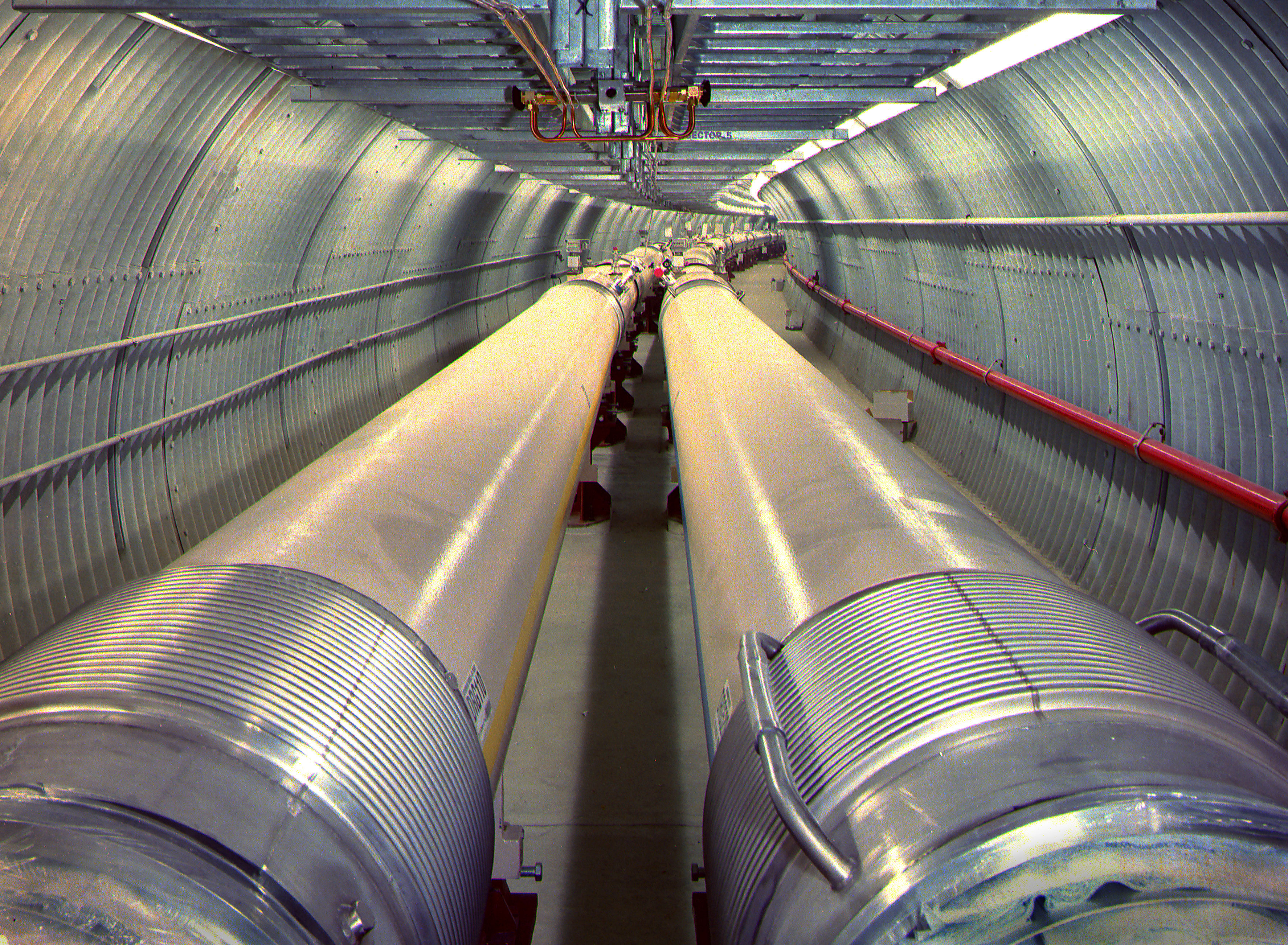
Two rings of superconducting ion storage magnets sit side-by-side throughout much of the Relativistic Heavy Ion Collider (RHIC) tunnel. One of these rings will be removed and replaced with a new electron storage ring as part of the conversion of RHIC into the Electron-Ion Collider. (Brookhaven National Laboratory)
UPTON, N.Y. — Work begins today at the U.S. Department of Energy’s (DOE) Brookhaven National Laboratory to remove components from the Relativistic Heavy Ion Collider (RHIC), a DOE Office of Science user facility for nuclear physics research that completed its 25th and final run in February. The removals mark an end, but also a new beginning: the first step in transforming the renowned collider into a new state-of-the-art nuclear physics research machine — the world’s only fully polarized Electron-Ion Collider (EIC).
The EIC is being built at Brookhaven Lab in partnership with DOE’s Thomas Jefferson National Accelerator Facility, leveraging decades of expertise in nuclear physics and accelerator science and technology at both laboratories.
“This is an exciting day as we embark on the journey of building the EIC, a machine with unmatched capabilities for exploring the building blocks of matter and the strongest force in nature,” said Abhay Deshpande, Brookhaven Lab’s associate laboratory director for nuclear and particle physics and science director for the EIC. “Even as one chapter ends, we are excited about what is to come. And RHIC provides both the scientific foundation and essential infrastructure for making this journey possible.”
 enlarge
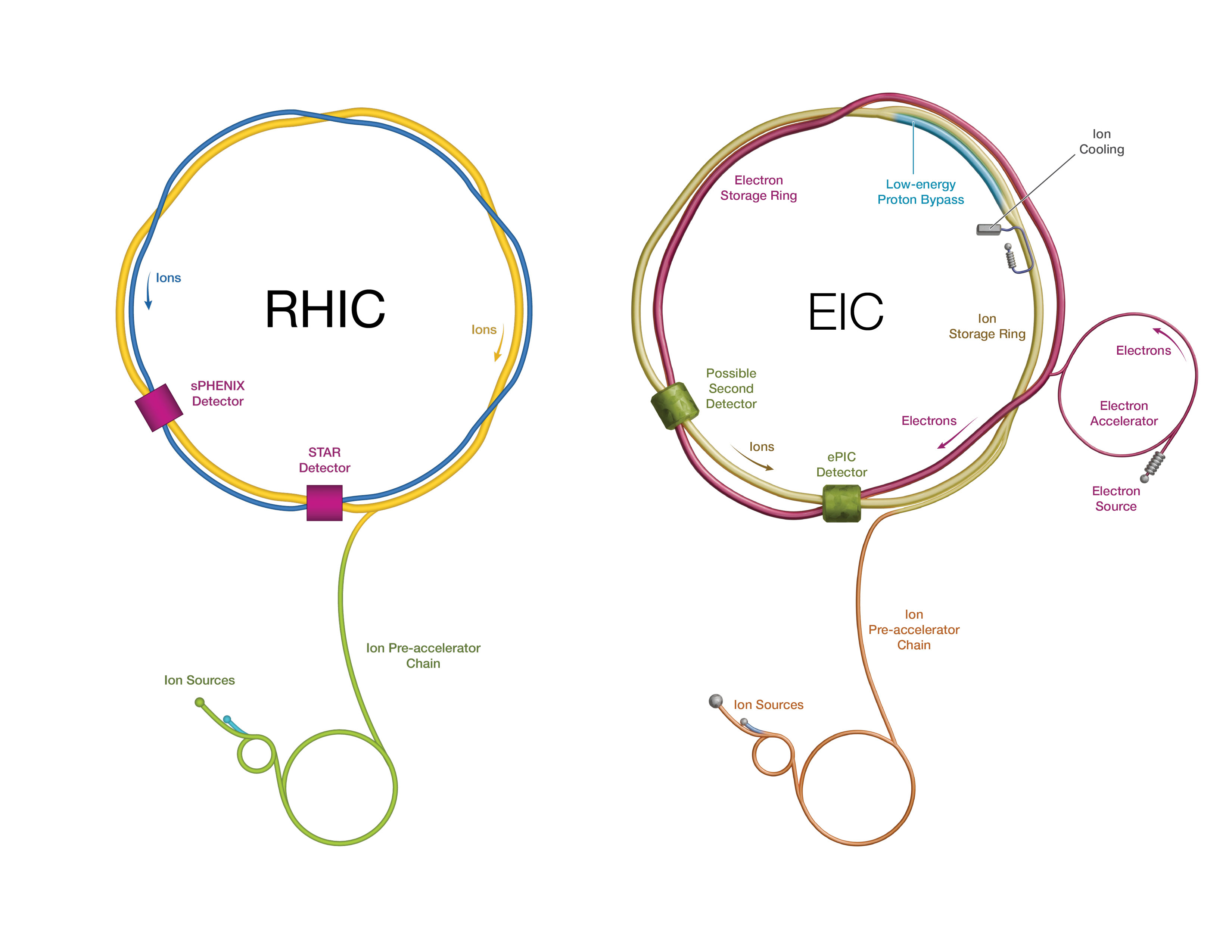
Some major components of the Relativistic Heavy Ion Collider (RHIC, left) will be reused for the Electron-Ion Collider (EIC, right). These include one of RHIC's ion storage rings, the pre-accelerator chain, and a large detector hall. The house-size detectors and the other ion storage ring are among the equipment that will be removed to make way for electron accelerator equipment both inside and outside the tunnel and a new detector known as ePIC. (Valerie A. Lentz/Brookhaven National Laboratory)
Indeed, the EIC will be built by reusing major components of RHIC, including its entire 2.4-mile-circumference tunnel, one of its superconducting-magnet ion storage rings, and other major accelerator and detector equipment. This repurposing of sophisticated equipment provides enormous cost-savings for building the EIC. But the EIC team will need space to add new polarized electron accelerator components, reconfigure particle interaction regions, and build a new detector to capture what happens when electrons collide with ions.
The Lab has developed a plan to accommodate these goals by keeping track of which equipment stays and goes and carrying out the removals with deliberation and care. This effort will be managed by David Chan, head of the Infrastructure and Technical Support Division within Brookhaven Lab’s Collider-Accelerator Department (C-AD).
“This initiative will clear obsolete components from RHIC and make select systems available for reuse by the EIC,” Chan said. “It will create the physical access and technical flexibility required for EIC installation, while maximizing cost savings through the identification and repurposing of valuable equipment.”
As EIC Project Director Jim Yeck noted, “The start of RHIC equipment removal marks a major step toward building the EIC and continuing RHIC’s tradition of groundbreaking discovery.”
 enlarge
About 50 members of the STAR collaboration stand in front of their detector during a collaboration meeting held in early March. This detector, which captured the first collisions at the Relativistic Heavy Ion Collider (RHIC) in 2000 and ran through every RHIC run until Feb. 6, 2026, will be taken apart to make way for the new ePIC detector being designed and constructed for the Electron-Ion Collider. (Kevin Coughlin/Brookhaven National Laboratory)
In addition to preserving items to be repurposed for the EIC, the team will retain some removed items such as small detector housings and power supplies for future use as spare components for the EIC and for potential research and development projects. They will return certain items to their respective owning institutions and manage the remaining materials in accordance with applicable property management requirements, including reutilization, recycling, or proper disposal.
“Our team will incorporate safety into every aspect of this work, with careful planning during every step of the removal process — from the start of disassembling components to their removal and relocation as well as the generation of waste,” said Raymond Fliller, head of the Environmental Safety, Security, Health and Quality Assurance Division within Brookhaven Lab’s Collider-Accelerator Department. “We have an excellent group of highly skilled engineers, technicians, riggers, and safety personnel with the technical skills and experience needed to carry out these challenging tasks.”
Deconstructing a collider, step-by-step
The removal process is expected to take place over a period of six years, with a work plan and schedule designed to enable simultaneous progress on EIC construction. It will encompass the removal and/or repurposing of approximately 6,500 major RHIC components.
In the RHIC tunnel, the team will remove select accelerator equipment, including one of the two existing rings of superconducting magnets previously used to circulate beams of RHIC’s ions, the cryostats used to keep these superconducting magnets and other equipment at near-absolute-zero operating temperatures, and radiofrequency systems that will no longer be needed. This work will take place sector-by-sector around the 2.4-mile-circumference ring, clearing the way for EIC equipment installations as the removals progress.
 enlarge
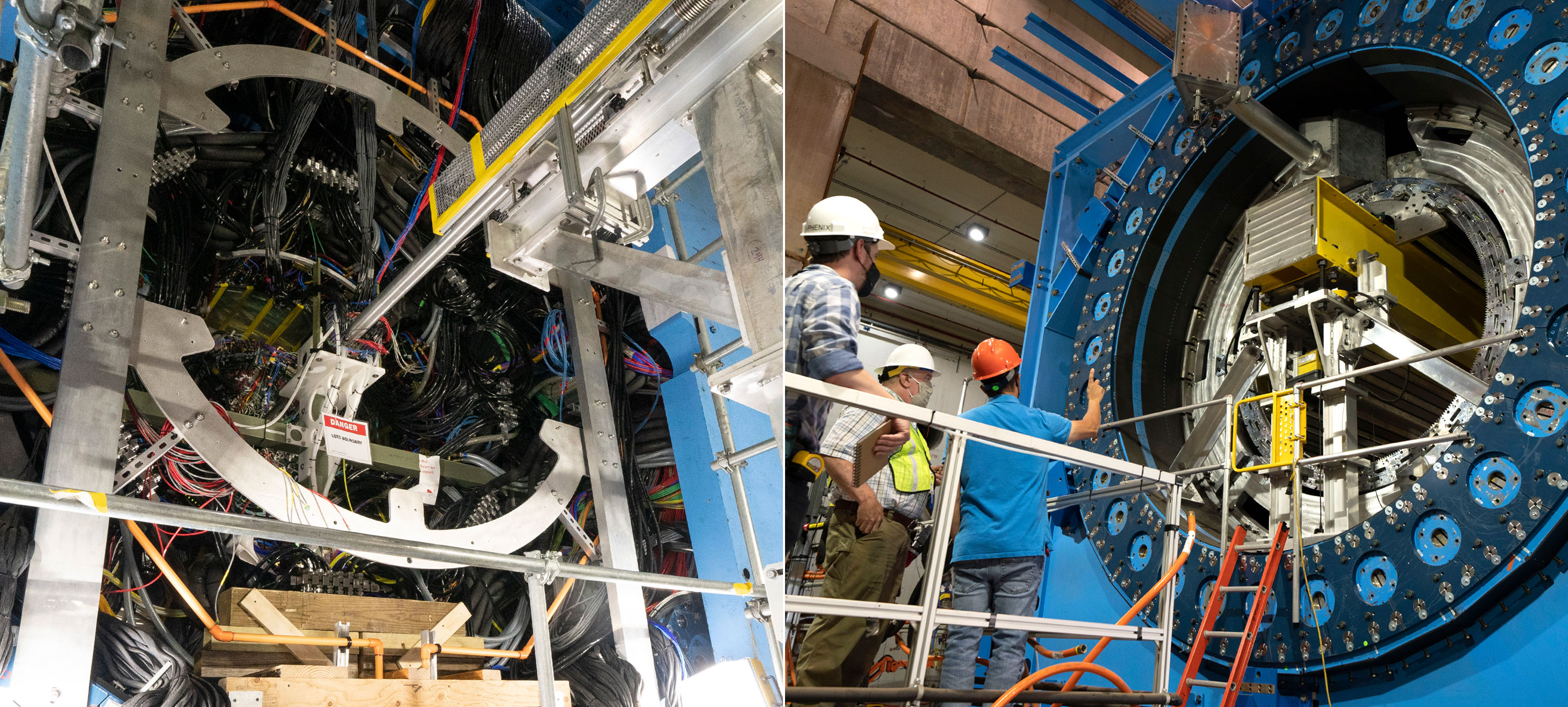
The sPHENIX detector at the Relativistic Heavy Ion Collider (left), which took data from 2023 to 2026, will be disassembled, but its outer hadronic calorimeter — the ring with blue circles shown during sPHENIX construction in 2022 (right) — will be used in the new detector for the Electron-Ion Collider. (Jessica Rotkiewicz/Brookhaven National Laboratory)
“Coordination between removal team and the team building the new electron storage ring for the EIC presents an important opportunity to efficiently integrate activities as installation of EIC components progresses alongside removal work in the ring. With clear scope boundaries, defined handoff conditions, integrated scheduling, and aligned work planning, the teams can effectively manage shared space, resources, and safety controls,” Chan said.
Another major component of this effort will be the disassembly and removal of the two remaining RHIC detectors: STAR, which has been operating continuously since RHIC turned on in 2000, and sPHENIX, which was commissioned in 2023 and collected unprecedented amounts of data in RHIC’s final run. Each detector is composed of many complex systems, including sophisticated electronics, wiring, gases, lasers, and enormous pieces of steel, some weighing tens of tons.
 enlarge
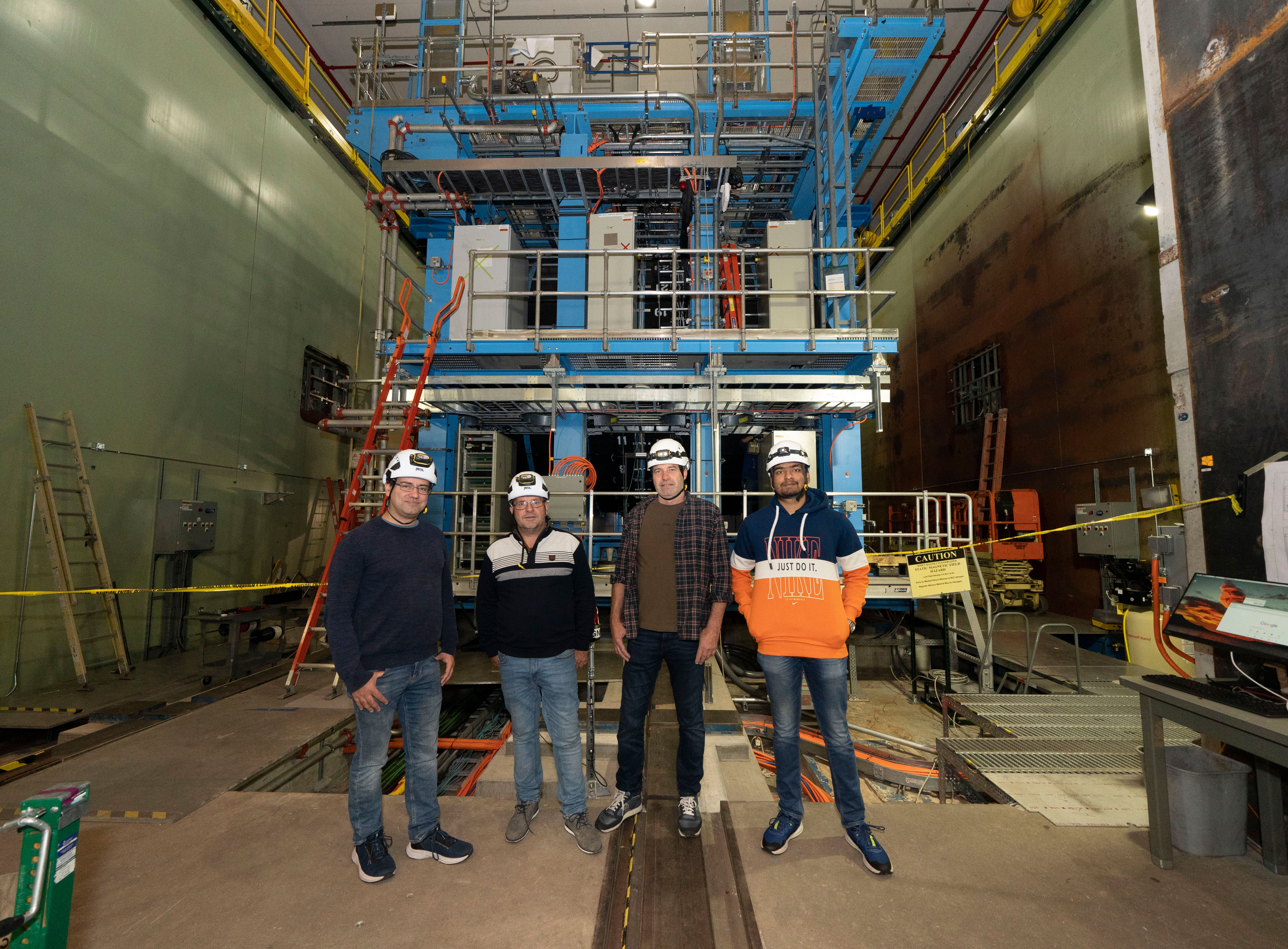
The green walls seen here during sPHENIX construction are the innermost of 15 such layers on either side of the detector. These massive steel plates — remnants of the original PHENIX detector at the Relativistic Heavy Ion Collider — will be removed along with the detector to make way for possible future Electron-Ion Collider project needs. (Jessica Rotkiewicz/Brookhaven National Laboratory)
Within the ring, the interaction region currently occupied by the STAR detector will be the location for the future EIC detector, known as ePIC. One major component of the sPHENIX detector — its outer hadronic calorimeter — will be reused for this new EIC experiment.
Also to be removed are 30 solid steel plates leftover from PHENIX, one of RHIC’s original detectors, which was located where sPHENIX now sits. The 15 plates on each side of the interaction region are each made of five sections that are four or eight inches thick, weighing in at 40 or 80 tons, respectively. Removing these pieces, though challenging, will make room for possible future EIC project needs.
“We are excited to be preparing for the future installation of the EIC,” Chan said. “The start of equipment removal is one of the first steps in building the EIC within the existing facility and marks an important milestone in this process. This work will be both challenging and rewarding, and we are enthusiastic about the opportunity ahead. With our knowledgeable technical staff, we are confident in our ability to successfully execute this important effort.”
This work is being funded by the DOE Office of Science.
Brookhaven National Laboratory is supported by the Office of Science of the U.S. Department of Energy. The Office of Science is the single largest supporter of basic research in the physical sciences in the United States and is working to address some of the most pressing challenges of our time. For more information, visit science.energy.gov.
Follow @BrookhavenLab on social media. Find us on Instagram, LinkedIn, X, and Facebook.
2026-22863 | INT/EXT | Newsroom