


Building the next discovery machine
Advancing our understanding of the origin of mass, structure, and binding of atomic nuclei
| We're hiring! | A collaborative network of talent is crucial to our mission. See available jobs |
Stay informed! Read the EIC Newsletter
Brookhaven National Laboratory is the host site for the future Electron-Ion Collider (EIC), a unique high-energy, high-luminosity polarized collider that will be one of the most challenging and exciting accelerator complexes ever built. The EIC will be a discovery machine, providing answers to long-elusive mysteries of matter related to our understanding the origin of mass, structure, and binding of atomic nuclei that make up the entire visible universe.
The EIC Directorate will work closely with domestic and international partners to deliver the $1.6B—$2.6B EIC construction project and then begin EIC operations.
Electron-Ion Collider Project
Public science site containing full details on the EIC physics mission.
The Science, Story, and Global Significance of the Electron-Ion Collider
July 7, 2026
Most of the mass in the visible universe originates not from atoms, but from gluons — the force-carriers that bind quarks inside protons and neutrons. Gluons also appear to play a key role in generating a fundamental quantum property of these particles: spin. Despite decades of experiments around the world gluons remain poorly understood. The Electron-Ion Collider (EIC), now under construction at Brookhaven National Laboratory, will change that. By colliding beams of electrons with protons and atomic nuclei, the EIC will produce the first detailed maps of how gluons and quarks are distributed inside matter, revealing where mass, spin, and the strong nuclear force truly come from.
-

-

-
-

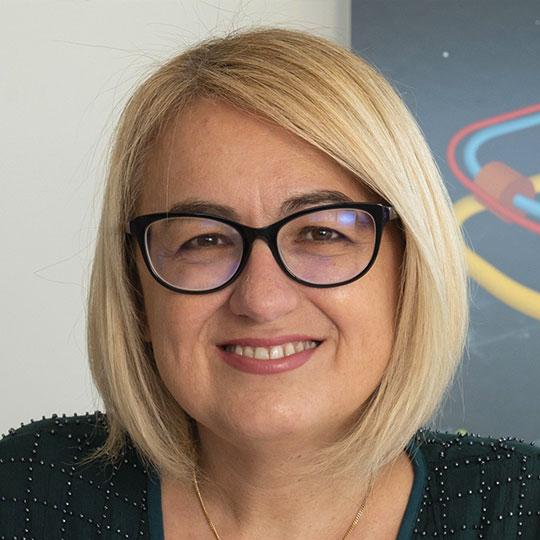
Elke-Caroline Aschenauer
EIC Co-Associate Director for Exp. Program / Cold QCD Groupleader
(631) 344-4769, elke@bnl.gov
-

-

-

Alyssa Petrone
Chief of Staff & Support Services Office, Interim Project Management Division Director
(631) 344-7735, apetrone@bnl.gov


Collaborations
Center for Frontiers in Nuclear Science
The mission of this Center is to promote and facilitate the realization of the U.S. based EIC by enhancing the science case and collaborations amongst the scientists around the world interested in the EIC.
Electron-Ion Collider User Group
The Electron-Ion Collider User Group consists of more than 1,500 physicists from over 300 laboratories and universities from 40 countries around the world who are working together to make the EIC a reality.
EIC Theory Institute
The mission of the EIC Theory Institute is to broaden our understanding of the scientific possibilities that will be created by the Electron-Ion Collider. A primary goal of the Institute is a vibrant and diverse program of short-term, mid-term and long-term visitors who enrich and complement EIC research at Brookhaven Lab.
EIC2@JLab
The Electron-Ion Collider Center at Jefferson Lab (EIC2@JLab) is an organization to advance and promote the science program at the EIC. Particular emphasis is on the close connection of EIC science to the current Jefferson Lab 12 GeV CEBAF science program.
Project Studies and Design Reports
The 2023 Long Range Plan for Nuclear Science
A long range plan to provide a framework for coordinated advancement of the Nation's nuclear science research programs over the next decade.
EIC Conceptual Design Report (2021)
Provides the technical reference design for the Electron-Ion Collider. (170 Mb)
An Assessment of U.S. Based Electron-Ion Collider Science (2018)
We are are poised to reach a deeper picture of the proton and neutron as collective many-body systems with new emergent behavior.
The Electron-Ion Collider: Assessing the Energy Dependence of Key Measurements (2017)
A close examination of the energy dependence of key measurements that are essential to ensure a compelling EIC science program.
Electron-Ion Collider: The Next QCD Frontier
The science case of an EIC, focused on the structure and interactions of gluon-dominated matter.
