- Home
-
Compliance
- Environmental Monitoring Plan
- Site Environmental Reports
Pollution Prevention
- Overview
-
Services
Field Sampling
- Overview
- Environmental Monitoring SOPs
- Staff
Env. Compliance Reps
- Process Assessments Forms
-
Resource Management
-
Groundwater Protection
-
Groundwater Protection
Program Overview
Documents and Reports
Groundwater Projects
Surface Projects
Land Use & Institutional Controls Mapping
Groundwater Status Reports
Contact
Reactor Decommissioning Projects
About
BGRR Science & Accomplishments
Celebrating DOE's Cleanup Accomplishments (PDF)
ContactBrookhaven Graphite Research Reactor (BGRR)
Brookhaven Graphite Research Reactor(BGRR) Overview
BGRR Complex Description
Decommissioning Decision
BGRR Complex Cleanup Actions
BGRR Documents
High Flux Beam Reactor (HFBR)
High Flux Beam Reactor (HFBR) Overview
HFBR Complex Description
Decommissioning Decision
HFBR Complex Cleanup Actions
HFBR Documents
-
- Contact
Timber and Cordwood Histories
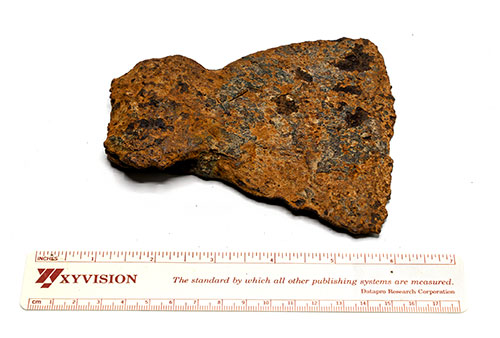
A nineteenth century iron axe head, representing historic wood chopping and splitting on the Brookhaven property.
Today, Brookhaven National Laboratory is surrounded by woods that comprise a portion of the Long Island Pine Barrens. These woods protect the sole source aquifer and provide a buffer for Laboratory activities. However, in the nineteenth century, the entire property was wooded and owned by the Smith and Weeks families, who profited from timber and cordwood trade and brought the Long Island Rail Road through their landholdings. Their logging business was primarily focused on the forest at “Wampmissic,” a portion of Manorville which is occupied by the Laboratory today.
Timber harvesting was an important industry in the Town of Brookhaven throughout the nineteenth century. Brookhaven woods were cut for lumber (for construction) and cordwood (for fuel) and carted to landings on the north shore, where they were transferred to small boats that coasted along the Long Island Sound to market at New York City and up the Hudson River Valley. Raw logs were cut into usable lumber at local sawmills for construction. Much of the wood was used to build the Long Island Rail Road, and cordwood powered the steam engines that ran along the rail line. The main line of the Long Island Rail Road was constructed in its current route south of the present laboratory site in the 1840s.
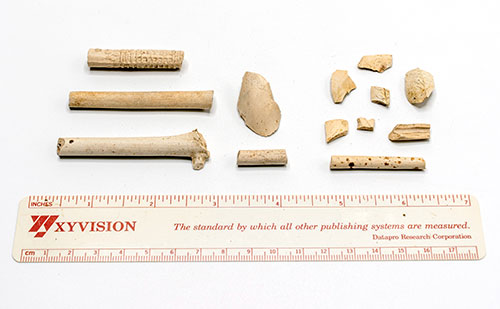
Fragments of nineteenth century ball-clay smoking pipes recovered at the woodcutter's home.
The Brookhaven Laboratory site was a vast, wooded tract of oak and pine trees, then owned by William Sidney Smith (owner of the Longwood Estate) and his brother-in-law James Huggins Weeks. When James H. Weeks moved to Yaphank, he purchased thousands of acres of woodlands from Smith and eventually employed more than thirty men from the surrounding area to cut, cart, and transport wood and cordwood. Woodcutters and wood carters cut paths through the forest to access woodlots. Meanwhile, Weeks lived in the main village of Yaphank with his wife Susan Maria and son William James. He was an investor in the mills that operated in Yaphank at the lower mills complex of the Carmans River, and an investor in the Long Island Rail Road Company. In fact, the construction of the railroad through Yaphank and Manorville was a direct consequence of Weeks’s investments, property ownership, and corporate relationships. Weeks served as president of the Long Island Rail Road from 1847 to 1850.
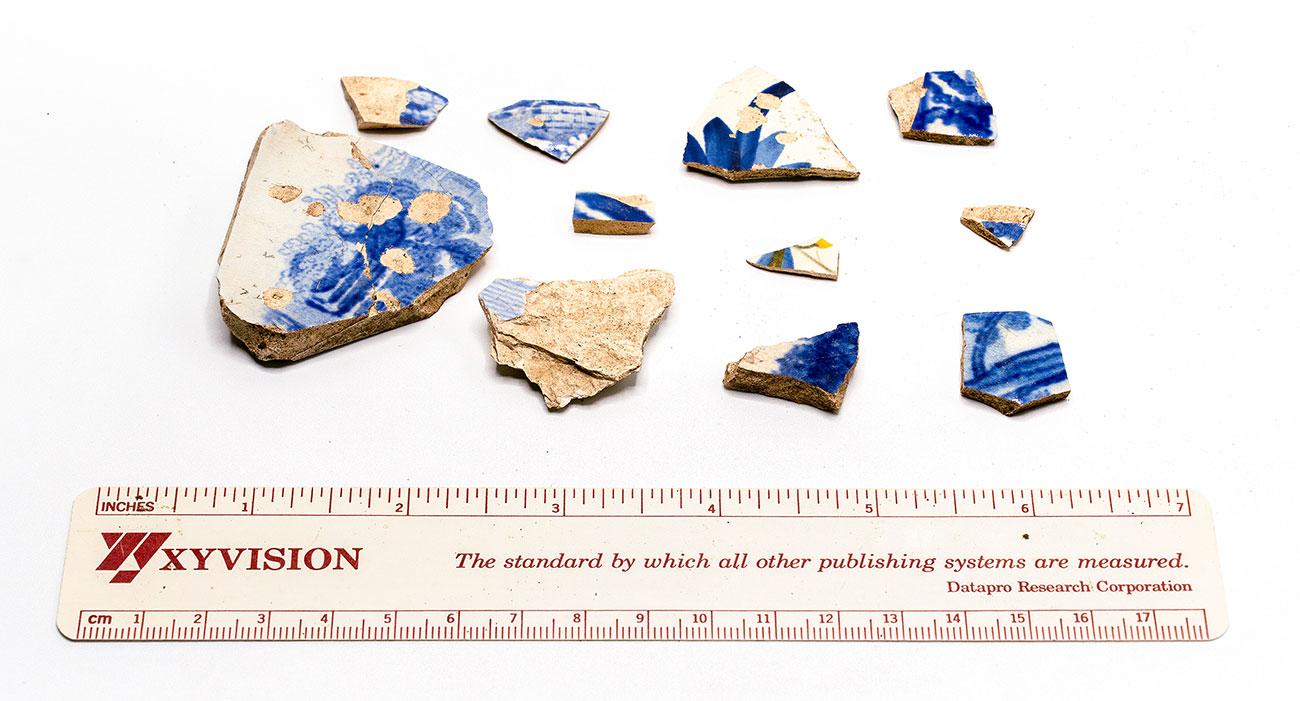
Weeks was also a rentier and speculator of property. He leased wood lots, farm lots and homes to men who also worked for him as wood cutters, farmers, and general laborers. He also rented wood lots from other property owners for access to timber and other natural resources. Two of Weeks’s rental properties were in the current Laboratory property. One of those properties, called the Yellow House, was rented by woodcutters and day laborers in the 1840s and 1850s. We know very little about the lives of Weeks’s tenants, but artifacts tell a story about their lives and the lives of their families in the mid-nineteenth century.
Fragments of nineteenth century ball-clay smoking pipes recovered at the woodcutter's home.