- Home
-
Compliance
- Environmental Monitoring Plan
- Site Environmental Reports
Pollution Prevention
- Overview
-
Services
Field Sampling
- Overview
- Environmental Monitoring SOPs
- Staff
Env. Compliance Reps
- Process Assessments Forms
-
Resource Management
-
Groundwater Protection
-
Groundwater Protection
Program Overview
Documents and Reports
Groundwater Projects
Surface Projects
Land Use & Institutional Controls Mapping
Groundwater Status Reports
Contact
Reactor Decommissioning Projects
About
BGRR Science & Accomplishments
Celebrating DOE's Cleanup Accomplishments (PDF)
ContactBrookhaven Graphite Research Reactor (BGRR)
Brookhaven Graphite Research Reactor(BGRR) Overview
BGRR Complex Description
Decommissioning Decision
BGRR Complex Cleanup Actions
BGRR Documents
High Flux Beam Reactor (HFBR)
High Flux Beam Reactor (HFBR) Overview
HFBR Complex Description
Decommissioning Decision
HFBR Complex Cleanup Actions
HFBR Documents
-
- Contact
Groundwater Projects
Brookhaven Linac Isotope Producer (AOC 16K)
A low level tritium plume was generated from activated soil surrounding the BLIP target vessel. Source area corrective actions were implemented including a concrete cap and storm water runoff controls. A draft record of decision is currently under regulatory review. The final remedy will include continued maintenance and inspection of the cap along with groundwater monitoring and reporting to verify that the source controls are effective.
g-2 Tritium Source Area and Plume (AOC16T)
This includes a tritium plume that originated from an activated soil shielding area adjacent to the g-2 experiment. A draft record of decision is currently under regulatory review. Several corrective actions have been implemented at the source area including a concrete cap and storm water controls. The Record of Decision (PDF) for Area of Concern 16T g-2 Tritium Source Area and Groundwater Plume, Area of Concern 16K Brookhaven Linac Isotope Producer, and Area of Concern 12 - Former Underground Storage Tanks was approved on May 10, 2007.
Operable Units
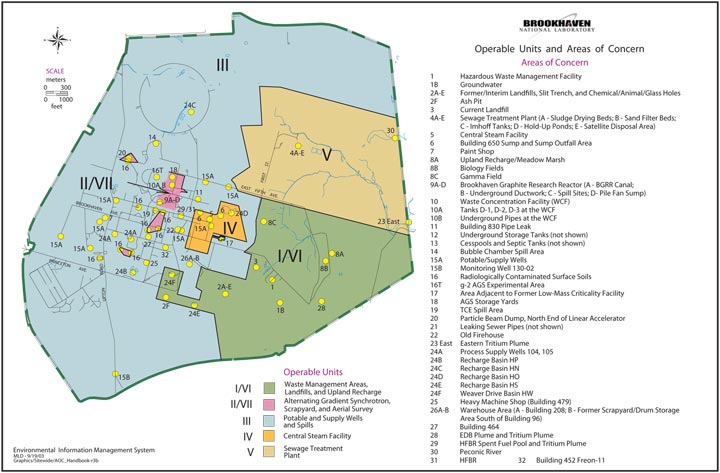
Operable Unit (OU) locations are designated as part of the CERCLA program to delineate significant known or potential source areas of contamination.
For each operable unit, a feasibility study was conducted to analyze and evaluate cleanup alternatives. The next step was to identify a preferred remedy, which is outlined in a document called the proposed remedial action plan. The record of decision is the final step, describing the chosen remedy and documenting the decisions that led to the chosen remedial action. Once the record of decision is issued, the remedial design and construction take place and the final cleanup begins. The following operable units contain areas of known groundwater contamination:
- Operable Unit I includes groundwater contamination in the southeastern area of the Laboratory that is being addressed by a removal action.
- Operable Unit III was developed to address groundwater "plumes," or areas of contamination, emanating from the central and southern portion of the BNL site. An Explanation of Significant Differences (PDF) to the OU III Record of Decision (PDF) has been approved. The main contaminants of concern are volatile organic compounds (VOCs), strontium-90, and tritium. VOCs have been found both on and off Laboratory property, while strontium-90 and tritium contaminants are confined to the Laboratory site.
- Operable Unit IV included groundwater contamination at BNL's Central Steam Facility. The five-year review of the Operable Unit IV treatment system is now available.
- Operable Unit V, also known as the Peconic River Project, includes groundwater in the eastern-central area of the Laboratory.
- Operable Unit VI includes groundwater in an area about 1,000 feet west of Weeks Avenue at depths of 90 - 130 feet below ground. Groundwater in this area contains the chemical EDB (ethylene dibromide), once commonly used as a pesticide and gasoline additive.
Project Information
- Shallow Glacial Aquifer Contour Map (PDF)
- Deep Glacial Aquifer Contour Map (PDF)
- Stratigraphy and Hydrologic Conditions (PDF) at the Brookhaven National Laboratory and Vicinity, Suffolk County, New York, 1994-97
- Monitoring Wells Location Map (PDF)
- Groundwater Treatment System Location Map (PDF)
- Volatile Organic Plumes Map (PDF)
- Radionuclide Plumes Map (PDF)
- USGS Real Time Water Level Data