Building Smart Tools — and Career Skills — at Brookhaven Lab
A returning community college intern shares how Brookhaven Lab experience solidified his interest in programming
October 2, 2026
 enlarge
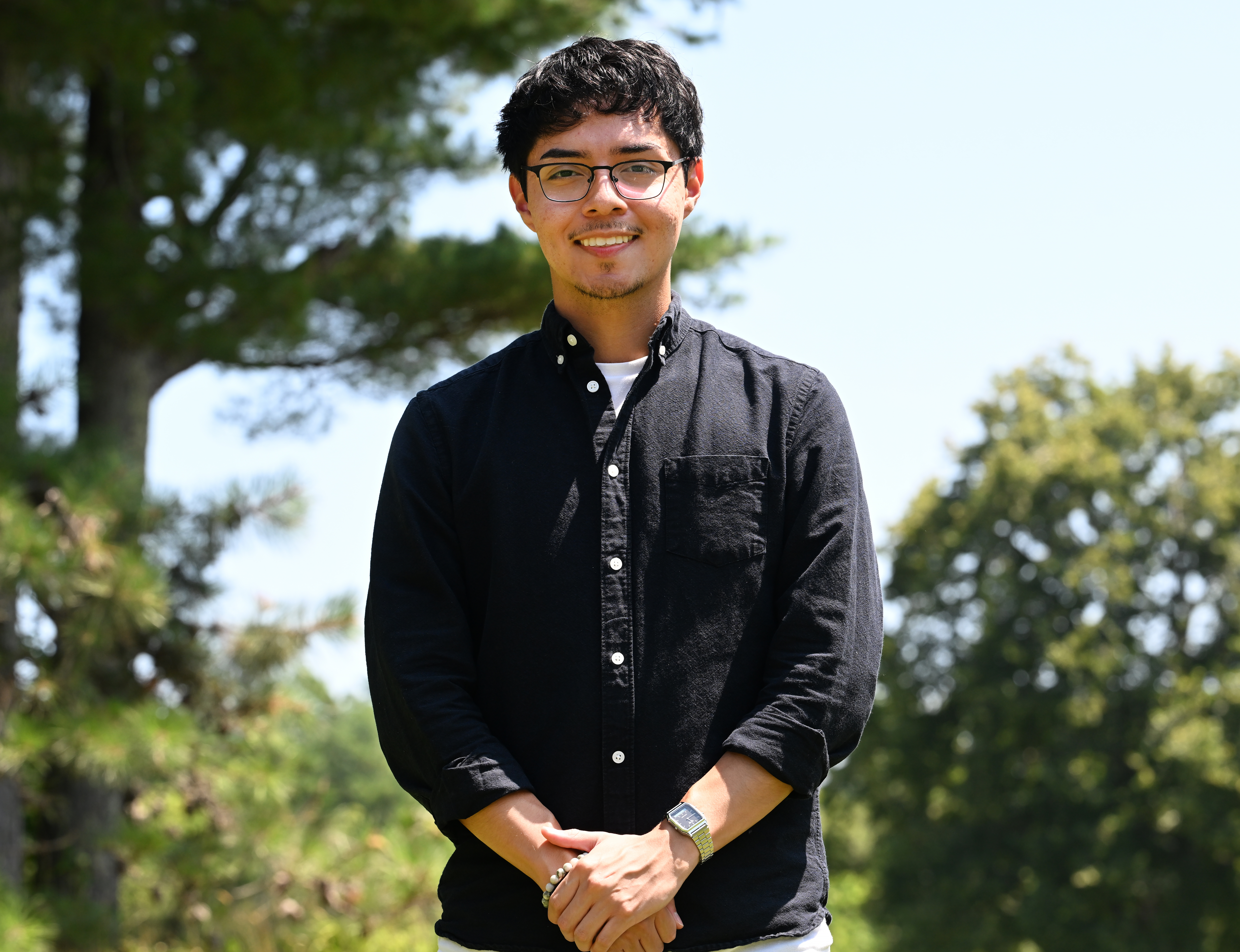
Bryan Aleman and fellow summer interns presented their projects at a poster session in August. (Kevin Coughlin/Brookhaven National Laboratory)
For Bryan Aleman, the U.S. Department of Energy’s (DOE) Community College Internships (CCI) program offered an opportunity to turn classroom learning into hands-on experience at a National Laboratory. The program places community college students at DOE National Laboratories for research and technical projects alongside laboratory staff.
Aleman recently graduated from Elgin Community College in Illinois and plans to pursue a bachelor’s degree in computer science at the University of Illinois Chicago. During two CCI internships at DOE’s Brookhaven National Laboratory, Aleman contributed to software development projects that included improving existing code and developing a tool for artificial intelligence (AI) resource management. Now, he looks forward to further developing his skills as a programmer.
What interested you in applying for the DOE CCI program at Brookhaven Lab, and what were you hoping to gain from the experience?
What interested me in applying to the DOE’s CCI program was the unique opportunity it offers community college students. Before my time at Brookhaven, I did not know there were internship opportunities specifically for community college students, so I quickly jumped at the opportunity as soon as I heard about it.
I first learned about CCI through an informational meeting hosted by Fermilab at Elgin Community College. They mentioned Brookhaven, the different types of science conducted there, and its unique research facilities. I selected both Fermilab because of its proximity to me and Brookhaven because of the wide range of work being done there as my lab choice in my application.
I was ultimately accepted to Brookhaven for the fall 2025 cohort, where I helped with software refactoring efforts at the National Synchrotron Light Source II. That first internship was such a great and impactful experience that I decided to apply again.
This summer, I returned to collaborate with Lisa Soto, my mentor in the Information Technology Division (ITD), on improving how Brookhaven manages its AI resources. I hoped to gain more real-world programming experience, strengthen my professional skills, and continue learning in a National Laboratory environment.
Can you describe the project you worked on this summer with Brookhaven's Information Technology Division?
 enlarge
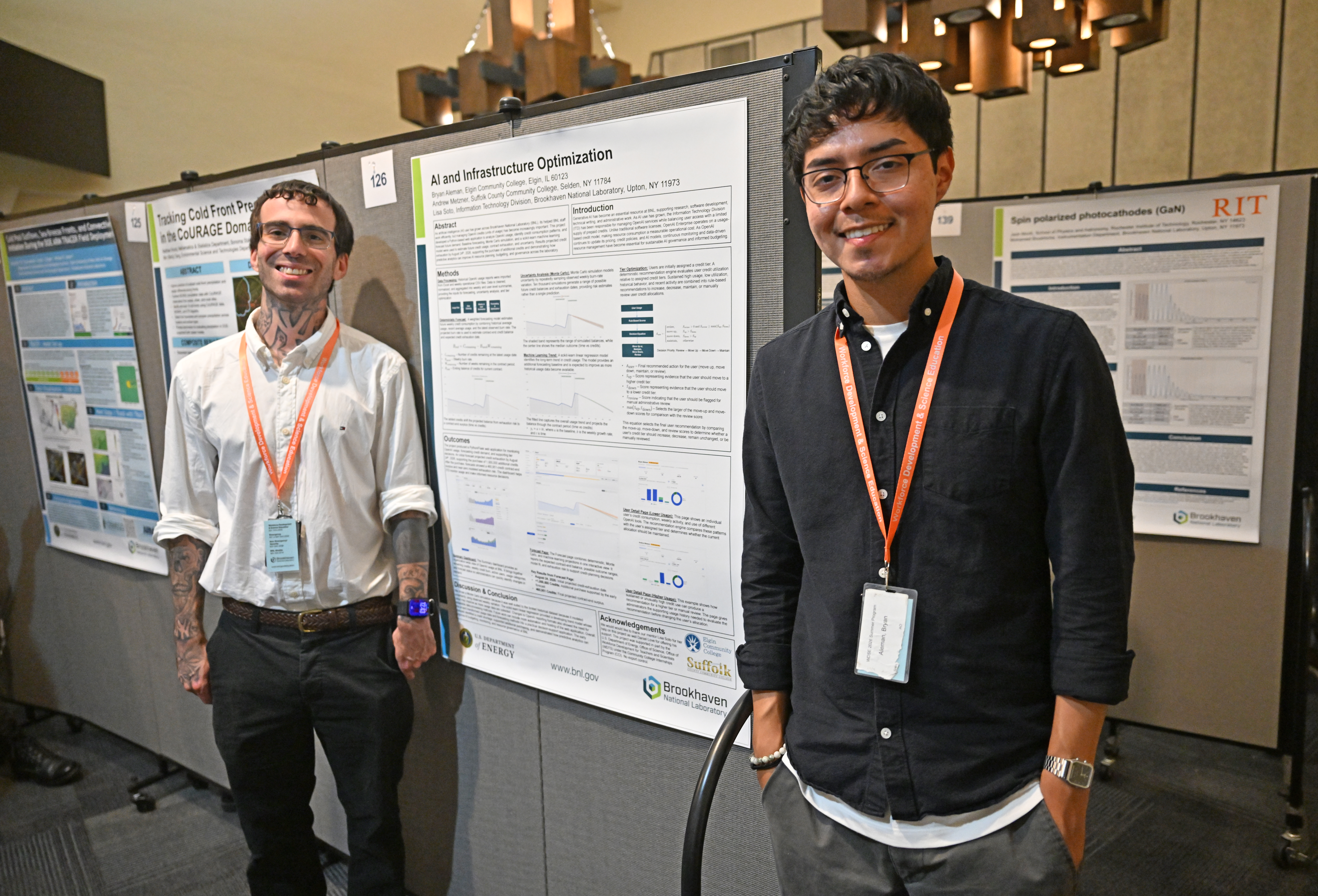
Andrew Metzner, left, and Bryan Aleman spent 10 weeks as interns within Brookhaven Lab's Information Technology Division. (Kevin Coughlin/Brookhaven National Laboratory)
Our mentor presented my partner and me with an interesting math-like problem. She wanted to optimize OpenAI credit usage and forecast when the Laboratory might run out of credits. OpenAI credits are prepaid units of AI usage that allow users to access advanced AI tools.
After being presented with the problem, my partner and I got to work. We decided to package a forecasting and optimization engine into a web application that ITD could use.
We built the application in Python and Flask. It processes OpenAI usage data and displays it through dashboards, charts, user summaries, and forecasting pages. The application tracks credit usage over time, shows how different tools are being used, and helps identify unusual or high-usage patterns.
We also developed multiple ways to forecast future credit consumption. These included a basic forecast using current and historical usage, Monte Carlo simulations that tested many possible future outcomes, and a machine-learning extension using linear regression. The application also includes an optimization feature that recommends when users’ credit tiers may need to be reviewed.
Overall, the project helps ITD make better-informed decisions about purchasing and allocating OpenAI credits.
What was the most interesting or challenging part of developing the forecasting model?
The most challenging part of developing the forecasting model was not the model itself but getting the data into a clean and consistent format for the model to process.
We received a lot of OpenAI credit-usage data in CSV files. Many of the files had overlapping dates and were formatted differently. Some summarized weekly usage, some showed daily usage, and others recorded individual usage entries. Even though every format included credit usage, we needed one uniform dataset to accurately forecast when the Laboratory might run out of credits.
To solve this, I created several Python scripts that could read the different file formats and output the data in a consistent weekly format. This was challenging because it required a lot of inspection and testing to make sure the dates, totals, and overlapping records were handled correctly. Eventually, we got the data into the format we needed.
The forecasting model was the most interesting part because it was going to be one of the most useful features for our mentor and ITD. We combined historical and recent usage rates, then used Monte Carlo simulations to show a range of possible outcomes instead of relying only on one forecast date.
What new technical or professional skills did you develop during your internship, and how did collaborating with Brookhaven Lab staff influence your learning?
Collaborating with my partner, Andrew Metzner, taught me a lot about how to create a web application. Before this project, I had never fully built a website. Andrew taught me about styling, development tools, application structure, and how hosting works. Through the project, I also improved my skills in Python, data processing, forecasting, visualization, Git, GitHub, and using the terminal.
Just like during my previous CCI appointment, I also learned a lot from collaborating with Brookhaven staff. This time, I gained a better understanding of how IT infrastructure works at a large organization like Brookhaven. I learned about the types of problems IT staff deal with, how they approach solving them, how AI is managed at an enterprise level, and how new products are researched and integrated into existing systems.
I also continued developing my communication skills. Andrew and I presented our project to ITD three separate times. We had to clearly communicate what we built, why it was important, and how it could help ITD. Regular check-ins with our mentor and conversations with other staff also helped me become more comfortable communicating in a professional environment.
How could tools like the one you developed help researchers and staff work more efficiently or make better use of AI resources?
One thing my partner and I learned from this project is that Brookhaven staff use AI a lot. Researchers and staff use AI to make their workflows more efficient, including for coding, writing, and research. Because of this, many people want access to these tools, but OpenAI credits are limited and become expensive when scaled across an organization like Brookhaven.
Our web application was developed to help ITD make decisions about those resources. It includes a visual dashboard showing credit usage by week, usage type, and active users. It also includes individual user pages that display each person’s usage through charts and summaries.
The forecasting page uses the current credit-usage rate to estimate when the Laboratory might run out of credits. It includes a basic forecast, Monte Carlo simulation, and a machine-learning extension.
The optimization page reviews users’ allocated credit tiers. It identifies users who are frequently nearing their limit and users who are using very little of their allocation. It then recommends whether a user may need to move up or down a tier or receive a manual review.
Together, these features help ITD decide how many credits to purchase and how to allocate them, giving researchers and staff better access to AI tools.
How has this internship shaped your educational or career goals, and what advice would you give to other community college students considering a DOE internship?
This internship solidified my decision to pursue a bachelor’s degree in computer science. It also allowed me to do what I enjoy most, which is using technology to help people.
I have always enjoyed coding and programming assignments in school, but I was unfamiliar with how those skills would translate into the real world. At Brookhaven, I was immediately able to apply what I learned in the classroom to interesting, real-world problems. I also learned tools I had not yet used in school, including Git, GitHub, and the terminal. My time in CCI added many industry-standard tools and skills to my experience.
The internship was also personally fulfilling. Our project helped ITD navigate the uncertain problem of managing AI credit usage, and hearing that our work was useful and valuable showed me that CCI interns can make meaningful contributions to the DOE mission. It also made me strongly consider a future working at a National Laboratory, possibly as a software engineer building tools that help others.
My advice to other community college students is to simply apply. You lose nothing by applying, but you can gain a great deal from the experience. I would also recommend researching each DOE laboratory so you can find the one that best matches your interests and career goals.
The National Synchrotron Light Source II is a DOE Office of Science user facility at Brookhaven Lab.
Brookhaven National Laboratory is supported by the Office of Science of the U.S. Department of Energy. The Office of Science is the single largest supporter of basic research in the physical sciences in the United States and is working to address some of the most pressing challenges of our time. For more information, visit science.energy.gov.
Follow @BrookhavenLab on social media. Find us on Instagram, LinkedIn, X, and Facebook.
2026-23112 | INT/EXT | Newsroom