Faster X-ray Imaging Requires Improved Beam Stability
August 12, 2026
 enlarge
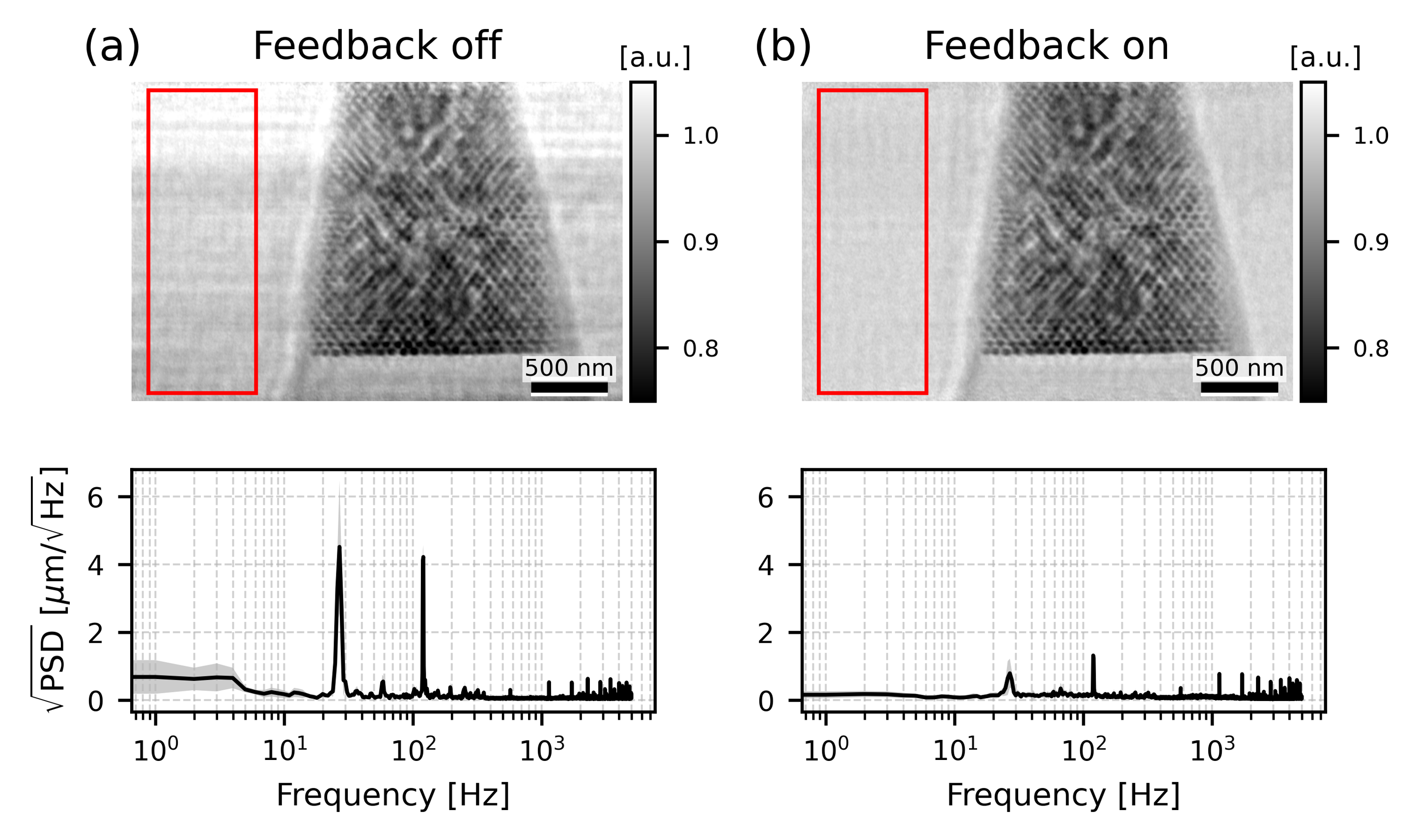
Ptychography reconstruction (top) of a gold nanoparticle superlattice acquired at a dwell time of 3.2 ms, showing the electron-beam-based X-ray feedback off (a) and on (b), using the X-ray beam position monitor at the secondary source aperture focal point as the input. The beam vibration spectra (bottom) show the corresponding horizontal X-ray beam motion measured by the X-ray beam position monitor. The red box indicates the region of interest (ROI) used for analysis. The scan step size was 20 nm × 20 nm with a 200 × 100 grid.
The Science
Researchers developed and demonstrated a new fast feedback system that uses the electron beam itself to actively suppress X-ray beam vibrations, improving beam stability at the Hard X-ray Nanoprobe.
The Impact
The approach enables more stable, high-speed X-ray imaging with fewer vibration-induced artifacts, providing a promising path toward meeting the demanding stability requirements of next-generation synchrotrons.
Summary
Future synchrotron light sources are being designed to deliver significantly higher brightness and coherence, enabling faster scanning and more advanced imaging techniques. However, realizing these capabilities requires improved X-ray beam stability, as vibrations directly limit measurement accuracy and image quality.
At the NSLS-II Hard X-ray Nanoprobe (HXN), a local mechanical feedback system mitigates low-frequency motion but provides only limited suppression of dominant vibrations at 27 Hz and 120 Hz. To address this limitation, this work explores the use of the electron beam itself as the actuator for feedback by integrating X-ray beam position monitor signals into the fast orbit feedback system through a dedicated electrometer.
Experimental results show that this approach effectively suppresses the dominant vibration peaks and enhances stability at the focusing point. Benchmark ptychography measurements further confirm that electron-beam-based feedback reduces background fluctuations and mitigates vibration-induced artifacts under fast-scanning conditions.
These results establish the feasibility of using the electron beam as a feedback actuator for next-generation synchrotron applications and provide an experimental assessment of its potential and limitations.
Download the research summary slide (PDF)
Related Links
Paper: Development of electron source feedback for enhanced X-ray beam stability at NSLS-II
Contact
Sukho Kongtawong
National Synchrotron Light Source II
skongtawong@bnl.gov
Yoshiteru Hidaka
National Synchrotron Light Source II
yhidaka@bnl.gov
Hanfei Yan
National Synchrotron Light Source II
hyan@bnl.gov
Publications
S. Kongtawong, Y. Hidaka, H. Yan, G. Wang, K. Ha, Y. Tian, J. Mead, D. Padrazo, Y. Chu, and T. Shaftan, Development of electron source feedback for enhanced X-ray beam stability at NSLS-II, J. Synchrotron Rad. 33, 585–595 (2026). https://doi.org/10.1107/S160057752600233X
Funding
This research used resources of the National Synchrotron Light Source II, a US Department of Energy (DOE) Office of Science User Facility operated for the DOE Office of Science by Brookhaven National Laboratory under Contract No. DESC0012704.
2026-23124 | INT/EXT | Newsroom