Atomically Precise Materials Improve Artificial Neurons
August 12, 2026
 enlarge
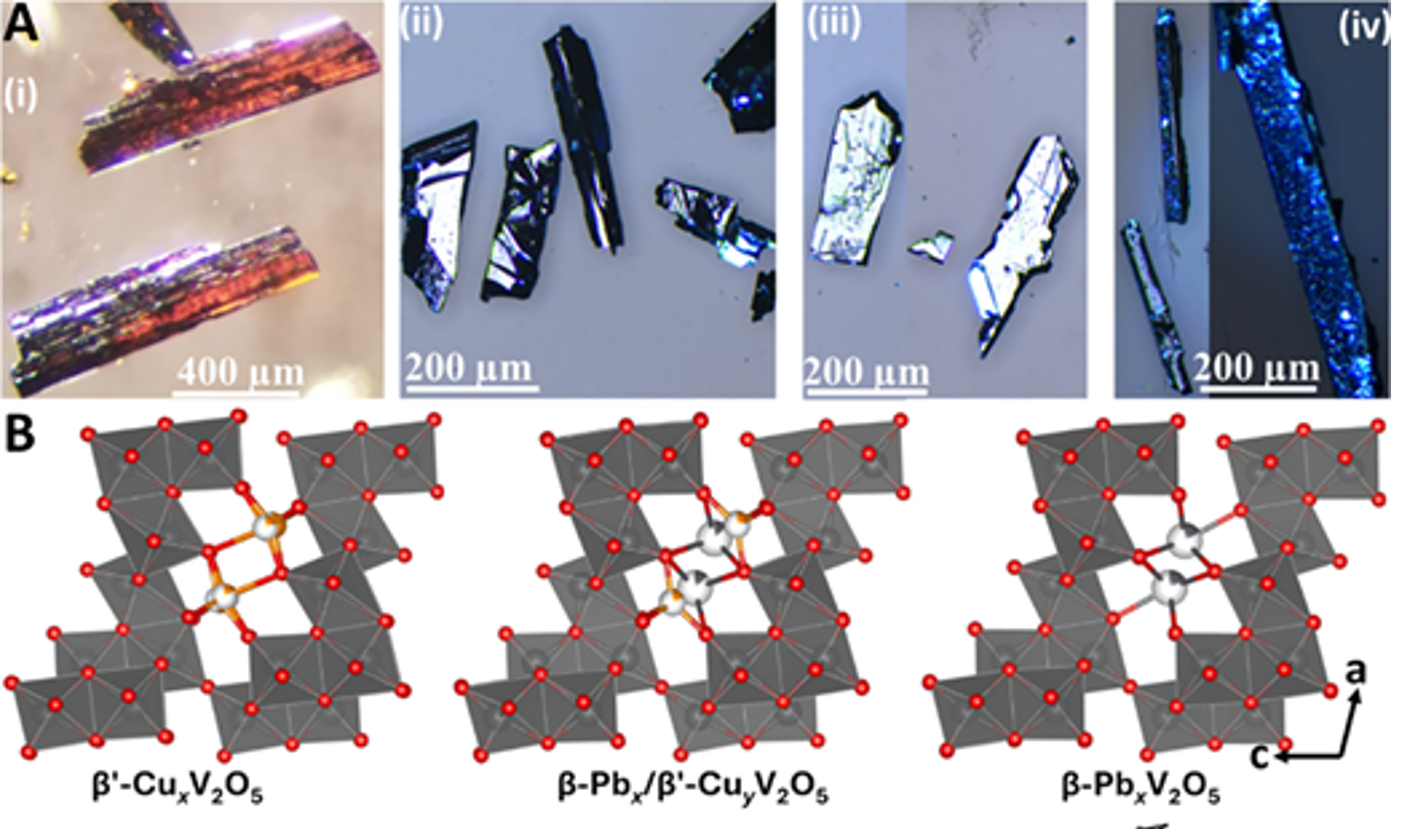
(A) Four related vanadium oxide crystals: (i) ζ-V2O5, (ii) β′-CuxV2O5, (iii) β-Pbx/β′-CuyV2O5, and (iv) β-PbxV2O5. Each has a distinct crystal shape and color, reflecting differences in composition (B) Single-crystal X-ray diffraction reveals where Pb and Cu are located within the vanadium oxide material's tunnel-like structure
The Science
Scientists positioned lead (Pb) and copper (Cu) atoms within millimeter-scale single crystals, modifying their charge ordering and producing more stable, neuron-like electrical oscillations.
The Impact
Understanding how atomic-scale changes control a material's electrical switching could enable more reliable, energy-efficient hardware for brain-inspired computing and AI hardware.
Summary
Inspired by the brains of mammals, neuromorphic computers process information by mimicking the way neurons communicate. Building these systems to accelerate computations for AI requires materials that can repeatedly switch between insulating and conducting states. A major challenge is that when these transitions occur too abruptly, they can generate unstable electrical and thermal spikes that can degrade or even destroy devices.
A team of scientists has recently demonstrated a way to make this switching smoother and more reliable by precisely placing individual lead (Pb) atoms into specific sites within the crystal lattice of copper-vanadium oxide crystals. Positioned in the material's tunnel-like framework, the Pb atoms subtly distort the crystal lattice and alter how electric charge moves through the crystal. This atom-by-atom modification dampens the material's phase transition, suppressing the abrupt electrical switching. As a result, the material produces smaller, more stable electrical oscillations that are less likely to overheat or fail during operation.
To get a more detailed view of these structural and electronic changes, the team used complimentary X-ray techniques at four of the beamlines at the National Synchrotron Light Source II (NSLS-II), a U.S. Department of Energy Office of Science user facility at Brookhaven National Laboratory. At the Pair Distribution Function (PDF) beamline, synchrotron X-ray diffraction and pair distribution function measurements tracked changes in both the average crystal structure and local atomic arrangements at different temperatures, revealing subtle distortions that are difficult to discern using conventional diffraction. At the Quick X-ray Absorption and Scattering (QAS) beamline, X-ray absorption spectroscopy characterized the local chemical environments, oxidation states, and bonding of vanadium, copper, and lead in the crystal. At the Spectroscopy Soft and Tender (SST-1) beamline, funded and operated by the National Institute of Standards and Technology (NIST), soft X-ray absorption spectroscopy probed the electronic structure and local bonding of vanadium and oxygen. Hard X-ray photoemission spectroscopy at the neighboring SST-2 beamline then measured the material's electronic structure and chemical states while avoiding charging effects that often limit conventional photoelectron spectroscopy.
Looking ahead, the researchers plan to investigate how other inserted elements will affect the material's behavior and explore controlling its electrical properties with stimuli such as light, mechanical strain, or ion insertion. Ultimately, they hope to develop ultralow-power energy efficient computing devices that more closely mimic the biological efficiency of the brain to enable AI at scale and to reduce the energy consumption of AI data centers.
Download the research summary slide (PDF)
Related Links
Contact
Sarbajit Banerjee|
ETH Zurich, Paul Scherrer Institute
sbanerje@ethz.ch
G. Sambandamurthy
The State University of New York, Buffalo
sg82@buffalo.edu
Publications
G. Agbeworvi, N. Kumar, J. D. Ponis, S. Hariyani, N. Jerla, F. Jardali, J. Li, W. Zaheer, J. V. Handy, J. R. Ayala, C. Jaye, C. Weiland, D. A. Fischer, P. J. Shamberger, J. Guo, R. S. Williams, G. Sambandamurthy, and S. Banerjee, “An atom-precise approach to damp first-order phase transitions and its implications for neuromorphic signal processing,” Journal of the American Chemical Society 148(20), 20677–20693 (2026). https://doi.org/10.1021/jacs.6c02370
Funding
This work was primarily supported as part of the Center for Reconfigurable Electronic Materials Inspired by Nonlinear Neuron Dynamics (reMIND), an Energy Frontier Research Center funded by the US Department of Energy, Office of Science, Basic Energy Sciences under Award No. DE-SC0023353. Transport measurements were supported by the National Science Foundation under Award no. 1726303.
2026-23125 | INT/EXT | Newsroom