Pore Structure Influences Nuclear Fuel Performance
August 12, 2026
 enlarge
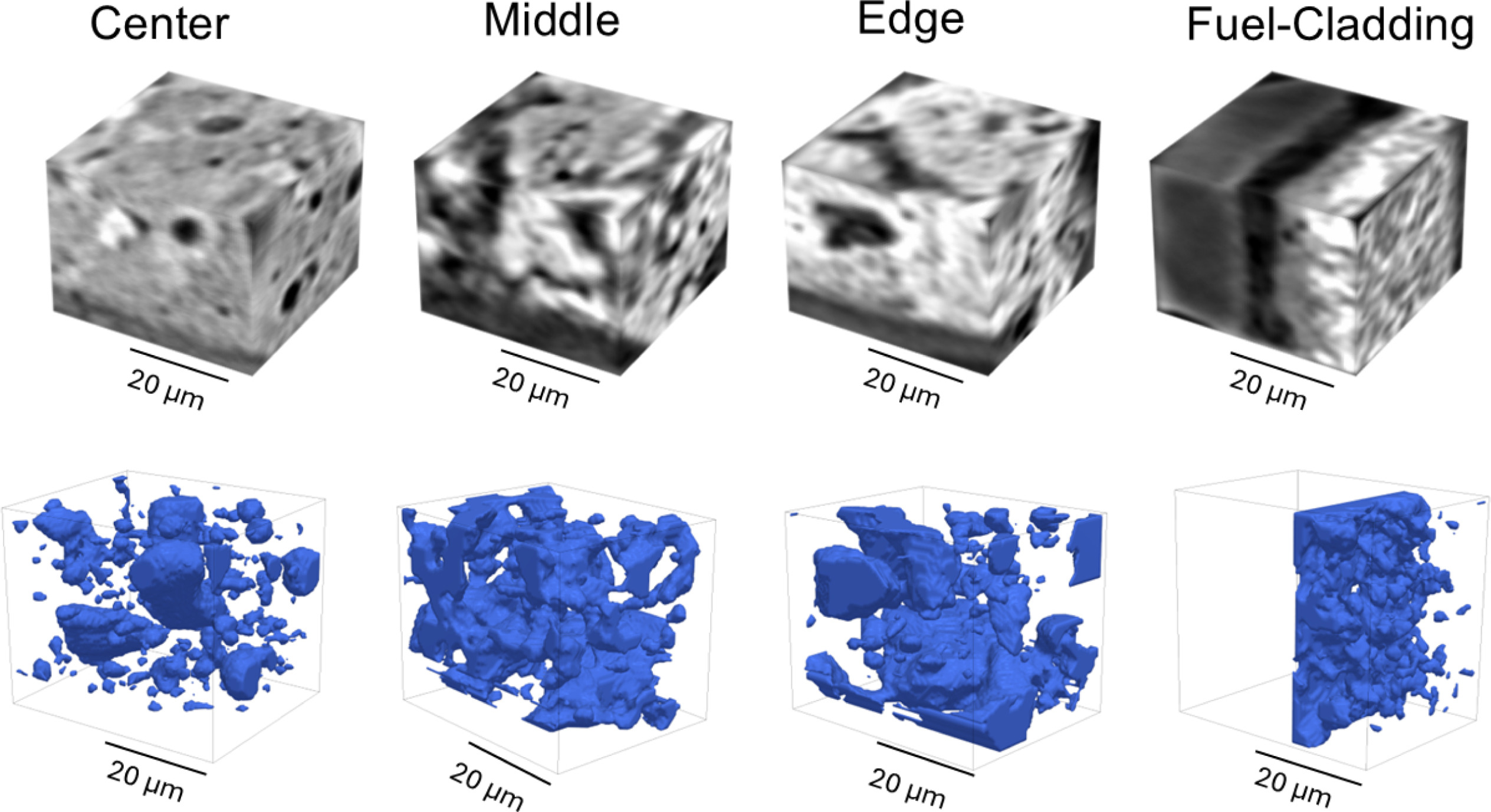
3D reconstructed microstructure (top row) and segmented porosity (bottom row) from X-ray tomography of U-10Zr fuel samples at increasing radial distances: Center, Middle, Edge, and Fuel-Cladding interface. Segmented pore volumes (blue) reveal larger, more interconnected porosity moving away from the center, towards the edge and cladding.
The Science
Scientists demonstrate that the performance of irradiated metallic nuclear fuel is not just influenced by the number of pores it has, but the size, shape, orientation, and connectivity of those pores.
The Impact
Understanding how these features affect heat transport, fission gas release, element transport, and long-term degradation can help guide the design of longer-lasting metallic fuels.
Summary
Uranium alloyed with 10% zirconium (U-10Zr) is one of the most promising metallic fuels for sodium-cooled fast reactors due to its high amount of uranium, thermal conductivity, and reliable performance under intense radiation. Over the years, more than 14,000 U-10Zr fuel rods have been tested in reactors such as the Experimental Breeder Reactor-II (EBR-II) and the Fast Flux Test Facility (FFTF). This long history of successful testing has made U-10Zr the benchmark metallic fuel for the U.S. fast reactor program.
Even with its strong performance record, scientists still do not fully understand how the fuel changes at the microscopic level during irradiation. As the fuel is exposed to radiation, its internal structure evolves, pores form, and uranium and zirconium redistribute within the material.
To better understand these changes, a group of scientists performed X-ray computed tomography experiments at the High Energy Engineering X-ray Scattering (HEX) beamline at the National Synchrotron Light Source II (NSLS-II), a U.S. Department of Energy Office of Science user facility at Brookhaven National Laboratory, creating detailed 3D images of U-10Zr nuclear fuel after it had been exposed to radiation inside a test reactor. They wanted to see how microscopic pores form and change throughout the fuel during reactor operation, and how those changes affect the fuel’s performance.
They found that the amount of porosity increases from the center of the fuel toward its outer edge. More importantly, the pores don't just become more numerous, they also change shape and begin connecting into complex networks. Near the fuel's outer edge and where the fuel meets the protective metal cladding, these interconnected pore networks become especially dense. These networks were found to be important, because they act like tiny highways that allow gases and radioactive fission products to move more easily through the fuel. That movement can speed up what is known as a “fuel-cladding chemical interaction,” a degradation process caused by the way the fuel reacts with the cladding.
The team also demonstrated how these pore structures affect heat flow. Isolated pores reduce the fuel's ability to conduct heat and interconnected pores amplify that effect. If liquid sodium fills some of the pores, it helps restore some of the fuel's ability to conduct heat, although it may also make chemical interactions between the fuel and cladding happen more quickly. These detailed findings can improve models used to design safer and more reliable fast-reactor fuels.
Download the research summary slide (PDF)
Related Links
- Paper: Site specific porosity-thermal performance correlations in neutron irradiated U-10Zr fuel
- News: Researchers uncover hidden pore network within nuclear fuel
Contact
Ericmoore Jossou
Massachusetts Institute of Technology
ejossou@mit.edu
Tiankai Yao
Idaho National Laboratory
Tiankai.Yao@inl.gov
Publications
A. A. Harrup, R. Moeykens, M. Drakopoulos, N. T. Vo, J. Howard, C. B. Jensen, T. Yao, E. Jossou, “Site specific porosity-thermal performance correlations in neutron irradiated U-10Zr fuel,” Materials Today 97, 103349 (2026). https://doi.org/10.1016/j.mattod.2026.103349
Funding
This work was funded by the Nuclear Energy University Program with award No. DE-NE0009491. This research used resources 27-ID (HEX) of the National Synchrotron Light Source II, a U.S. Department of Energy Office of Science User Facility operated for the DOE Office of Science by Brookhaven National Laboratory under contract No. DE-SC0023462. The sample preparation was carried out at Idaho National Laboratory through the Rapid Turnaround Award (24-4985), which is part of the Nuclear Science User Facilities.
2026-23117 | INT/EXT | Newsroom