


Toward All-Tantalum Josephson Junctions for Low-Loss Qubits
September 30, 2026
 enlarge
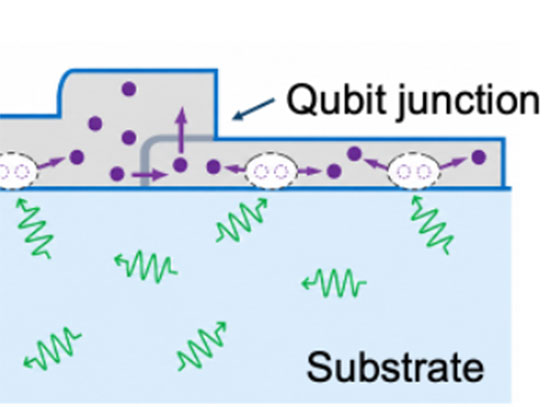
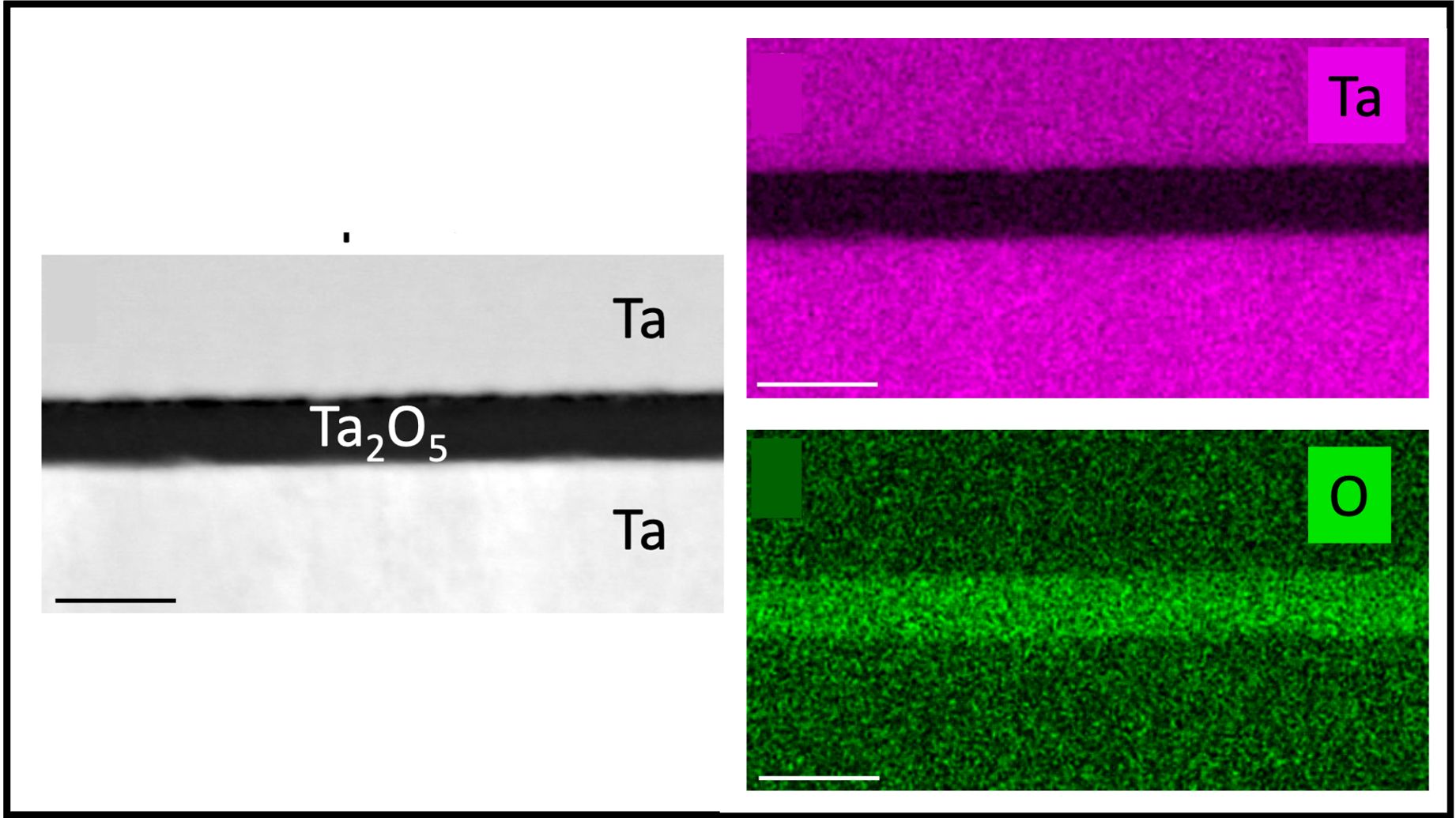
High-resolution STEM and EDX mapping show that plasma oxidation forms a smooth Ta2O2 barrier between two α-Ta layers, with sharp interfaces and little intermixing.
Scientific Achievement
C2QA researchers and collaborators developed a method to grow α-Ta/Ta2O5/α-Ta trilayers with controlled orientation and provided the atomic scale insight into the mechanisms of Ta oxidation processes.
Significance and Impact
This work establishes a pathway to Ta-based Josephson junctions with compositionally clean interfaces, which may further reduce the effect of two-level system defects on coherence in superconducting qubits.
Research Details
- Examined tube furnace, rapid thermal, and plasma anneal methods to create a TaOx barriers.
- Characterized TaOx chemistry, morphology, and defectivity.
- Developed ab initio model of Ta oxidation and self-limiting thickness.
Collaborating Institutions
- University of Washington
- Pacific Northwest National Laboratory
Publication
R. Potluri, R. Tangirala, S. Bauers, A. Barrios, P. Kumar, P. V. Sushko, D. P. Pappas, S. Eley, Fabrication and Structural Analysis of Trilayers for Tantalum Josephson Junctions with Ta2O5 Barriers, arXiv.2510.20114 (2025) https://doi.org/10.48550/arXiv.2510.20114
Acknowledgements
This work was primarily supported by the U.S. Department of Energy (DOE), Office of Science, National Quantum Information Science Research Centers, Co-design Center for Quantum Advantage (C2QA) under Contract No. DE-SC0012704 and PNNL FWP 76274 (R.P., R.T., P.S., S.E.). Materials growth and processing were conducted at the Washington Nanofabrication Facility / Molecular Analysis Facility, a National Nanotechnology Coordinated Infrastructure (NNCI) site at the University of Washington with partial support from the National Science Foundation via awards NNCI-1542101 and NNCI-2025489. Focused Ion Beam-Scanning Electron Microscopy (FIB-SEM) and Scanning Transmission Electron Microscopy with Energy Dispersive X-ray Spectroscopy (STEM-EDX) were performed in the following core facility, which is part of the Colorado School of Mines Shared Instrumentation Facility: Electron Microscopy (RRID:SCR\_022048). This research also used resources of the National Energy Research Scientific Computing Center (NERSC), a DOE Office of Science User Facility supported by the Office of Science of the U.S. DOE under Contract No. DE-AC02-05CH11231 using NERSC award BES-ERCAP0033525.
2026-22874 | INT/EXT | Newsroom