EIC Advances with Arrival of Key Electrical Substations
First substation delivery positions project for spring construction
April 28, 2026
 enlarge
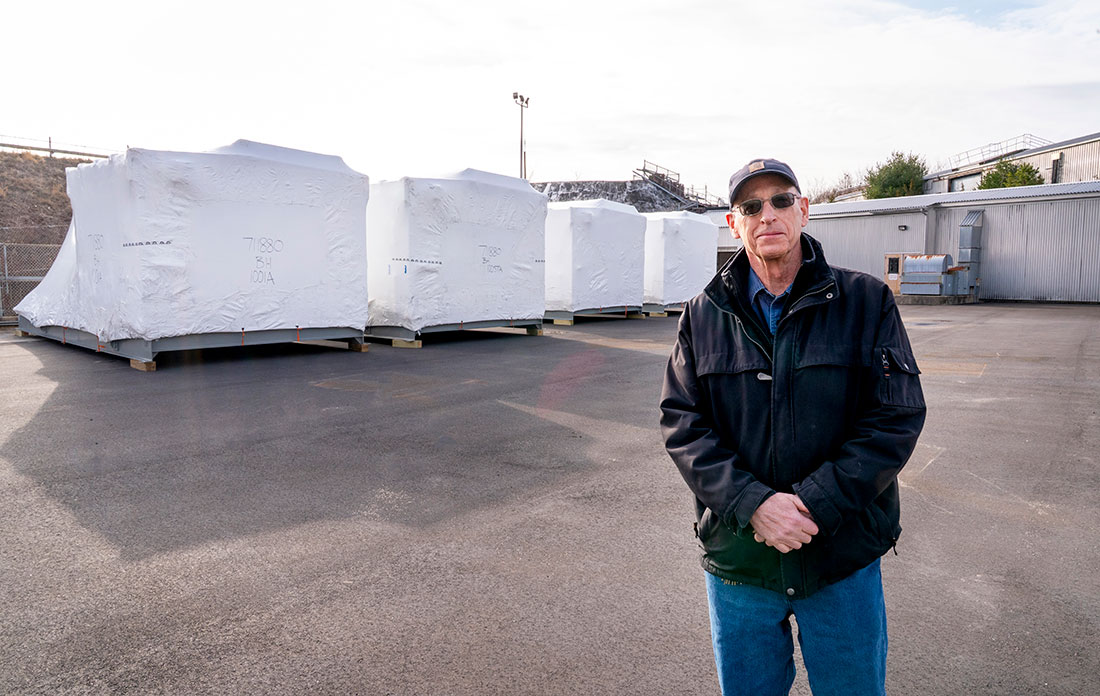
Thomas Nehring, group leader of the Electron-Ion Collider's (EIC) electrical power systems, stands in front of four electrical unit substations that will supply power for the EIC complex at Brookhaven National Lab. Their delivery enables the start of the EIC's site construction in 2026. (David Rahner/Brookhaven National Laboratory)
UPTON, N.Y. — The U.S. Department of Energy’s (DOE) Brookhaven National Laboratory has received the first batch of electrical unit substations for the Electron-Ion Collider (EIC), marking a major milestone as the ambitious project moves into conventional construction this spring. The ElC will be one of the most complex accelerators ever built — and the only one of its kind in the world.
The four unit substations, the first of 15 early procurements, are part of an $11.2 million contract awarded to Switchgear Solutions Ltd., a New York- and New Jersey-based power and distribution equipment supplier. The project awarded this contract in 2024 under Critical Decision 3-A, which gave the go-ahead to order long-lead procurements — materials that involve significant wait times — that are necessary to meet the project’s schedule.
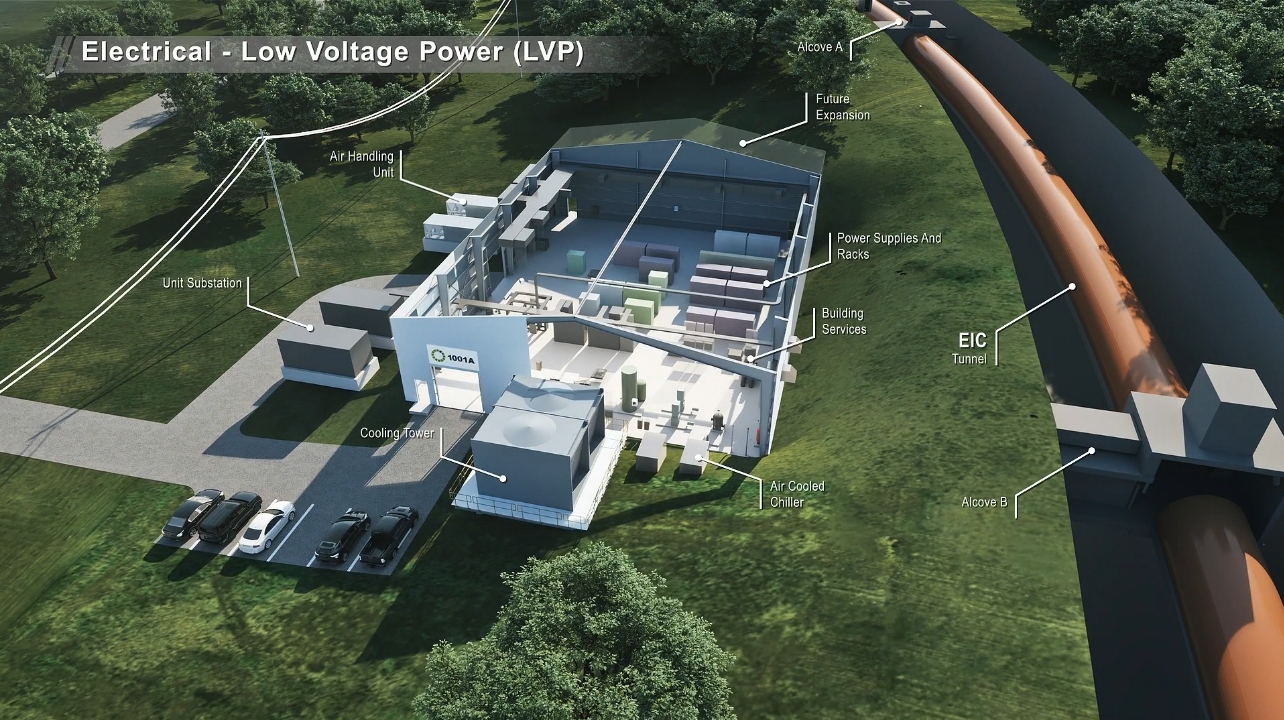
The newly delivered substations are mission-critical equipment. They will feed power into new support structures around the EIC complex that will supply electricity for accelerating particle beams, cooling superconducting magnets, operating data-readout electronics, and supporting essential building systems.
“These substations are foundational to everything that follows,” said EIC Interim Project Manager and former Infrastructure Director Charles Folz. “With long-lead equipment in hand, we’re positioned to begin construction knowing the facility’s power infrastructure will be ready when we need it.”
Progress toward construction
The EIC will be a 2.4-mile-circumference accelerator collider complex for exploring the building blocks of visible matter. The facility will be built on the backbone of Brookhaven Lab’s Relativistic Heavy Ion Collider (RHIC), a DOE Office of Science user facility that recently completed operations after a historic 25-year run. Like RHIC, construction of the EIC will be funded primarily by the Office of Science.
Preparing the site and building new structures to support the collider will rely on $100 million from New York State, awarded in 2024. This conventional construction is expected to begin in June 2026.
 enlarge
The recently delivered set of four unit substations, supplied by Switchgear Solutions, Ltd. in New Jersey, assembled by ESS Metron in Denver, Colorado, will provide critical power to the EIC's new power supply buildings. (Image courtesy of HDR, Inc.)
The initial construction scope will clear approximately six acres across five separate construction sites and includes removing trees and shrubs, excavating topsoil, preparing the ground for building, establishing erosion controls, and installing temporary fencing.
This early work will prepare the site for new support buildings and infrastructure essential to the EIC complex.
“We need the early unit substations before we can begin using the buildings,” said Thomas Nehring, group leader of the EIC’s electrical power systems. “To occupy a building, it must be complete and usable; that means the lights work, fire detection is active, facilities are secure, and we can begin installing high-value equipment.”
Approximately 20 additional unit substations will be required to power the entire accelerator complex.
Powering a next-generation collider
 enlarge
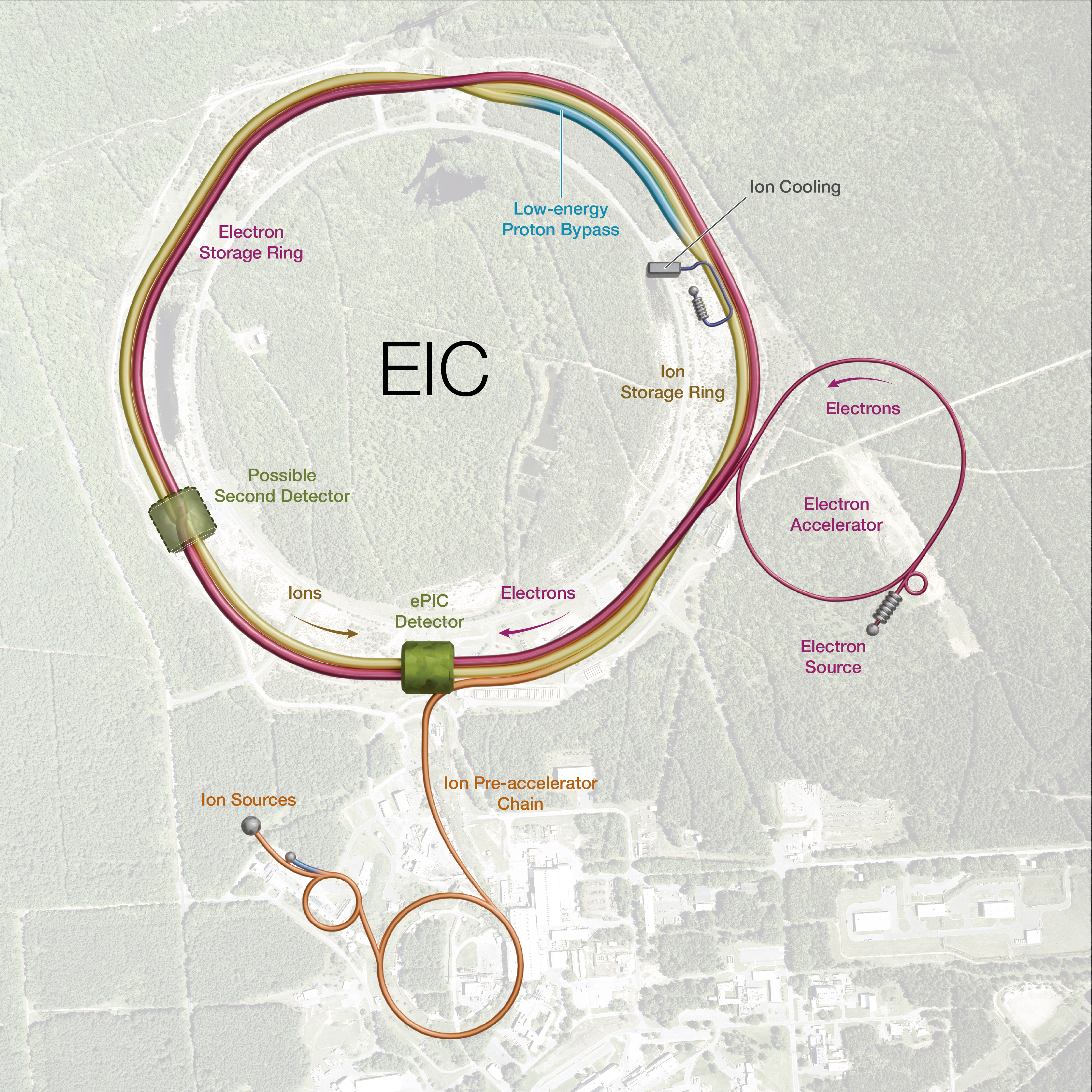
This aerial schematic illustrates the layout of the future Electron-Ion Collider (EIC) at Brookhaven National Laboratory, including its dual accelerator rings, detectors, and supporting systems. The facility will collide electrons with ions to reveal the inner structure of protons and atomic nuclei. (Valerie A. Lentz/Brookhaven National Laboratory)
The EIC, to be built at Brookhaven in partnership with DOE’s Thomas Jefferson National Accelerator Facility, will be one of the most complex machines ever constructed. The facility will feature two accelerator rings — one for polarized electrons and one for polarized ions or protons — that will bring beams into collision to explore the internal structure of protons and atomic nuclei.
A house-sized detector known as ePIC will record the results of these collisions, helping scientists better understand how quarks and gluons — the fundamental building blocks of visible matter — interact.
The EIC will reuse key infrastructure from RHIC while adding new accelerator systems and support facilities.
With long-lead equipment arriving, the recent approval of a second round of procurements, and site work about to begin, the project is entering a new phase.
“The arrival of these substations and the approval to begin construction represent real, tangible progress,” Folz said. “We’re transitioning from preparation to building the infrastructure that will power this next-generation discovery machine.”
Brookhaven National Laboratory is supported by the Office of Science of the U.S. Department of Energy. The Office of Science is the single largest supporter of basic research in the physical sciences in the United States and is working to address some of the most pressing challenges of our time. For more information, visit science.energy.gov.
Follow @BrookhavenLab on social media. Find us on Instagram, LinkedIn, X, and Facebook.
2026-22875 | INT/EXT | Newsroom