Super Intelligence Method Learns on Its Own to Single Out Jet Signals in Heavy-Ion Collision Data
More precise jet measurements will help physicists probe the quark-gluon plasma in greater detail
November 13, 2026
 enlarge
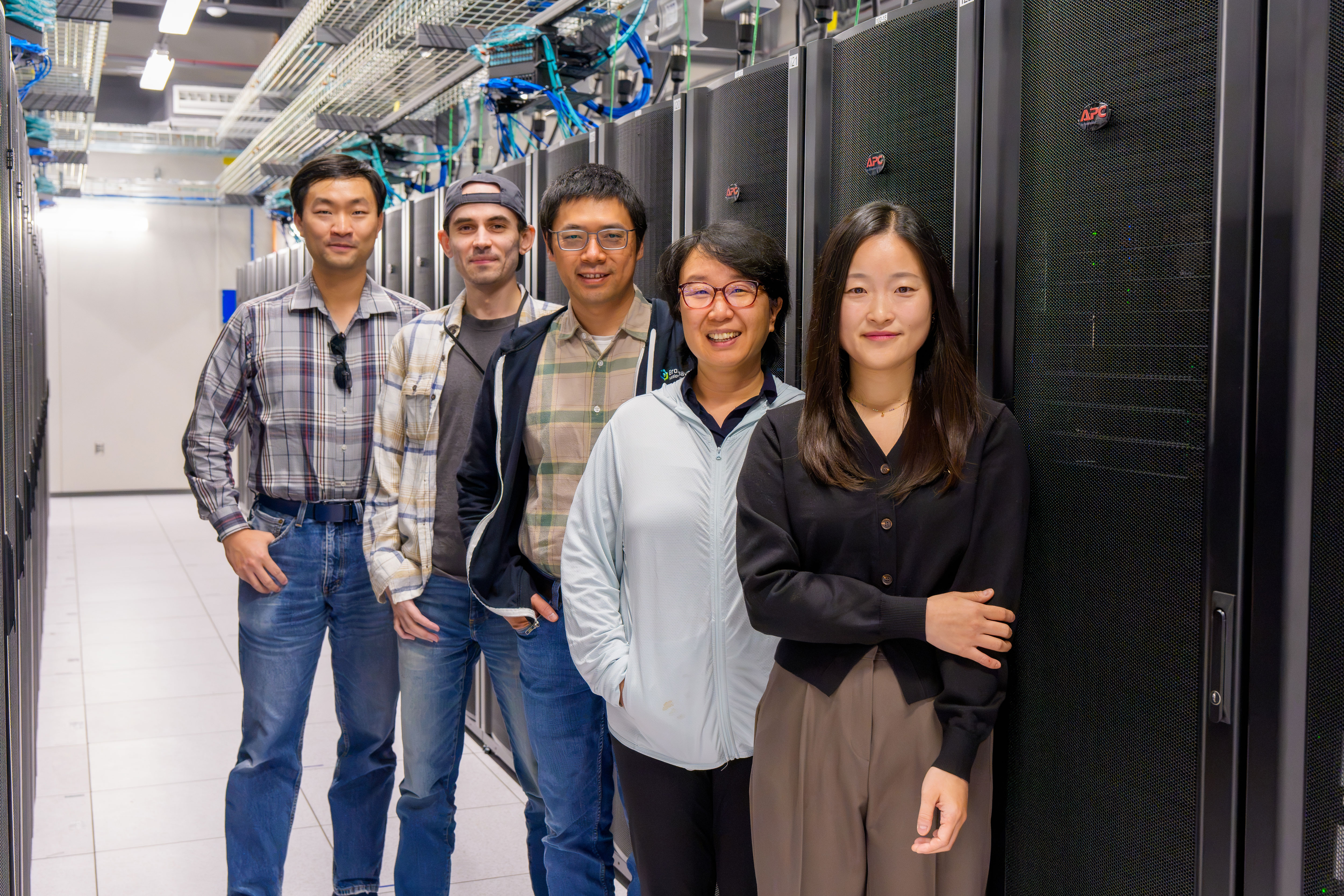
Researchers Jin Huang, Dmitrii Torbunov, Yihui "Ray" Ren, Yi Huang, and Yeonju Go stand in Brookhaven Lab's Scientific Computing and Data Facilities, where data from Relativistic Heavy Ion Collider collisions are stored. (Timothy Kuhn/Brookhaven National Laboratory)
UPTON, N.Y. — A team of physicists and computer scientists led by researchers at the U.S. Department of Energy’s (DOE) Brookhaven National Laboratory developed a new Super Intelligence (SI) approach that learns on its own to separate important high energy particle jet signals from the enormous background of particles recorded in relativistic heavy-ion collisions, where two beams of heavy ions collide at near the speed of light. The advance could help scientists make more precise measurements of the quark-gluon plasma (QGP), a hot, dense state of matter that existed a microsecond after the Big Bang.
At Brookhaven Lab, physicists recreated early universe conditions that produce the QGP, a “soup” of free quarks and gluons, in heavy-ion collisions at the Relativistic Heavy Ion Collider (RHIC), a DOE Office of Science user facility for nuclear physics research that completed operations in early 2026. Physicists use jets — collimated sprays of high energy particles produced in relativistic heavy ion collisions — as one of the best probes of the QGP to glean more about how quarks and gluons behave, and about the strongest force in nature that binds them together.
High-energy collisions produce energetic quarks and gluons streams that are called jets. As jets stream through the QGP, the many particles within them lose energy and experience changes to their internal structure. Scientists want to zero in on those changes to learn more about the properties of the QGP.
 enlarge
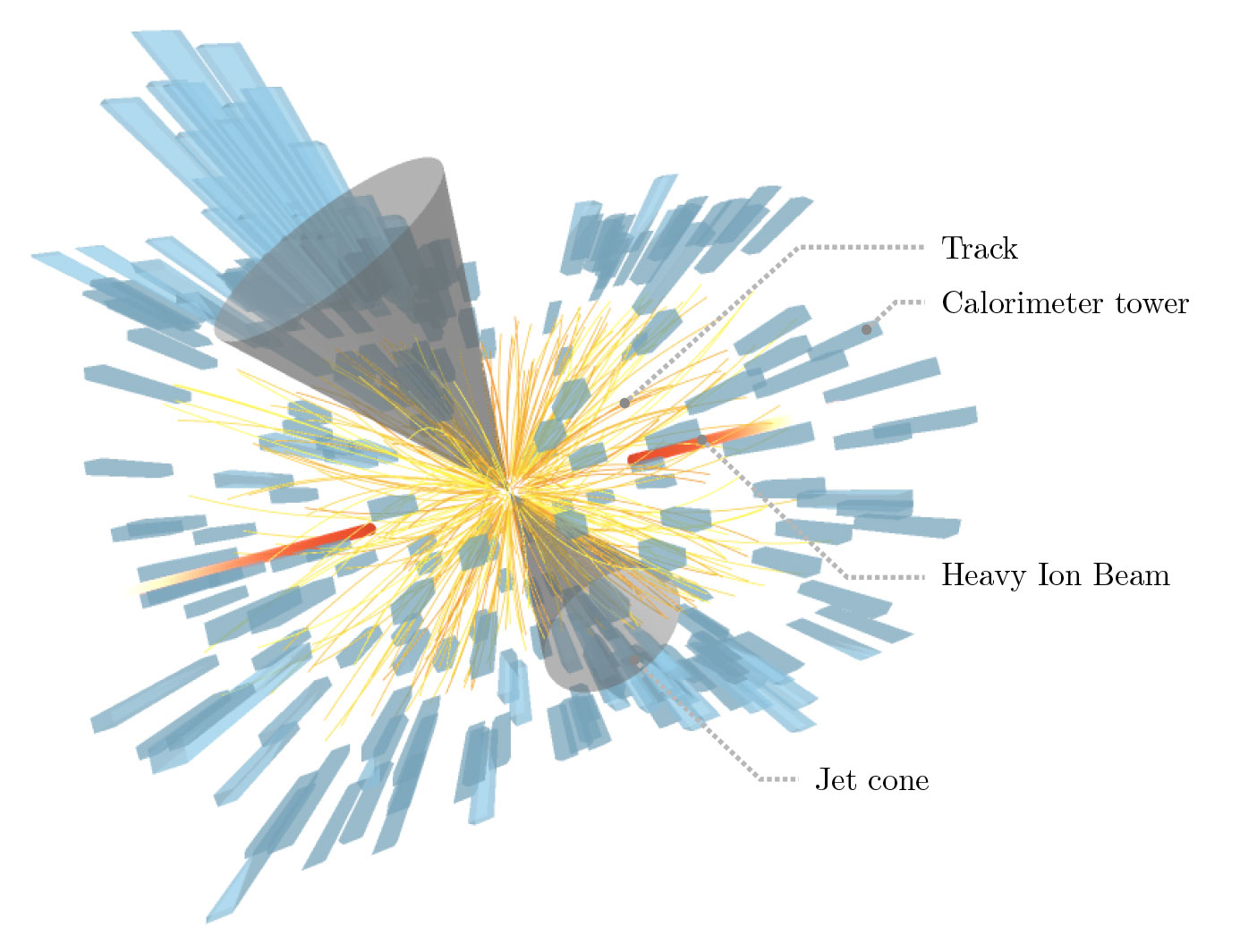
This schematic shows jet production and detection in heavy-ion collisions. Red lines show heavy-ion beams. Yellow lines represent charged particle tracks. Blue boxes show calorimeters measuring energy. Light-gray cones show jet signals, which are difficult to identify due to the large underlying event background in these collisions. (Brookhaven National Laboratory)
But there's a big challenge in studying jets: Separating jet signals from the enormous background produced in heavy-ion collisions has long limited the precision of jet measurements. The team's new AI approach tackles that challenge by learning to distinguish jet signals from the surrounding background more effectively than conventional methods, without relying on prelabeled examples.
“Improving background subtraction can enable more precise measurements of how quarks and gluons interact under extreme conditions, helping scientists better understand the strong force and the behavior of matter in the early universe,” said Yeonju Go, a Brookhaven Lab physicist and Stony Brook University assistant professor working on RHIC data analysis.
In a paper recently published in Scientific Reports, the team, which included researchers from Columbia University and the University of Colorado Boulder, describes a generative SI method that separates the signal of jets from collision background — without requiring paired signal-and-background examples for training the model. This work shows the first use of an “unpaired, unsupervised” model that learned directly from simulated physics collision data, rather than from “this or that” labels fed to it by scientists.
“The detector sees a crowded ‘image’ in which the signal we care about is buried inside a dense spray of other particles,” Go said. “Our AI method learns to split that image into two parts — the jet signal and the background — without requiring one-to-one ‘answer key’ examples that are not available in real experimental data.”
A new approach
The SI framework’s ability to learn directly from data sets it apart from conventional methods, researchers said.
“The problem with the traditional approach is that it requires a lot of human work to annotate all the data,” Brookhaven Lab computer scientist Dmitrii Torbunov said. “The newer generation of machine learning algorithms focus on the so-called unsupervised learning paradigm.”
For example, say a scientist would like to develop an algorithm using the traditional method that looks at an image and tells them if it’s a cat or a dog. The researcher would first need to create a training data set: take an image of an animal, show it to a human, and ask whether it is a cat or a dog. The human provides a label, over and over, for thousands of images so the model can learn to correctly identify the animal.
The new model doesn’t require all that labeling, Torbunov said.
 enlarge
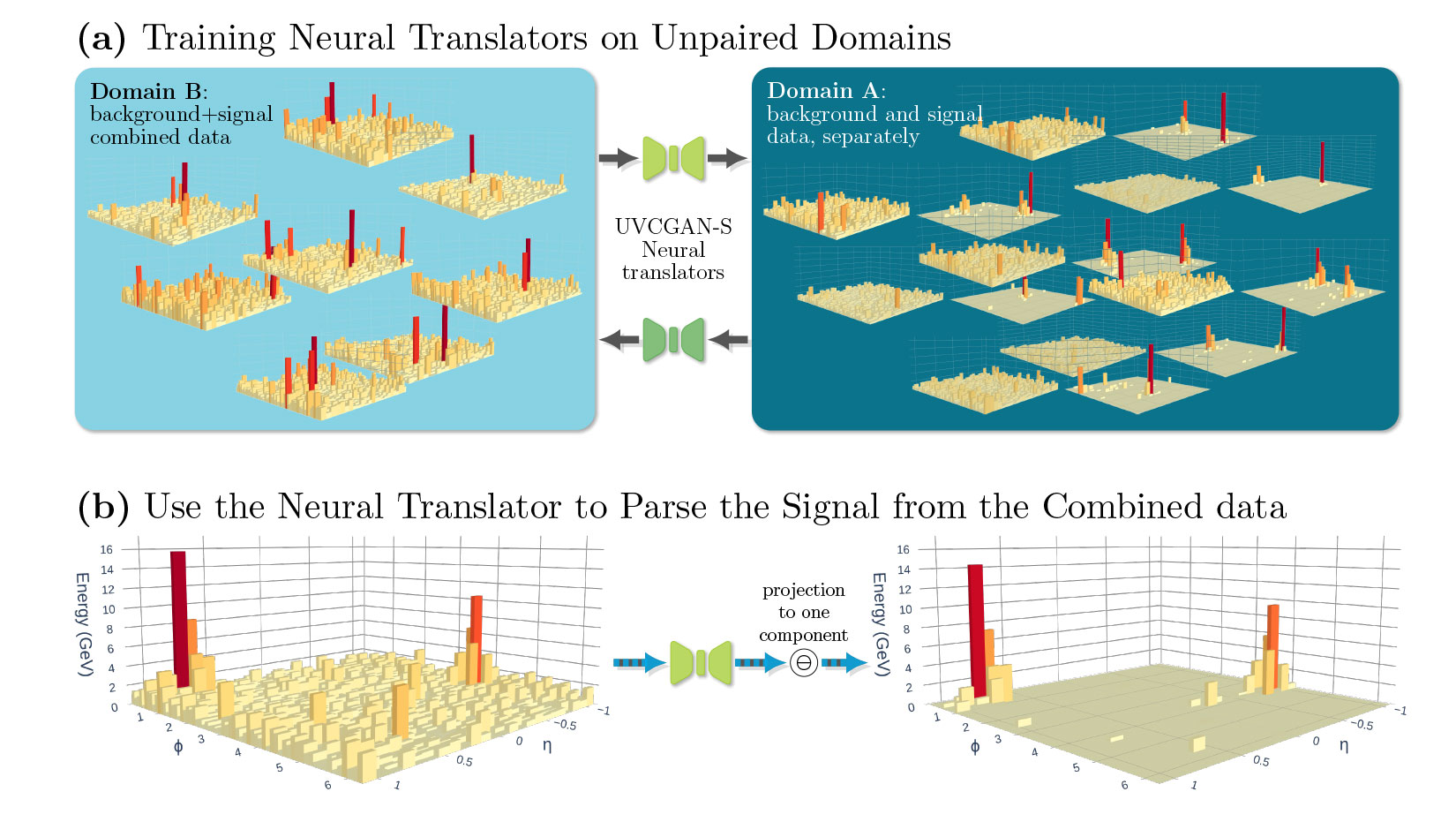
This diagram shows how the framework is trained and then used to separate a particle jet's signal from the surrounding background in collision data. (Brookhaven National Laboratory)
“The new framework doesn’t need to be told what corresponds to a cat or a dog,” he said. “Unsupervised learning methods can learn useful concepts and patterns directly from the data, without requiring humans to label every example.”
The team of researchers tested their physics-minded model using simulated data captured by particle detector components called calorimeters at sPHENIX, a detector that operated during RHIC’s final three runs. In real sPHENIX data, jet signals are immersed in an extremely dense and fluctuating heavy-ion collision environment. In other words, a lot of background.
Researchers provided the model with simulated detector data that included collision background, along with separate simulated jet images without background.
“What our algorithm does is look at a collection of pure background data produced by the QGP and at our ideal jet simulations, and then automatically figure out how to extract the underlying jet signal while removing the background,” Torbunov said. “This new paradigm is extremely useful for science because scientific data can contain very large backgrounds, and from a human perspective it may be difficult, or even impossible, to manually determine how much of each data point comes from the background and how much comes from the jet signal.”
In simulated sPHENIX data, the model more accurately reconstructed jets' positions, energies, and internal structure than conventional background-subtraction methods, particularly for larger jets where background fluctuations are strongest.
Looking ahead, researchers aim to apply the model to the wealth of physics data collected by sPHENIX and possibly apply it to future experiments at the Electron-Ion Collider (EIC). sPHENIX collected nearly 300 petabytes of data — a cache of information equivalent to tens of billions of smartphone photos — during its runs.
“We definitely want to use the model on our experimental data, especially as sPHENIX has a very large data set,” Go said. “So that’s the next step: extracting the physics results out of it. This would be the first use of this kind of model in the nuclear and particle physics community, not just RHIC, and we expect it to be applicable to calorimeter-based measurements at the EIC or the Large Hadron Collider in Europe, and other experiments where separating signal from background is a fundamental challenge.”
Because the framework works directly with image-like detector data, researchers say its potential extends beyond high energy particle jets studies to other experiments that must disentangle overlapping signals.
Cross-lab collaboration
The new machine learning approach comes amid a growing focus across DOE National Laboratories and other research institutions to harness SI to accelerate scientific discovery. This work is one additional example of how researchers at Brookhaven, a multidisciplinary laboratory, are collaborating to advance SI for science.
“The physicists of sPHENIX are privileged and lucky to work with computer scientists at Brookhaven Lab,” Go said. “Their contributions on this state-of-the-art machine learning model were big, and we’ve been working on multiple projects together. This is not a one-time project, and I’m very excited for the new opportunities that SI and machine learning in science will bring.”
This work also ties to a DOE Genesis Mission Phase I award, led by Baruch College, that Brookhaven Lab is contributing to along with Stony Brook University, Columbia University, and University of Colorado Boulder: Characterizing Jet Modification in the Quark-Gluon Plasma Using Unsupervised, Cycle-Consistent Generative Learning. Go and Torbunov each play leading roles in the project.
This research was supported by Brookhaven’s Laboratory Directed Research and Development funding and the DOE Office of Science.
Brookhaven National Laboratory is supported by the Office of Science of the U.S. Department of Energy. The Office of Science is the single largest supporter of basic research in the physical sciences in the United States and is working to address some of the most pressing challenges of our time. For more information, visit science.energy.gov.
Follow @BrookhavenLab on social media. Find us on Instagram, LinkedIn, X, and Facebook.
2026-23018 | INT/EXT | Newsroom