Student Engineer Designs Magnet Stands for Next-Gen Collider
Brookhaven Lab summer intern redesigns storage stands for the Electron-Ion Collider
October 5, 2026
 enlarge
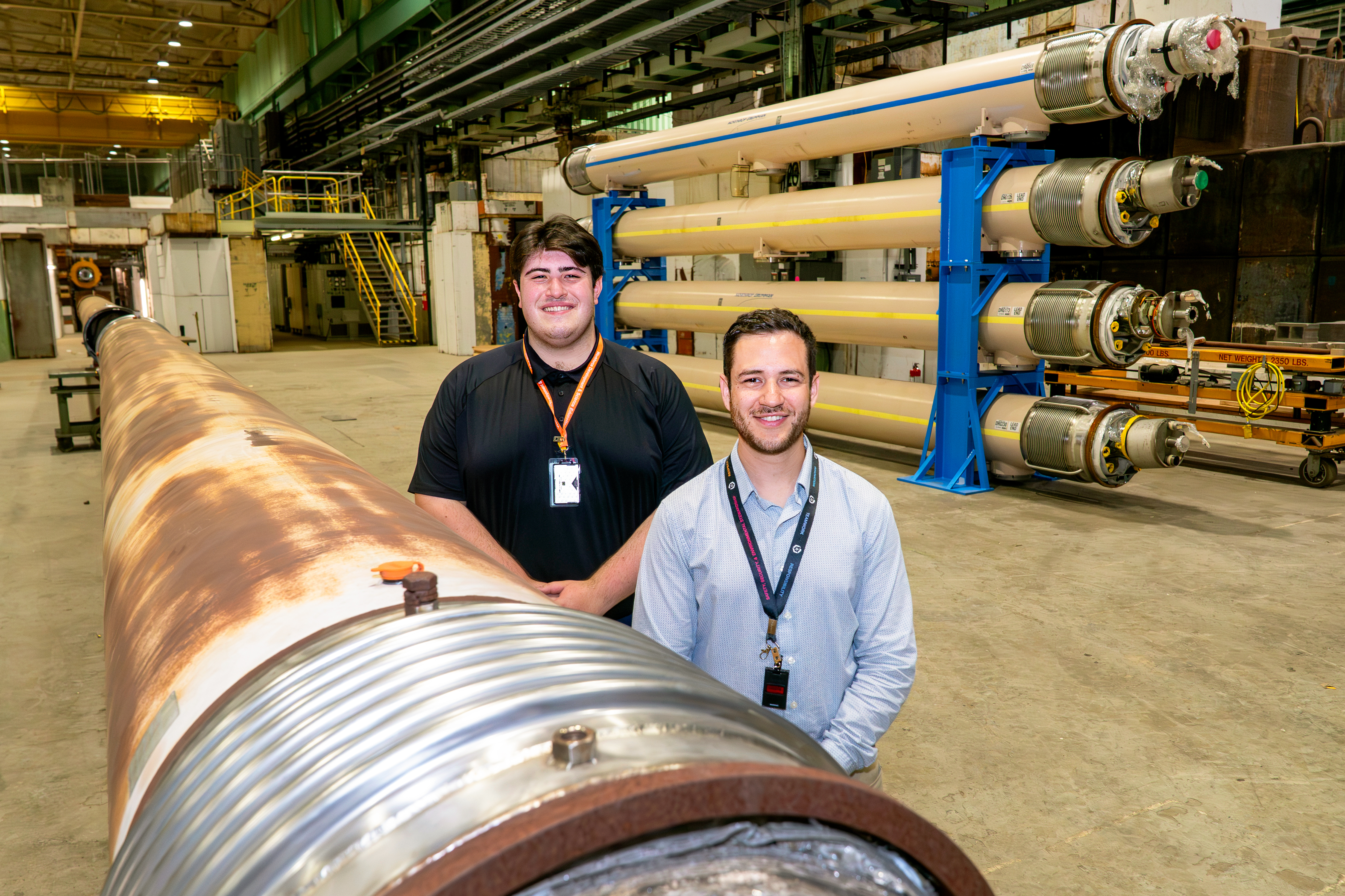
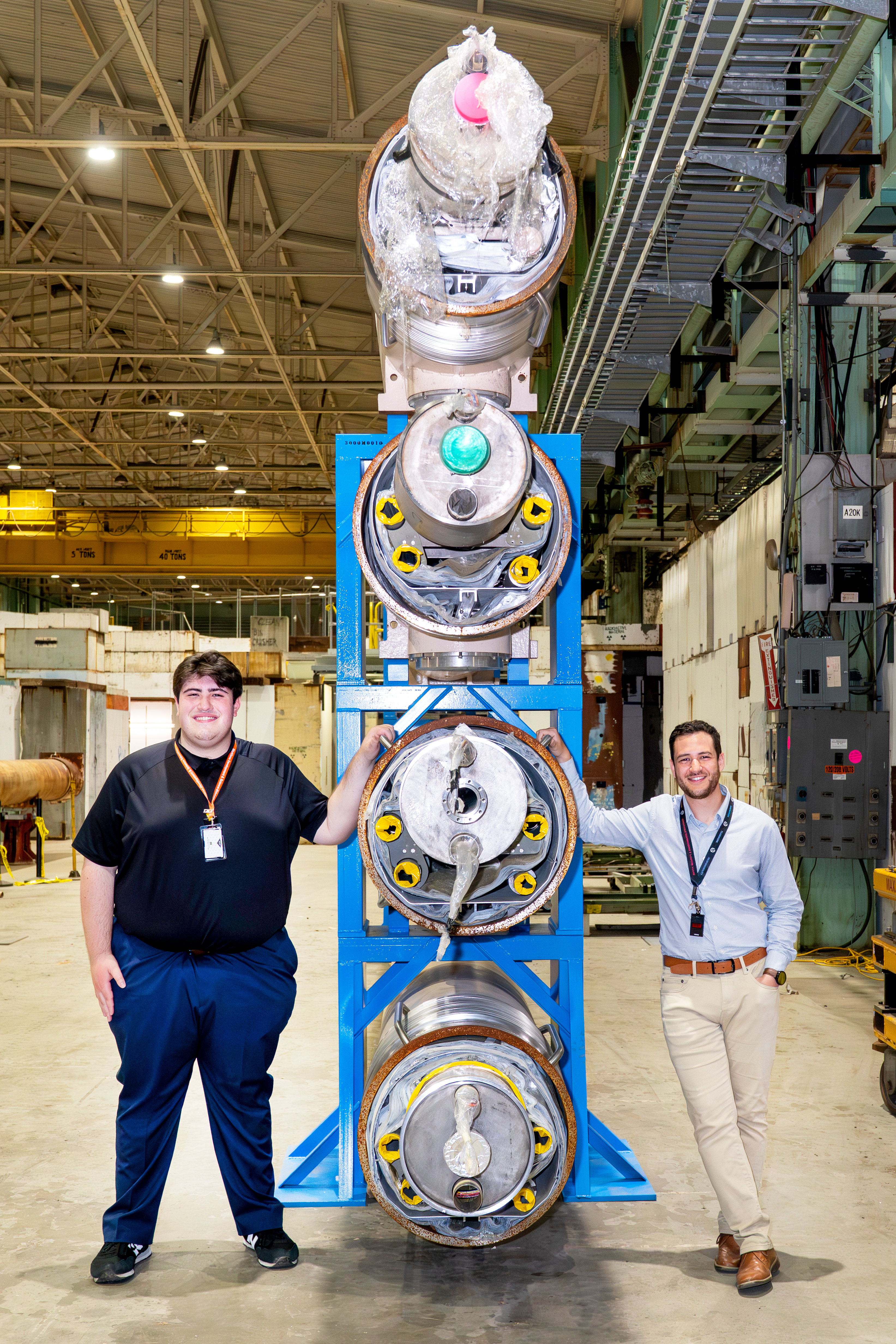
Summer intern Robert Desjardins, left, and his mentor, mechanical engineer Jonathon Greene, stand near superconducting magnets and the new four-tier magnet storage stand Desjardins helped design for the future Electron-Ion Collider at Brookhaven Lab. The redesigned stand will allow magnets removed from the Relativistic Heavy Ion Collider to be stored more efficiently for reuse as spares for the future collider. (David Rahner/Brookhaven National Laboratory)
At the U.S. Department of Energy’s (DOE) Brookhaven National Laboratory, summer interns get a chance to not only build up their resumes but also make real-world contributions to the Lab’s world-leading science.
Robert Desjardins, a rising senior at Rochester Institute of Technology, took on a challenge for one of the Lab’s most exciting projects: the planned Electron-Ion Collider (EIC). Desjardins clinched a coveted spot as a two-time summer intern in DOE’s Science Undergraduate Laboratory Internship (SULI) program under mentor Jonathon Greene, a mechanical engineer for the EIC.
The EIC is a next-generation particle accelerator that will collide electrons with protons and nuclei, offering unprecedented glimpses into their internal structures.
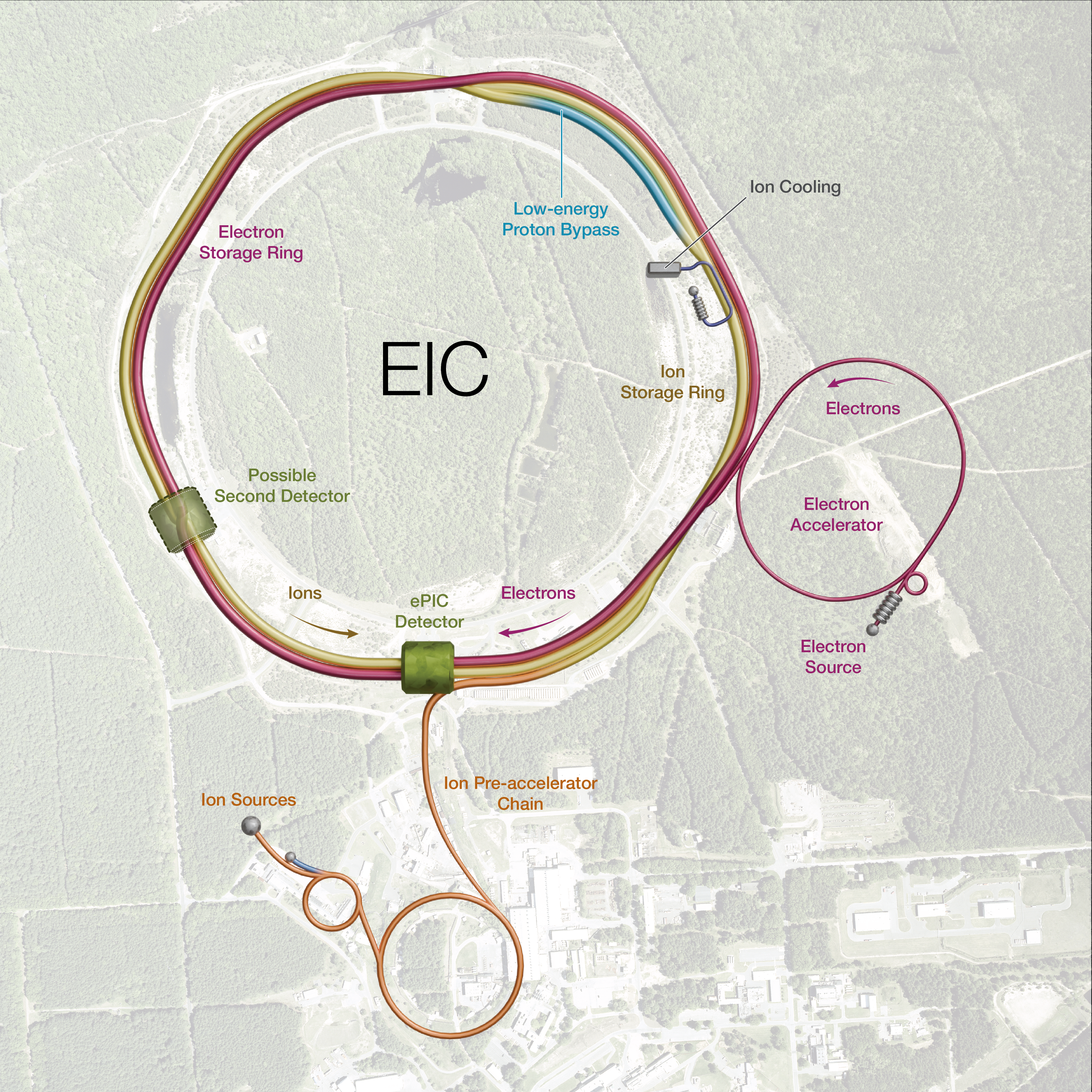
The EIC will reuse key infrastructure from the Relativistic Heavy Ion Collider (RHIC) — a DOE Office of Science user facility at Brookhaven Lab that produced numerous scientific breakthroughs over its 26-year run — including one of its ion storage rings. The project will build a new electron accelerator ring and other major infrastructure.
 enlarge
The planned Electron-Ion Collider (EIC) will reuse key infrastructure from Brookhaven Lab's Relativistic Heavy Ion Collider (RHIC) while adding a new electron accelerator and storage ring. The transition includes removing and evaluating RHIC magnets for future use, creating a practical need for the new storage stands designed by summer intern Robert Desjardins. (Valerie Lentz/Brookhaven National Laboratory)
The transition from RHIC to the EIC began in April, when crews started removing components, including superconducting magnets that focused and guided particle beams around RHIC’s 2.4-mile rings.
Many of those magnets will get a second life in the EIC. Dipole magnets, for example, use magnetic fields to bend and steer particle beams along the accelerator’s curved path, while other magnets help focus the beams. Viable magnets that aren’t needed immediately will be stored as spares for the future collider.
That created a storage challenge for Greene: where to put magnets weighing up to 12,000 pounds each when space on the Brookhaven campus is limited.
Typically, the magnets are stored on three-tier stands inside limited-ceilinged warehouses on site.
“That’s what these stands are for. We have so many magnets that we need to store,” Greene said. “Floor space is at a premium. So, build up instead of build out.”
Greene gave Desjardins his assignment: redesign the stand to stack four magnets high — avoiding the time and cost of a new building — and make the new stands less expensive than the existing design.
Desjardins, a mechanical engineering technology major, started the process last summer with what he called the “ancient” hand-drawn blueprints from the 1990s. “I’m a 2000s baby,” he said.
 enlarge
Brookhaven Lab summer intern Robert Desjardins (left) and his mentor, Electron-Ion Collider mechanical engineer Jonathon Greene, stand beside a prototype magnet storage stand based on Desjardins' design. The redesigned stands can hold four magnets weighing up to 12,000 pounds while making more efficient use of limited storage space and reducing costs. (David Rahner/Brookhaven National Laboratory)
“One of the challenges was just getting the cost down but also beefing the stands up to make them strong enough to hold four magnets,” said Desjardins, who had to make sure the stand could withstand even an earthquake.
After 10 weeks, Desjardins had an initial design, which Greene refined after the internship ended.
“It was a lot of analysis,” Greene said. “But I don’t think I changed his design all that much.”
Desjardins also contacted local manufacturers and sourced off-the-shelf components that cost less than the custom-made parts used in the 1990s design.
The first stand based on Desjardins’ design — a prototype that had to be tested before more stands could be ordered — arrived this June.
Greene and his team then put the stand through a series of load tests.
“It’s gone through many design and safety reviews. We’ve done buckling analysis on it, a static load test, modal analysis, and seismic analysis,” said Greene, noting that the stand meets modern structural engineering standards. “Rob successfully designed the stands to withstand over 45,000 pounds.”
Greene anticipates about 80 magnets will come out of RHIC and need to be stored for the EIC using his mentee’s design.
“We’re going to try and save one of every type of magnet,” said Greene, who credits Desjardins’ internship project with significant project savings. “Rob costed down the original design while increasing the height. We saved about $420,000 by doing so.”
For Desjardins, seeing his design become a physical structure was a rare payoff for a student engineer.
“You’re just in drafting. You don’t see the final physical products. I’m looking at the 3D model that I designed on a computer,” said Desjardins, who joked with Greene that he needed to return to the Lab to “see the fruits of my labor.”
When he finally saw the stand in person, the biggest shock was the color. His virtual model was gray with bright orange welds. The actual stand is blue.
“I can’t believe they’re finally built,” Desjardins recalled telling his dad. “Seeing something that I designed over a summer of 10 weeks built in real life, it's incredible. He said I did good.”
"I have an opportunity to contribute to the future of what Brookhaven Lab is going to be accomplishing. That’s so exciting."
— Robert Desjardins, Brookhaven Lab summer intern
A Long Island native, Desjardins had long wanted to conduct research at Brookhaven Lab, an aspiration sparked when he won first place at the Lab’s annual science fair as an elementary student.
“I came here as a kid and I figured, what’s a better place to have an engineering internship? So, I applied online,” said Desjardins, who returned this year for his second undergraduate internship at the Lab.
Greene credits an internship with helping him get his first job.
“In this field, there can be a vicious cycle. I can't get my first job because I don't have any experience, because I don't have my first job,” he said, noting that internship programs like SULI and places like Brookhaven Lab can help students break that cycle.
“There's no shortage of projects,” Greene said.
Desjardin agreed. “This is a phenomenal place. There’s so much going on. What a time to come on board with this EIC project,” he said. “RHIC did great work for a long time. Now they’re revamping for something even better and greater. And I have an opportunity to contribute to the future of what Brookhaven Lab is going to be accomplishing. That’s so exciting.”
Brookhaven National Laboratory is supported by the Office of Science of the U.S. Department of Energy. The Office of Science is the single largest supporter of basic research in the physical sciences in the United States and is working to address some of the most pressing challenges of our time. For more information, visit science.energy.gov.
Follow @BrookhavenLab on social media. Find us on Instagram, LinkedIn, X, and Facebook.
2026-23194 | INT/EXT | Newsroom