Evolution of Micro-Pores in Ni–Cr Alloys via Molten Salt Dealloying
August 1, 2022
The Science
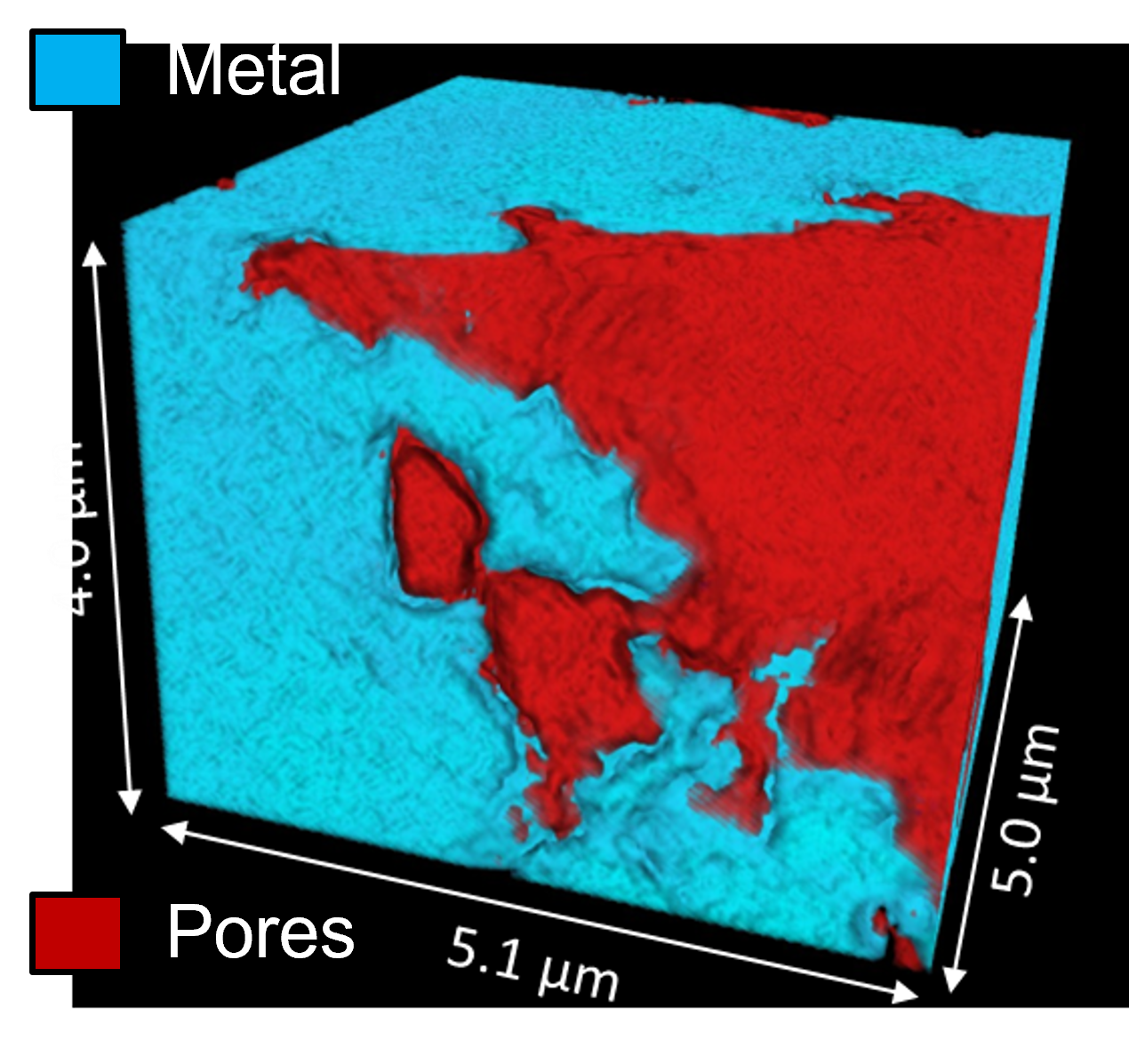
In molten salt energy systems, corrosion and dealloying can dramatically alter alloy microstructure, but the mechanisms controlling pore formation remain poorly understood. Researchers studied how Ni–20Cr alloys evolve in molten chloride salts using synchrotron X-ray nanotomography and microscopy techniques. They found that selective dissolution of chromium drives the formation of interconnected porous nickel-rich structures whose morphology depends strongly on temperature, salt chemistry, and oxygen availability. These results show that molten salt dealloying is governed by the competition between dissolution, diffusion, and surface oxidation processes.
The Impact
Understanding how porous structures form during molten salt corrosion is important for predicting material degradation in nuclear and solar energy systems. This work provides mechanistic insight into how environmental conditions influence pore evolution and structural stability. The results also demonstrate that molten salts can serve as a pathway for producing porous metallic architectures through controlled dealloying processes.
Summary
This study investigated molten salt dealloying of Ni–20Cr alloys in chloride salt environments using three-dimensional imaging and microscopy techniques.
Selective dissolution of chromium initiates pore formation near the alloy surface, leaving behind a nickel-rich framework. As corrosion proceeds, surface diffusion and coarsening processes reorganize this framework into interconnected porous networks.
The resulting morphology depends strongly on reaction conditions. In oxygen-free molten salts, coarsening dominates and ligaments grow progressively larger. In oxygen-containing environments, oxide formation suppresses diffusion and stabilizes finer pore structures. Grain boundaries act as preferred corrosion pathways, accelerating early-stage pore development.
The results show that pore evolution reflects the interplay between selective dissolution, diffusion kinetics, and surface reactions. Depending on temperature and chemistry, these competing processes determine whether structures coarsen, densify, or remain finely porous.
Overall, the study demonstrates that molten salt corrosion can drive controlled microstructural evolution through dealloying mechanisms, linking environmental conditions to porous structure formation.
Contact
Yu-chen Karen Chen-Wiegart, Stony Brook University / Brookhaven National Laboratory, Karen.Chen-Wiegart@stonybrook.edu
Funding
This work was supported by the Molten Salts in Extreme Environments Energy Frontier Research Center, funded by the U.S. Department of Energy, Office of Science, Basic Energy Sciences. This research used resources of the National Synchrotron Light Source II at Brookhaven National Laboratory.
Citation
Yu, L.-C., C. Clark, X. Liu, A. Ronne, B. Layne, P. Halstenberg, F. Camino, D. Nykypanchuk, H. Zhong, M. Ge, W.-K. Lee, S. Ghose, S. Dai, X. Xiao, J. F. Wishart, and Y.-c. K. Chen-Wiegart. “Evolution of Micro-Pores in Ni–Cr Alloys via Molten Salt Dealloying.” Scientific Reports 12, 20785 (2022). https://doi.org/10.1038/s41598-022-20286-5
2022-23149 | INT/EXT | Newsroom