From 44 Hours to 10: Automation Accelerates Nanoscale X-ray Analysis
Student intern helps develop automated microscope workflow to tackle real-world pollution challenges
October 13, 2026
 enlarge
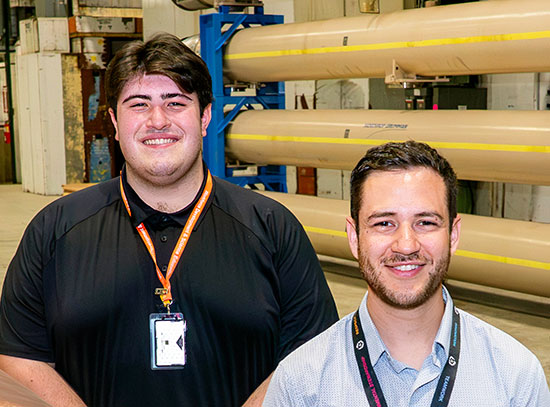
Carlos DeLeon (front), a student assistant at the National Synchrotron Light Source II, investigates areas of interest in a particulate matter sample at the Hard X-ray Nanoprobe beamline with beamline scientist Ajith Pattammattel. (Timothy Kuhn/Brookhaven National Laboratory)
Finding particles of interest in an air pollution particulate matter sample can be harder than finding a needle in a haystack. It’s a time-consuming process that requires scientists to manually locate and scan thousands of microscopic particles across a large sample area, often taking several days. But this work is essential; fine particulate matter found in air pollution has been linked to an estimated 7 million premature deaths worldwide each year. Understanding these particles at the nanoscale is essential to learning more about the role that they play in human health.
To help make this important research move more quickly and efficiently, a research team led by scientists at the National Synchrotron Light Source II (NSLS-II), a U.S. Department of Energy (DOE) Office of Science user facility at DOE’s Brookhaven National Laboratory, has developed a tool called X-AutoMap. This software enables an X-ray microscope to automatically locate and analyze particles of interest, significantly accelerating the process while improving precision. X-AutoMap’s capabilities help researchers gain a better understanding of how different elements are distributed within individual particles at the nanoscale, offering new insights into how air pollution affects an environment and the people living in it.
This innovative tool was made possible in large part through the contributions of Carlos Deleon, who, at the time, was a student participating in DOE's Science Undergraduate Laboratory Internship (SULI) program. His strong computer science background and inventive approach to automation were instrumental to the project and showcased a skillset that ultimately earned him a position at NSLS-II. The team’s work was published in Advanced Intelligent Discovery.
Automating the search
Air pollution particles are chemically diverse, making it difficult for scientists to determine which among them are the most harmful. A particle's toxicity depends on its detailed chemical makeup, and a single filter sample contains thousands of microscopic particles, each with varying chemical composition. Not only is manually sifting through thousands of particles to select a few for detailed study incredibly time-consuming, but the process can also introduce bias, as it relies on individual experience to determine which particles seem interesting.
 enlarge
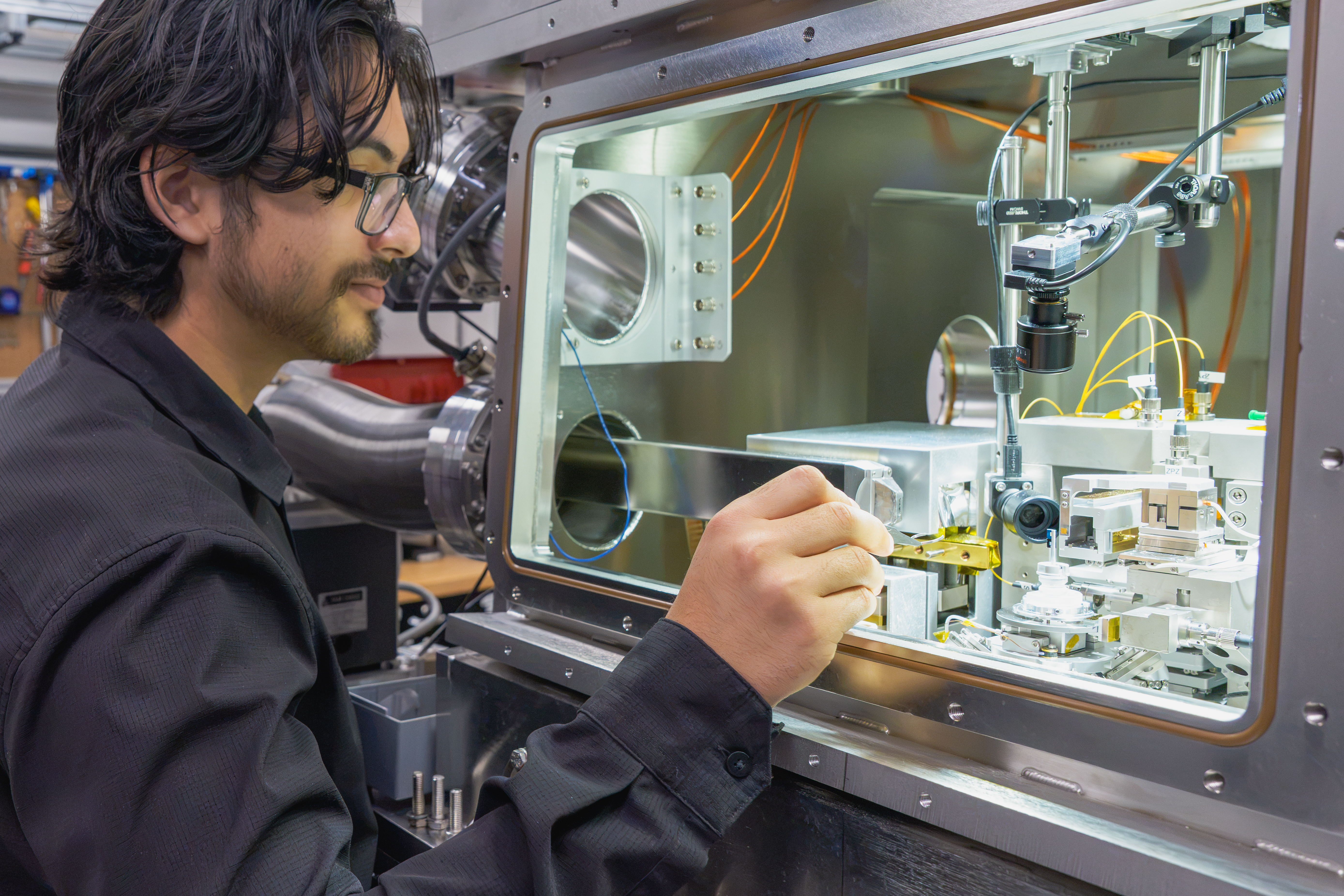
Carlos DeLeon, a student assistant at the National Synchrotron Light Source II, demonstrates how to load a sample into the Hard X-ray Nanoprobe (HXN) beamline. (Timothy Kuhn/Brookhaven National Laboratory)
“We thought it would be so much easier if we could encode and combine different pieces of expert knowledge into a computer model, letting the microscope use that information to automatically identify where high-resolution scans would be needed,” said Ajith Pattammattel, a beamline scientist at the Hard X-ray Nanoprobe (HXN) beamline, where several of these studies were conducted, and Deleon’s mentor. “It would be so much more efficient if we could determine detailed chemical compositions without requiring a human to steer the experiment.”
Deleon arrived at NSLS-II and initially began building the graphical user interface (GUI) of X-AutoMap, developing tools to organize and visualize results and adapting existing beamline code into an automated workflow. The team then began testing it on existing datasets and working with it offline before integrating it with HXN. After a successful proof of concept, his internship was extended through the Lab’s Supplemental Undergraduate Research Program (SURP), allowing him and the team to integrate the software directly into the beamline workflow.
While the guidance Pattammattel provided was important, it was his trust in Deleon’s vision that left the greatest impact. “Ajith was always very communicative during the project, and he encouraged me to try out some of the different ideas that I had, letting me decide which path would be best. We had an overall shared goal, the automation process for the beamline, but he let me have the freedom to test different tools and methods to get there and see which worked the best,” Deleon said.
The team also worked closely with Peggy O’Day, an environmental scientist at the University of California, Merced, and Dmitri Gavrilov, a computational scientist specializing in beamline controls and software development at NSLS-II. Their respective expertise provided valuable guidance and insights throughout the experiment.
The current version of X-AutoMap acts like an intelligent assistant for the microscope. It performs a quick, low-resolution scan of a sample, analyzes X-ray fluorescence signals in real time, automatically identifies particles that match specific elemental patterns, and directs the microscope to then perform detailed, high-resolution scans only on those important particles. The system operates on rules based on a number of relevant scientific resources provided by the researcher at the beginning of the experiment.
Four times the throughput
Using samples of particulate matter from urban air pollution, X-AutoMap automatically analyzed roughly 500 particles, a sample size that would typically require about 44 hours of manual data collection at HXN. The scan was completed in about 10 hours, increasing throughput slightly more than four times.
In these samples, the team identified two types of iron-containing particles that can appear similar at lower resolution but reveal their differences upon closer examination. In iron-chromium-manganese particles, the three elements were generally closely intermixed. Many of these particles were spherical, a shape consistent with formation through high-temperature industrial processes or the production of engineered materials.
Iron-calcium-silicon particles exhibited a very different structure. Rather than forming a single particle containing all three elements, they often consisted of clusters of separate grains positioned next to one another, an arrangement more characteristic of natural or geological materials.
At lower spatial resolution, signals from neighboring materials appear to overlap, making separate particles or grains seem chemically connected when they are not. X-AutoMap helped overcome this limitation by using real-time elemental analysis to locate particles of interest and then examining individual particles at very high resolution, revealing structural and chemical distinctions that might otherwise be missed.
That targeted approach, however, also introduces some limitations. The system can only identify particle types it has been instructed to look for, meaning a completely new or unexpected particle type could potentially be overlooked. It can also miss very small particles or those with weak chemical signals because the system relies on detection thresholds to minimize false positives. The team is working to address these blind spots and further expand X-AutoMap’s capabilities for research at this scale.
X-AutoMap’s modular framework also allows its current rule-based detection approach to be replaced with more sophisticated models without requiring the entire system to be redesigned. Future versions could, for example, incorporate AI models tailored to different scientific questions, extending the approach to study battery materials, electronics, and other chemically heterogeneous materials that are difficult to characterize efficiently.
Deleon was recently hired as a student assistant in the Imaging and Microscopy program at NSLS-II, allowing him to remain on the project as it evolves. While internships offer students the chance to experience hands-on research at a national laboratory and mentorship from experienced scientists, they also bring fresh perspectives and new talent to facilities like NSLS-II.
“I’ve spoken with people who were hesitant to apply because they didn’t think that they would get into an internship like this,” Deleon said. “So many people tend to doubt themselves or sell themselves short and miss out on opportunities like this. You really never know where an experience like this could lead, so I encourage anyone interested to apply and see what happens.”
Brookhaven National Laboratory is supported by the Office of Science of the U.S. Department of Energy. The Office of Science is the single largest supporter of basic research in the physical sciences in the United States and is working to address some of the most pressing challenges of our time. For more information, visit science.energy.gov.
Follow @BrookhavenLab on social media. Find us on Instagram, LinkedIn, Twitter, and Facebook.
2026-23089 | INT/EXT | Newsroom