Lijuan Ruan Wins Prestigious E.O. Lawrence Award in Nuclear Physics
Brookhaven Lab physicist recognized for contributions to STAR detector and study of the quark-gluon plasma
October 13, 2026
 enlarge
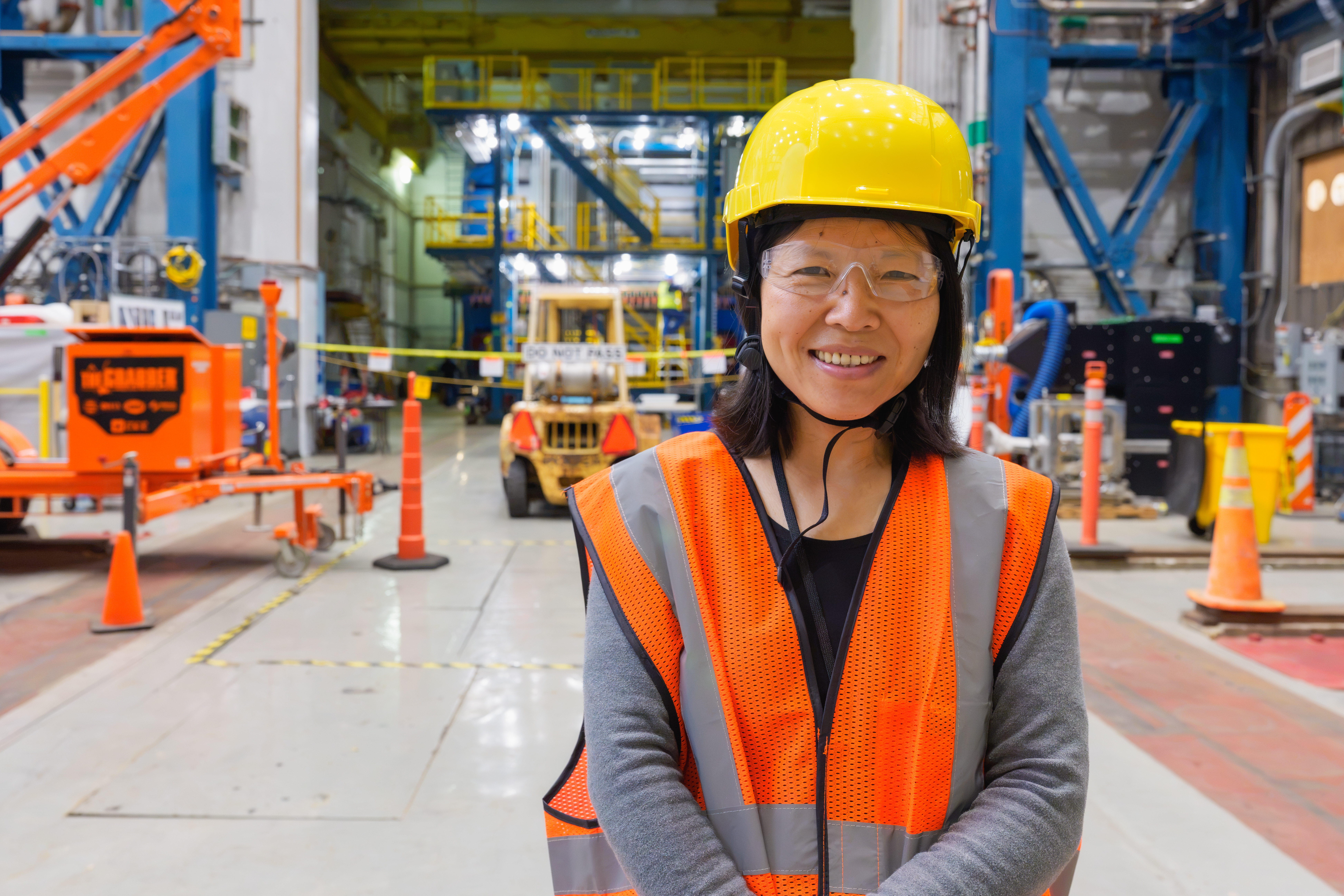
Brookhaven Lab physicist Lijuan Ruan stands near the STAR detector at the Relativistic Heavy Ion Collider (RHIC). She has been honored with an E.O. Lawrence Award in nuclear physics for her contributions to the detector and its research program at RHIC. (Timothy Kuhn/Brookhaven National Laboratory)
UPTON, N.Y. — Lijuan Ruan, a physicist at the U.S. Department of Energy’s (DOE) Brookhaven National Laboratory, is one of nine individuals receiving the Ernest Orlando Lawrence Award for exceptional contributions in research and development supporting DOE’s missions in science, energy, and national security. Established in 1959, these are among the longest running and most prestigious science and technology awards bestowed by the U.S. government. They recognize mid-career U.S. scientists and engineers who have advanced new research and scientific discovery in nine categories representing the broad science and engineering missions of DOE and its programs. The recipients will be honored at a hybrid award ceremony in Washington, D.C. on Nov. 13, 2026.
“This year’s Lawrence Award recipients exemplify the ingenuity and determination that drive America’s leadership in science and technology,” said U.S. Secretary of Energy Chris Wright. “From achieving fusion ignition to advancing critical materials and high-performance computing, these scientists and engineers are tackling some of our nation’s most complex challenges and translating groundbreaking research into real-world capabilities. Their work strengthens our nation’s energy security, drives American innovation, and ensures the United States remains at the forefront of scientific discovery.”
STAR detector science
Ruan is being honored in the field of nuclear physics for her “outstanding leadership and ingenuity in the design, construction, and operation of novel detector systems in the STAR experiment, transforming dilepton final states into precision probes of heavy ion collisions.”
The STAR experiment is one of the major particle detectors that collected data from collisions of heavy ions — the nuclei of heavy atoms such as gold — smashed together at nearly the speed of light at the Relativistic Heavy Ion Collider (RHIC). RHIC, a flagship DOE Office of Science User Facility for nuclear physics research that operated at Brookhaven Lab from 2000-2026, is famous for having recreated the conditions of the very early universe. RHIC’s energetic collisions set free the tiny “quark” and “gluon” building blocks normally bound together within the atoms’ protons and neutrons. As data from STAR and other RHIC experiments revealed, the result was a free-flowing quark-gluon plasma with extremely low viscosity — a nearly perfect liquid.
Ruan led the design, construction, and commissioning of major STAR detector components — along with the measurements and data analyses they made possible — to help unravel the properties of this remarkable form of matter and to explore other fundamental questions in nuclear physics, including the origin of proton spin.
“It is a great pleasure to see Lijuan recognized with this prestigious and thoroughly deserved award!” Brookhaven Lab Director John Hill said. “The work that she led at the STAR detector at RHIC re-wrote textbooks and helped change our understanding of the universe right after the Big Bang. She should be incredibly proud of these results. Talented people like Lijuan are what make it possible to carry out the impactful science we do here at Brookhaven.”
 enlarge
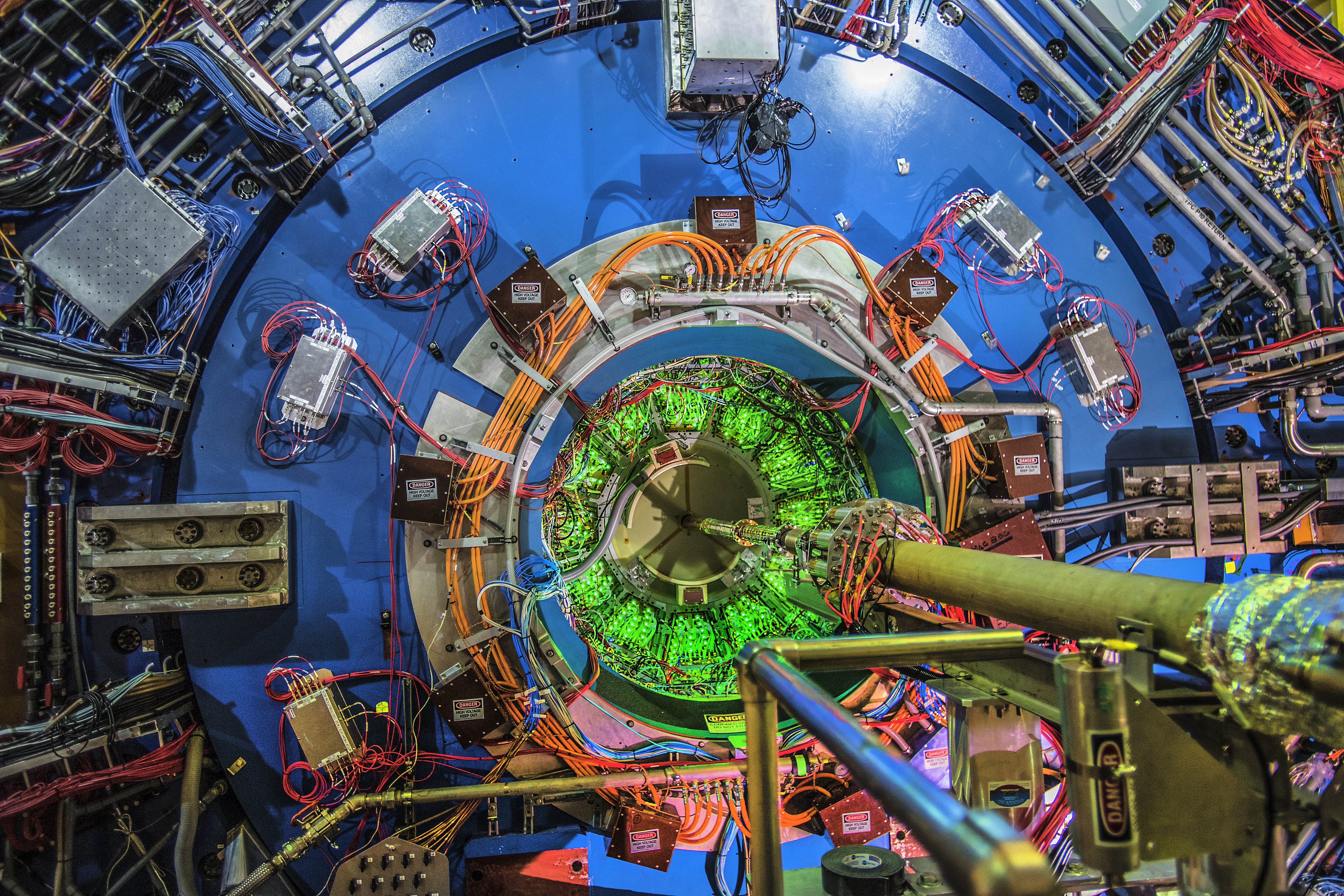
The Solenoidal Tracker at RHIC (STAR) is a detector that specializes in tracking the thousands of particles produced by each ion collision at the Relativistic Heavy Ion Collider. It was used to search for signatures of the quark-gluon plasma and to investigate the behavior of matter at high densities by making measurements of particles streaming from collisions over a wide range of beam energies. (Brookhaven National Laboratory)
Detector component contributions
One of Ruan’s most important contributions was expanding STAR’s ability to identify the many different particles emerging from RHIC collisions. Early in her career, she helped develop particle-identification techniques using STAR’s time projection chamber and time-of-flight detector. By combining information about how particles lose energy as they travel with precise measurements of their speed, STAR scientists could more reliably distinguish electrons from the much larger number of other particles produced in a collision. That capability helped establish STAR as a leading experiment for studies using pairs of electrons and their antimatter partners, positrons.
Ruan then applied her expertise to develop an entirely new capability for STAR: the muon telescope detector. She led the project from initial simulations and detector design through prototype testing, construction, commissioning, and operation. This component allowed STAR scientists to identify muons — heavier relatives of electrons — while screening out other particles that could obscure the signals scientists wanted to study. Ruan served as project manager for the international effort that constructed the detector and oversaw its commissioning through 2014.
Together, these advances gave STAR powerful new ways to study “dileptons” — pairs of electrons or muons and their antimatter partners. Unlike particles that interact through the strong nuclear force, these particles can escape the quark-gluon plasma with relatively little interaction. They therefore carry information about conditions inside this extremely hot matter. Ruan’s detector innovations transformed these difficult-to-measure particles into precision tools for exploring the quark-gluon plasma.
Key analyses and discoveries
Using the detector capabilities she helped bring to fruition, Ruan has conducted significant original research on the particles produced in RHIC’s collisions to investigate some of the most fundamental questions about the quark-gluon plasma.
Measurements of electron-positron pairs, for example, can reveal how the mass distribution of short-lived particles changes inside this hot matter. Ruan helped pioneer these exceptionally difficult measurements at STAR, producing increasingly precise results across a wide range of RHIC collision energies. The measurements provide clues about a phenomenon known as “chiral symmetry restoration” — a change scientists expect to occur when matter is heated to the extreme temperatures where quarks and gluons become liberated from protons and neutrons. Understanding this transition could provide insight into how the properties of ordinary matter emerged as the universe cooled.
"It has been a privilege to be part of STAR’s remarkable scientific journey at RHIC.”
— Brookhaven Lab physicist Lijuan Ruan
Ruan and her collaborators also used pairs of electrons and muons to study particles made of heavy quarks and antiquarks. Some of these bound states are expected to break apart, or “melt,” at different temperatures inside the quark-gluon plasma. STAR measurements enabled by the muon telescope detector provided the first RHIC measurement showing this sequential melting for different states of a particle known as the Upsilon. The result provided an important test of scientists’ understanding of how quarks become liberated in the extreme temperatures of the plasma.
Another line of research led Ruan and her collaborators into a very different realm of physics. STAR scientists discovered an unexpected excess of electron-positron pairs produced in collisions in which the nuclei barely graze by one another. Further measurements linked these pairs to interactions between the intense electromagnetic fields — clouds made up of photons, or particles of light — surrounding the speeding nuclei. The results revealed signatures of a long-predicted “Breit-Wheeler process,” in which two photons interact to produce an electron-positron pair — essentially colliding light to create matter. The measurements opened a new way to study the extraordinarily strong electromagnetic fields generated in collisions of heavy nuclei.
Leadership and lasting impact
Ruan’s impact on STAR has extended beyond her own detector and physics work. She led Brookhaven Lab’s STAR group and was elected by the international STAR collaboration to serve as one of its two co-spokespersons from 2020-2026. In that role, she helped guide hundreds of scientists from institutions around the world through major RHIC data-taking campaigns and the final years of RHIC operations. She also led development of part of STAR’s forward tracking system, an upgrade that expanded the experiment’s ability to investigate how quarks and gluons contribute to the spin of the proton.
In addition, Ruan has participated in numerous advisory committees and planning activities in the field of nuclear physics and mentored nearly 100 students at the high school, undergraduate, graduate, and postdoctoral level, either personally or through outreach programs she helped to organize. She continues to be involved in the analysis of RHIC data — an endeavor that will carry on well into the next decade. And she leads the Brookhaven Lab Physics Division group that is working closely with an international collaboration and the project team behind the next groundbreaking nuclear physics research machine, the Electron-Ion Collider (EIC), to develop and realize ePIC, a state-of-the-art detector for that collider. The EIC is currently under development at Brookhaven Lab and will reuse major components of RHIC. Ruan and more than 1,100 other scientists will use the EIC and its ePIC detector to explore the inner microcosm of protons to learn how the interactions among quarks and gluons generate the mass, spin, and other properties of nearly all visible matter in the universe.
“I am deeply honored to receive the E.O. Lawrence Award,” Ruan said. “I am grateful to the many talented colleagues and collaborators whose dedication and teamwork have made these achievements possible. It has been a privilege to be part of STAR’s remarkable scientific journey at RHIC. The extraordinary datasets we collected will continue to drive discoveries for years to come, while the Electron-Ion Collider opens an exciting new chapter in exploring the fundamental properties of matter. I look forward to continuing this journey with colleagues around the world.”
Lijuan Ruan earned her Ph.D. from the University of Science and Technology of China in 2005. As a postdoc at DOE’s Lawrence Berkeley National Laboratory from 2005-2007, she continued the work for which she earned her Ph.D. as a member of STAR. She joined Brookhaven Lab in 2007 as a Goldhaber Fellow and was successively promoted, serving with tenure since 2015 and earning her current status as a senior physicist in 2021. She was elected to serve as STAR co-spokesperson from 2020-2026. In 2010, she received the Young Scientist in Nuclear Physics Award from the International Union of Pure and Applied Physics, and in 2013, she was the first Brookhaven Lab nuclear physicist to receive a DOE Early Career Award. Additional individual honors include Brookhaven Lab’s Sambamurti Memorial Lecture Award in 2016, a Brookhaven Lab Science and Technology Award in 2020, and being selected as a Fellow for the Oppenheimer Science and Energy Leadership Program in 2023. She was among those recognized by two Secretary of Energy Achievement Awards, one given to the STAR group in 2018 and the other to the RHIC Discovery and Innovation Team in 2026. In 2026, she was also named as a Fellow of the American Physical Society.
Research at RHIC is supported primarily by the DOE Office of Science.
Brookhaven National Laboratory is supported by the Office of Science of the U.S. Department of Energy. The Office of Science is the single largest supporter of basic research in the physical sciences in the United States and is working to address some of the most pressing challenges of our time. For more information, visit science.energy.gov.
Follow @BrookhavenLab on social media. Find us on Instagram, LinkedIn, X, and Facebook.
2026-23206 | INT/EXT | Newsroom