Two Brookhaven Lab Physicists Named APS Fellows
Lijuan Ruan and Xin Qian honored for contributions to the Relativistic Heavy Ion Collider and tracking ghostlike neutrinos, respectively
October 9, 2026
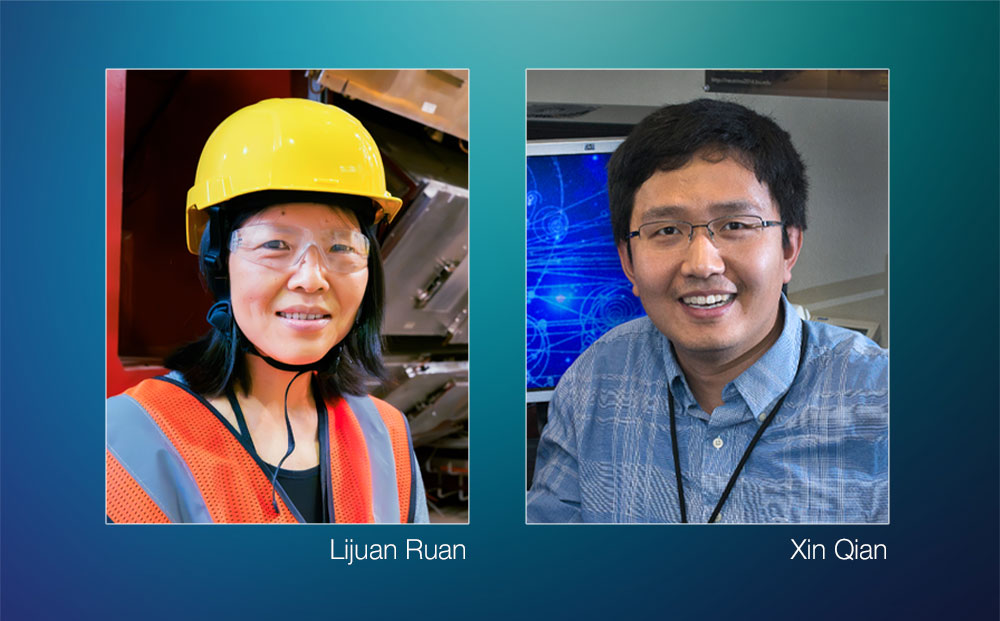
Lijuan Ruan and Xin Qian (Brookhaven National Laboratory)
UPTON, N.Y. — Two physicists at the U.S. Department of Energy’s (DOE) Brookhaven National Laboratory have been named 2026 Fellows of the American Physical Society (APS). The honor recognizes their excellence in physics and exceptional service to the physics community. This year’s Brookhaven Lab honorees — Lijuan Ruan and Xin Qian — are among a class of 153 Fellows selected from among APS’s membership of more than 50,000 physicists in academia, National Laboratories, and industry in the United States and around the world.
Lijuan Ruan, leader of the ePIC Group, Physics Division, and former STAR co-spokesperson
For innovative development of the STAR Time-of-Flight and Muon Telescope Detectors, and for the physics of identified hadrons, dileptons, and quarkonia in the study of quark-gluon plasma properties at RHIC
 enlarge
Lijuan Ruan of the Brookhaven National Laboratory Physics Division was named an APS Fellow for her contributions to the STAR detector and the study of the quark-gluon plasma at the Relativistic Heavy Ion Collider. (Timothy Kuhn/Brookhaven National Laboratory)
Lijuan Ruan, the leader of Brookhaven Lab’s ePIC detector group for the upcoming Electron-Ion Collider (EIC) and former co-spokesperson for the STAR experiment at its predecessor, the Relativistic Heavy Ion Collider (RHIC), has had a sustained and field-shaping impact on experimental relativistic heavy-ion physics. This field explores the fundamental building blocks of visible matter, known as quarks and gluons, by colliding the nuclei of heavy atoms such as gold at relativistic speeds — that is, close to the speed of light. Physicists analyze the collision “debris” using particle detectors like the Solenoidal Tracker at RHIC (STAR) to make discoveries about the unique form of hot, dense matter created in these collisions, which is known as a quark-gluon plasma (QGP).
Ruan made major contributions to components of the STAR detector that were essential for identifying and tracking particles created in the collisions. For example, she designed a prototype time-of-flight detector that led to the construction of a full-scale time-of-flight detector, and she participated in the testing, installation, and commissioning of this device. She developed simulations and analysis software that made it possible to analyze data from the TOF as soon as it was available and used this data to calibrate the detector’s measurements. She also applied her expertise to develop a novel and compact muon telescope detector. She was involved in all aspects of the project, starting with simulations, detector design, prototype testing, and construction, and she later led a major upgrade of this component. Her leading role in the development of multi-gap resistive plate chambers was essential to the success of these detector components.
Ruan also conducted significant original research on the production and transport of a wide range of particles in the QGP using the detector components she helped to construct and by pairing their measurements with other capabilities of STAR. Her analyses include measurements of hadrons, which are composite particles made of two or three quarks, dilepton pairs such as electrons and positrons or muons and antimuons, as well as heavy quark-antiquark pairs known as quarkonia. Her research helped elucidate how particles produced in these collisions arise from multi-quark and gluon processes, not just fragmentation of the original colliding nuclei. She helped identify how certain particles lose energy as they transit through the hot, dense matter through a process known as jet quenching. And she helped carry out a meticulous program to collect data from collisions of gold nuclei across a wide span of energies to elucidate the behavior of quark matter at different temperatures and densities. All her research bears directly on the overarching goal of understanding the properties of the strongly interacting QGP discovered at RHIC, including mapping out and identifying key transitions among the phases of nuclear matter.
“This award is such a great honor for the wonderful experience I had working on the STAR detector components and data analyses, alongside students, postdocs, technicians, engineers, and scientists from many international collaborating institutions,” Ruan said. “I also want to thank my mentors who pushed me forward and gave me opportunities to work on the time-of-flight detector and lead the muon telescope detector upgrade, both of which have been essential to so many beautiful physics results at RHIC.”
Lijuan Ruan earned her Ph.D. from the University of Science and Technology of China in 2005. As a postdoc at DOE’s Lawrence Berkeley National Laboratory from 2005-2007, she continued the work for which she earned her Ph.D. as a member of STAR. She joined Brookhaven Lab in 2007 as a Goldhaber Fellow and was successively promoted, serving with tenure since 2015 and earning her current status as a senior physicist in 2021. She was elected to serve as STAR co-spokesperson from 2020-2026. In 2010, she received the Young Scientist in Nuclear Physics Award from the International Union of Pure and Applied Physics, and in 2013, she was the first Brookhaven Lab nuclear physicist to receive a DOE Early Career Award. Additional individual honors include Brookhaven Lab’s Sambamurti Memorial Lecture Award in 2016, a Brookhaven Lab Science and Technology Award in 2020, and being selected as a Fellow for the Oppenheimer Science and Energy Leadership Program in 2023. She was also among those recognized by two Secretary of Energy Achievement Awards, one given to the STAR group in 2018 and the other to the RHIC Discovery and Innovation Team in 2026.
Xin Qian, Electronic Detector Group, Physics Division
For significant contributions to neutrino physics through precise measurement of antineutrino oscillations at Daya Bay and groundbreaking searches for new physics in MicroBooNE
 enlarge
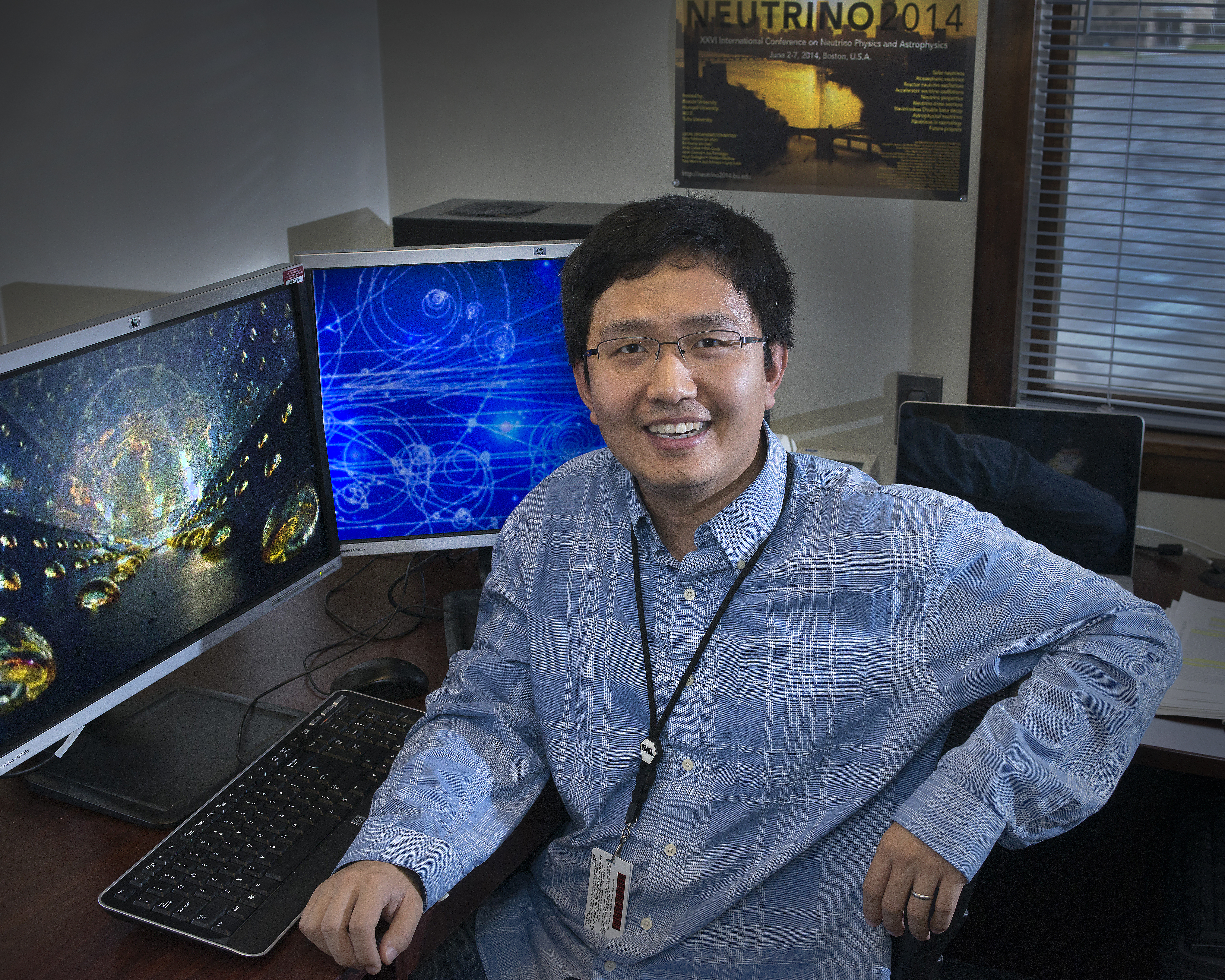
Xin Qian of the Brookhaven National Laboratory Physics Division was named an APS Fellow for his contributions to neutrino research at several groundbreaking experiments. (Brookhaven National Laboratory)
Xin Qian, a staff scientist in the Electronic Detector Group of Brookhaven Lab’s Physics Division, has been an intellectual leader and major contributor to several experiments exploring the properties and behavior of neutrinos, tiny subatomic particles that may hold clues to some of the biggest mysteries in physics. These ghostlike particles have the unique ability to shift identities among three known “flavors.” Tracking this behavior, known as neutrino oscillation, and looking for differences in how ordinary matter neutrinos and their antimatter opposites oscillate may help scientists discover whether neutrinos exhibit any “violations” of fundamental physics symmetries and why the universe today is made mostly of matter.
Qian has made significant contributions to precision neutrino oscillation measurements at the Daya Bay reactor antineutrino experiment and MicroBooNE, an experiment located at DOE’s Fermi National Accelerator Laboratory (Fermilab). For Daya Bay, he developed many of the analysis tools and methods that contributed to the discovery of a key property governing how neutrinos transform from one flavor to another and enabled the experiment’s first measurement of the rate of these transformations. The surprisingly strong transformation observed opened the door for next-generation experiments to investigate some of the field’s most fundamental questions, including why the universe contains far more matter than antimatter and how the different neutrino states are ordered by mass. He also invented the “3D Wire-Cell” software used to reconstruct rare neutrino sightings with unprecedented efficiency and purity from particle tracks and other signals captured in large liquid-argon detectors. This technique, which was successfully deployed at MicroBooNE, takes advantage of improved sensitivity of electronics capable of operating inside the ultracold detectors. Qian led key analyses, including a search for a theorized fourth neutrino flavor and precision measurements of neutrino-argon interactions.
Together Qian’s contributions to neutrino measurements, detector technologies, and data analysis help to lay the foundation for the success of future neutrino research at the Deep Underground Neutrino Experiment (DUNE). DUNE, headquartered at Fermilab in Batavia, Illinois, has oscillation tracking detectors located 800 miles (1,300 kilometers) away at the Sanford Underground Research Laboratory in Lead, South Dakota. Tracking neutrinos over this enormous distance will enable scientists to study their transformations with unprecedented precision, probing fundamental questions such as whether neutrinos and antineutrinos behave differently, which is a possible clue to why the universe is dominated by matter, and how neutrino masses are ordered.
“I am excited to be recognized with this honor, and I look forward to pursuing DUNE’s broad scientific program,” Qian said. “With the tools and analysis methods we’ve developed, we’ll be able to study neutrinos from exploding stars, search for the extraordinarily rare possibility that protons decay, and look for other signs of new physics beyond our current understanding of fundamental particles and forces.”
Xin Qian earned a Ph.D. in experimental nuclear physics in 2010 from Duke University. He was a Robert A. Millikan Postdoctoral Scholar in Experimental Physics from 2010 to 2013 at the California Institute of Technology and joined Brookhaven Lab in 2013. Since 2020, he has also been an adjunct faculty member in the Department of Physics and Astronomy at Stony Brook University. He won DOE Early Career Award funding for research on neutrino detector development in 2014, shared in the 2016 Breakthrough Prize in Fundamental Physics awarded to a worldwide community of neutrino researchers, and earned a 2017 Young Experimental Scientist Prize from the European Physical Society. In 2022, he was recognized with one of Brookhaven Lab’s highest honors — a Science and Technology Award — and shared in the High Energy and Particle Physics Prize from the European Physical Society in 2023 as a member of the Daya Bay Collaboration.
Research by both scientists is funded primarily by the DOE Office of Science. RHIC was a DOE Office of Science user facility for nuclear physics research at Brookhaven Lab that is now being transformed into the Electron-Ion Collider.
Brookhaven National Laboratory is supported by the Office of Science of the U.S. Department of Energy. The Office of Science is the single largest supporter of basic research in the physical sciences in the United States and is working to address some of the most pressing challenges of our time. For more information, visit science.energy.gov.
Follow @BrookhavenLab on social media. Find us on Instagram, LinkedIn, X, and Facebook.
2026-23202 | INT/EXT | Newsroom