Neural Network-Based Analysis of Multimodal Bond Distributions Using EXAFS Spectra
March 1, 2024
The Science
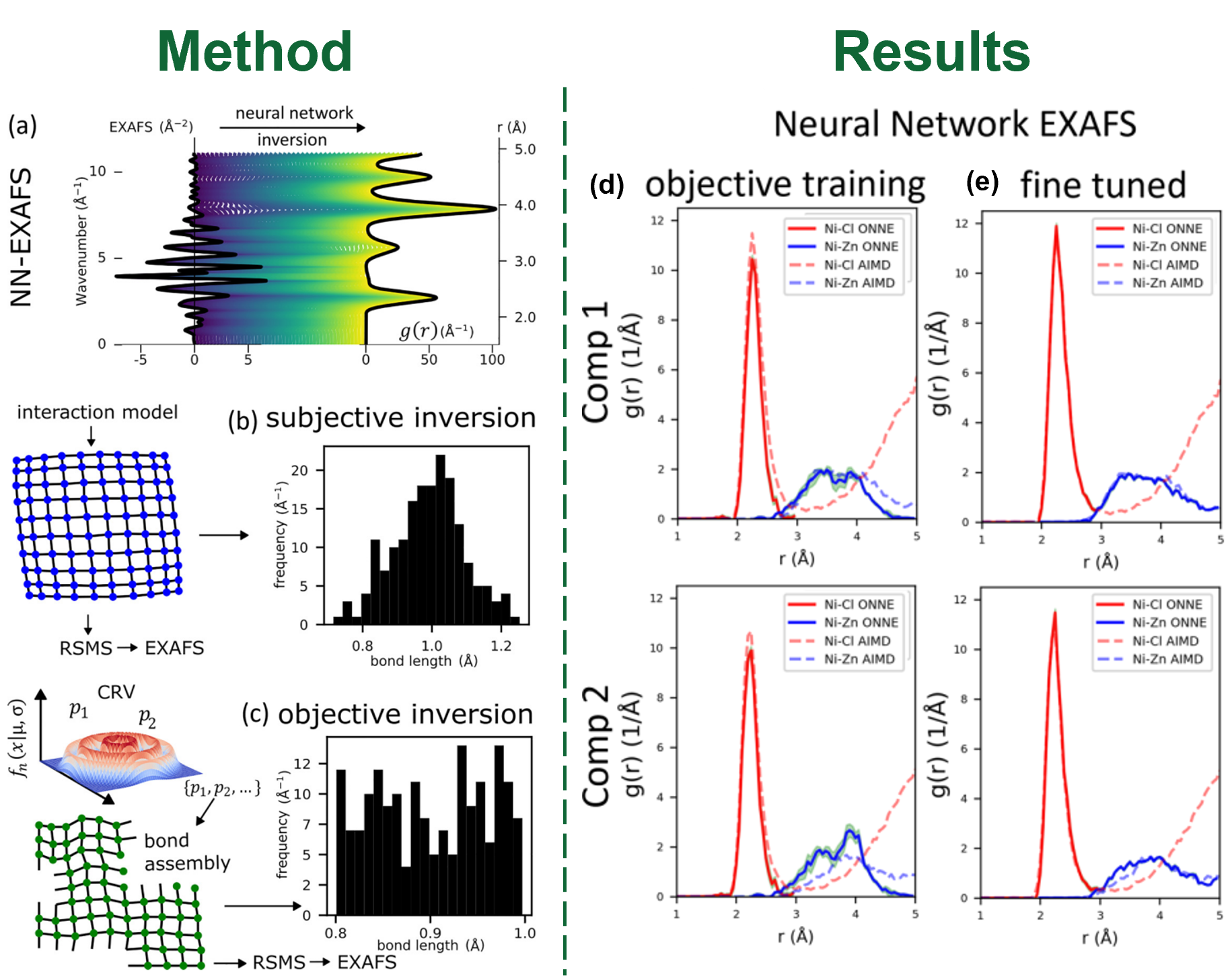
In nuclear systems and molten salt environments, understanding local atomic structure is essential for interpreting spectroscopic data, but conventional EXAFS analysis struggles with disordered and heterogeneous systems. Researchers developed a neural network-based method to directly reconstruct atomic pair distributions from EXAFS spectra. Instead of relying on structural models or simulations, the method uses statistically generated training data to learn general relationships between spectra and structure. The results show that complex, multimodal coordination environments can be resolved directly from experimental data, establishing a model-independent framework for analyzing disordered systems.
The Impact
Reliable interpretation of EXAFS data is critical for understanding structure and speciation in molten salts and other complex materials. This work provides a new approach that reduces reliance on assumptions about local structure. The method improves the ability to analyze disordered systems and supports more accurate interpretation of experimental spectroscopy.
Summary
This study introduces a neural network EXAFS (NN-EXAFS) framework that reconstructs radial distribution functions directly from EXAFS spectra.
The approach generates synthetic training data using statistical distributions of bond lengths, avoiding dependence on molecular dynamics simulations. A neural network is trained to map spectral features to structural information, enabling inversion of experimental spectra into local atomic environments.
Validation on simple systems demonstrated accurate recovery of bond distances and coordination numbers. Application to Ni²? in molten salt systems showed that the method captures multiple coexisting coordination environments and resolves structural heterogeneity that is difficult to extract using conventional techniques.
The results demonstrate that EXAFS spectra encode sufficient information to distinguish complex structural distributions when analyzed with machine learning.
Overall, the method provides a general framework for linking spectroscopic data to atomic structure in disordered systems, enabling model-independent interpretation of complex materials.
Contact
Anatoly I. Frenkel, Stony Brook University / Brookhaven National Laboratory, frenkel@bnl.gov
Funding
This work was supported by the Molten Salts in Extreme Environments Energy Frontier Research Center, funded by the U.S. Department of Energy, Office of Science, Basic Energy Sciences. This research used resources of the Center for Functional Nanomaterials at Brookhaven National Laboratory.
Citation
Marcella, N., S. Lam, V. S. Bryantsev, S. Roy, and A. I. Frenkel. “Neural Network-Based Analysis of Multimodal Bond Distributions Using Extended X-ray Absorption Fine Structure Spectra.” Physical Review B 109, 104201 (2024). https://doi.org/10.1103/PhysRevB.109.104201
2024-23150 | INT/EXT | Newsroom