Temperature-Dependent Morphological Evolution during Corrosion of the Ni–20Cr Alloy in Molten Salt Revealed by Multiscale Imaging
May 1, 2023
The Science
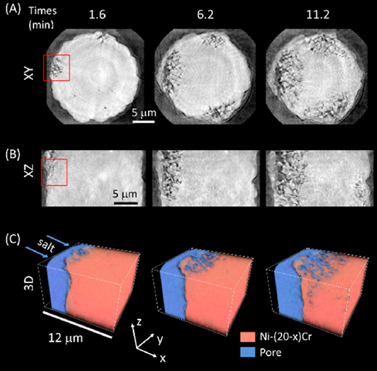
In nuclear systems, corrosion of structural alloys in molten salts depends strongly on temperature, but the mechanisms controlling morphological evolution are not fully understood. Researchers used in situ synchrotron X-ray nanotomography and electron microscopy to study corrosion of Ni–20Cr in molten KCl–MgCl2. They found that corrosion proceeds through different pathways depending on temperature, with distinct pore formation mechanisms emerging at different conditions. These results show that corrosion behavior is governed by the balance between reaction kinetics and diffusion processes at the metal–salt interface.
The Impact
Predicting corrosion behavior is essential for designing materials for molten salt systems. This work provides direct evidence of how temperature controls corrosion mechanisms and resulting microstructures. The findings improve understanding of degradation processes and support development of strategies to mitigate corrosion in high-temperature environments.
Summary
This study used in situ X-ray nanotomography and electron microscopy to investigate the three-dimensional corrosion of Ni–20Cr in molten KCl–MgCl2 across a range of temperatures.
At 600 °C, corrosion proceeds in two stages: initial intergranular attack along grain boundaries, followed by slower corrosion into adjacent grain surfaces. Chromium preferentially dissolves, forming Cr ion species in the salt, while nickel redistributes to form a Ni-rich surface layer.
At higher temperatures (700–800 °C), corrosion transitions to form bicontinuous porous structures throughout the material.
The results show that temperature controls the competition between chromium dissolution and nickel surface diffusion, determining whether corrosion remains localized grain boundary attacks, or evolves into bulk porous structure.
Overall, the study demonstrates that corrosion morphology in molten salts is governed by the interplay between reaction kinetics and mass transport, linking temperature to structural evolution pathways.
Contact
Yu-chen Karen Chen-Wiegart, Stony Brook University / Brookhaven National Laboratory, Karen.Chen-Wiegart@stonybrook.edu
Funding
This work was supported by the Molten Salts in Extreme Environments Energy Frontier Research Center, funded by the U.S. Department of Energy, Office of Science, Basic Energy Sciences. This research used resources of the National Synchrotron Light Source II at Brookhaven National Laboratory.
Citation
Liu, X., K. Bawane, X. Zheng, M. Ge, P. Halstenberg, D. S. Maltsev, A. S. Ivanov, S. Dai, X. Xiao, W.-K. Lee, L. He, and Y.-c. K. Chen-Wiegart. “Temperature-Dependent Morphological Evolution during Corrosion of the Ni–20Cr Alloy in Molten Salt Revealed by Multiscale Imaging.” ACS Applied Materials & Interfaces 15, 13772–13782 (2023). https://doi.org/10.1021/acsami.2c23207
2023-23155 | INT/EXT | Newsroom