Are High-Temperature Molten Salts Reactive with Excess Electrons? Case of ZnCl2
November 1, 2023
The Science
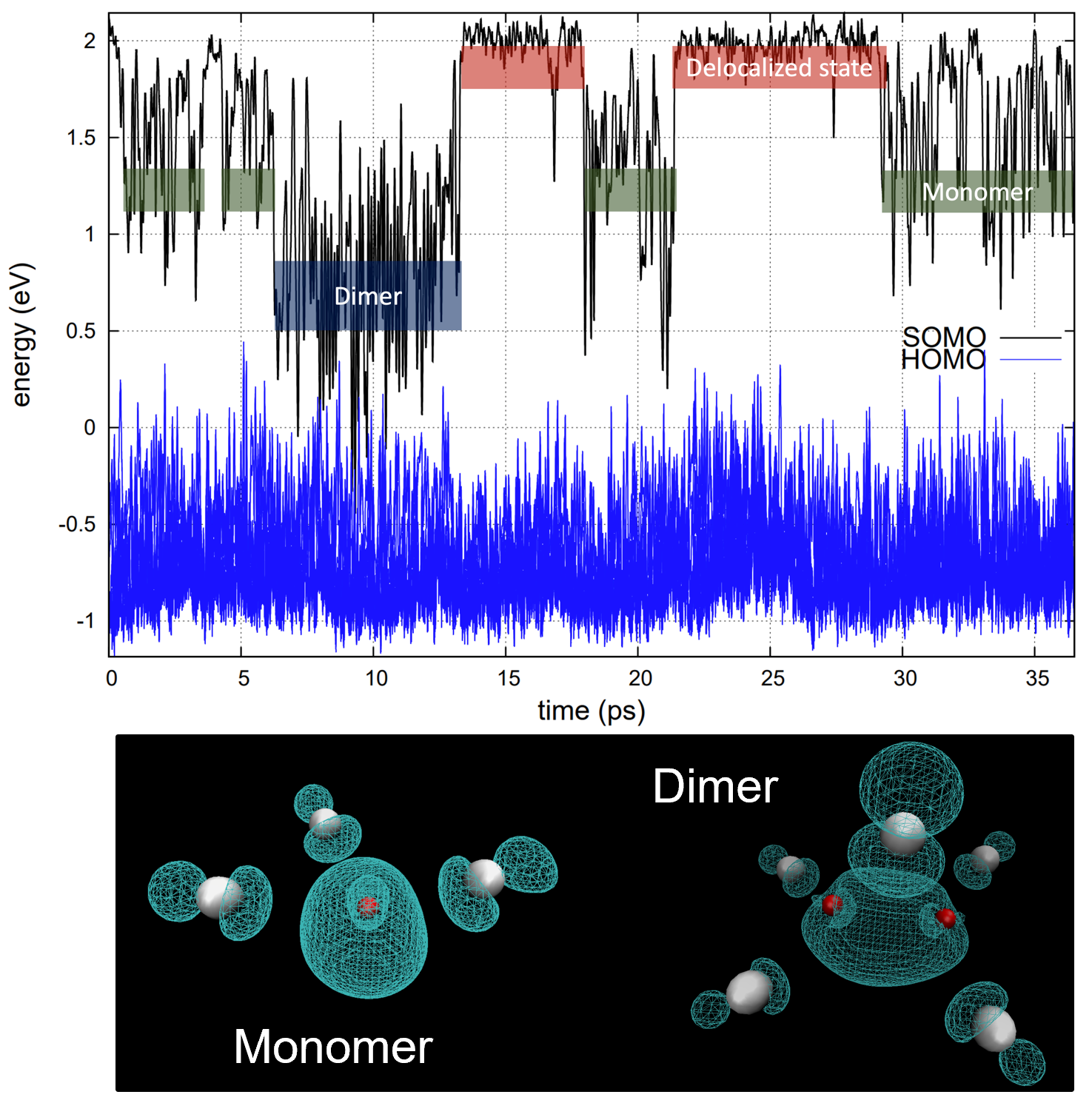
Radiation in molten salt nuclear systems generates excess electrons that can drive chemical transformations, but their behavior in molten salts remains poorly understood. Researchers used first-principles molecular dynamics simulations to investigate how excess electrons behave in molten ZnCl2. They found that electrons dynamically transition between states associated with one or two zinc ions, nominally ZnCl3•2– and Zn2Cl5•2–. These results show that molten salts can support transient reactive electronic species whose structure and stability depend on the identity of the salt and the local liquid environment.
The Impact
Understanding how excess electrons behave in molten salts is essential for interpreting radiation chemistry and predicting redox processes in reactor environments. This work demonstrates that molten salts can be chemically active toward excess electrons and can stabilize multiple reactive states. The findings provide a molecular-level framework for understanding radiation-induced chemistry, and the article speculates that such radicals upon reaction could potentially lead to the formation of nanoparticles.
Summary
This study used first-principles molecular dynamics simulations to investigate the behavior of excess electrons in molten ZnCl2.
The simulations revealed a set of distinct electronic modes of localization in which an electron tends to replace the role of an anion within the Zn charge network. These states continuously interconvert due to thermal fluctuations and local structural rearrangements within the liquid.
The localized states correspond to transient reduced species stabilized by the surrounding molten salt structure. The dimeric configuration is particularly stable because the excess electron can be shared between neighboring zinc ions, creating a molecular-like bonding arrangement within the liquid.
Overall, the study demonstrates that excess electrons in molten salts participate in complex, dynamic chemistry governed by the interplay between local coordination environment and electronic structure.
Contact
Vyacheslav S. Bryantsev, Oak Ridge National Laboratory, bryantsevv@ornl.gov
Claudio J. Margulis, University of Iowa, claudio-margulis@uiowa.edu
Funding
This work was supported by the Molten Salts in Extreme Environments Energy Frontier Research Center, funded by the U.S. Department of Energy, Office of Science, Basic Energy Sciences. Work used computational resources at Oak Ridge National Laboratory.
Citation
Nguyen, H. H., V. S. Bryantsev, and C. J. Margulis. “Are High-Temperature Molten Salts Reactive with Excess Electrons? Case of ZnCl2.” The Journal of Physical Chemistry B 127, 9155–9164 (2023). https://doi.org/10.1021/acs.jpcb.3c04210
2023-23156 | INT/EXT | Newsroom