Exploring Cr and Molten Salt Interfacial Interactions for Molten Salt Applications
July 1, 2024
The Science
In nuclear systems, corrosion at molten salt–metal interfaces impacts material lifetime, yet interfacial processes are difficult to observe directly. Taking a multimodal approach, researchers combined in situ X-ray imaging, diffraction spectroscopy, and atomistic simulations to study chromium behavior in molten KCl–MgCl2. They found that corrosion involves both dissolution and phase transformation, including the formation of a previously unobserved δ-A15 phase at the interface. These results show that interfacial reactions are governed by coupled thermodynamic and kinetic processes, where molten salt interactions can stabilize new phases not present under standard conditions.
The Impact
Understanding interfacial reactions is essential for predicting corrosion and designing materials for molten salt systems. This work demonstrates that corrosion can involve phase transformations as well as dissolution. The findings improve interpretation of interfacial chemistry and highlight the importance of considering phase stability under molten salt conditions.
Summary
This study used multimodal imaging and simulations to investigate chromium evolution in molten KCl–MgCl2.
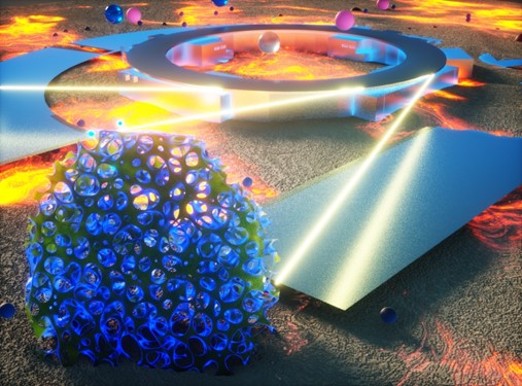
Experiments showed that chromium undergoes rapid dissolution, forming porous structures, while simultaneously developing a surface layer at the metal–salt interface. Diffraction measurements revealed the emergence of a new δ-A15 crystalline phase that remains stable as the original bcc phase dissolves.
Simulations indicate that this phase transformation is driven by interfacial interactions with the molten salt. Strong coordination between salt species and the metal surface stabilizes the new phase and alters local energetics.
These results demonstrate that corrosion is not purely a degradation process but can involve structural reorganization and phase selection controlled by the interface.
Overall, the study shows that molten salt–metal interactions can drive coupled dissolution and phase transformation, linking interfacial chemistry to material stability.
Contact
Yu-chen Karen Chen-Wiegart, Stony Brook University / Brookhaven National Laboratory, Karen.Chen-Wiegart@stonybrook.edu
Anatoly I. Frenkel, Stony Brook University / Brookhaven National Laboratory, anatoly.frenkel@stonybrook.edu
Vyacheslav S. Bryantsev, Oak Ridge National Laboratory, bryantsevv@ornl.gov
Funding
This work was supported by the Molten Salts in Extreme Environments Energy Frontier Research Center, funded by the U.S. Department of Energy, Office of Science, Basic Energy Sciences. This research used resources of the National Synchrotron Light Source II and the Center for Functional Nanomaterials at Brookhaven National Laboratory, and computational resources at Oak Ridge National Laboratory.
Citation
Liu, X., Y. Liu, L. D. Gibson, M. Ge, D. Olds, D. Leshchev, J. Bai, A. M. Plonka, P. Halstenberg, H. Zhong, S. Ghose, C.-H. Lin, X. Zheng, X. Xiao, W.-K. Lee, S. Dai, G. D. Samolyuk, V. S. Bryantsev, A. I. Frenkel, and Y.-c. K. Chen-Wiegart. “Exploring Cr and Molten Salt Interfacial Interactions for Molten Salt Applications.” Physical Chemistry Chemical Physics 26, 21342–21356 (2024). https://doi.org/10.1039/D4CP01122H
2024-23157 | INT/EXT | Newsroom