Computing the Solubility of Argon and Xenon in Molten Sodium Chloride and Potassium Chloride Salts
March 2, 2026
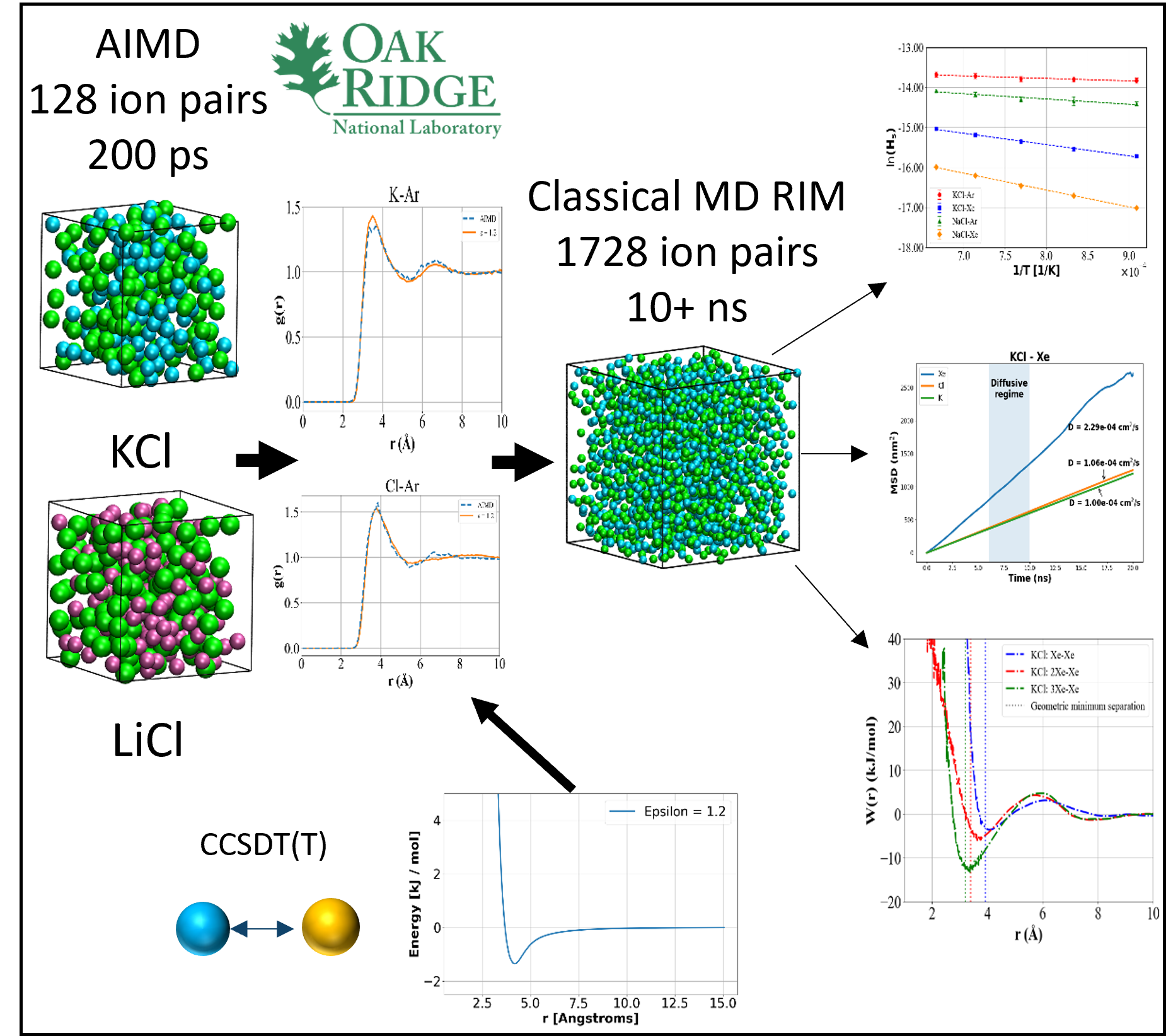
The Science
In nuclear systems, noble gas fission products such as xenon influence molten salt chemistry and reactor performance, but their solubility is difficult to measure experimentally. Researchers used molecular dynamics simulations to calculate the solubility of argon and xenon in molten NaCl and KCl. By combining first-principles-derived interaction potentials with statistical insertion methods, they determined how gas atoms interact with the liquid salt ions and computed gas solubilities as a function of temperature. The results show that gas solubility is governed primarily by the availability of free volume in the molten salt.
The Impact
Understanding noble gas behavior is essential for managing fission products in molten salt reactors. This work provides a computational approach for predicting gas solubility where experimental data are limited. The results improve understanding of how salt composition and temperature affect gas retention and transport.
Summary
This study used molecular dynamics simulations and the Widom insertion method to compute Henry’s law constants and solvation enthalpies for argon and xenon in molten NaCl and KCl.
New interaction potentials between noble gas atoms and salt ions were developed using first-principles calculations. Simulations showed that solubility increases with temperature and is higher in KCl than in NaCl. Argon is more soluble than xenon due to its smaller size.
Free volume analysis revealed that these trends are driven primarily by structural properties of the liquid. KCl has larger ionic spacing and greater free volume, allowing easier insertion of gas atoms. Increasing temperature expands the liquid, further enhancing solubility.
The results also showed that polarizable ion models provide more accurate predictions than rigid ion models due to improved representation of liquid density.
Overall, the study demonstrates that noble gas solubility in molten salts is controlled by entropic effects associated with available free space, linking liquid structure to gas behavior.
Contact
Edward J. Maginn, University of Notre Dame, ed@nd.edu
Funding
This work was supported by the Molten Salts in Extreme Environments Energy Frontier Research Center, funded by the U.S. Department of Energy, Office of Science, Basic Energy Sciences. This work used computational resources at the University of Notre Dame and DOE-supported computing facilities.
Citation
Strickling, C., Y. Zhang, and E. J. Maginn. “Computing the Solubility of Argon and Xenon in Molten Sodium Chloride and Potassium Chloride Salts.” Fluid Phase Equilibria 587 (2025): 114216. https://doi.org/10.1016/j.fluid.2024.114216
2026-23161 | INT/EXT | Newsroom