Luca Cultrera Leads by Learning
Brookhaven Lab's Instrumentation Division section leader reflects on the lifelong curiosity that has guided his career
October 8, 2026
 enlarge
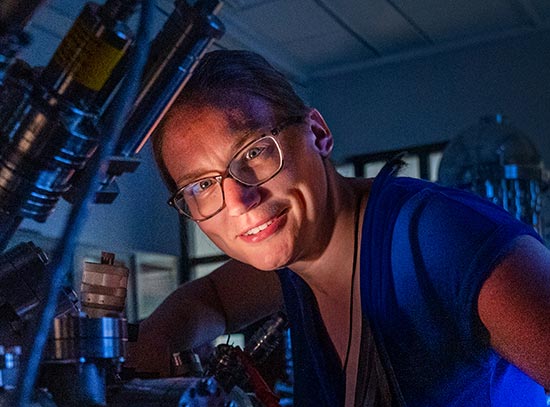
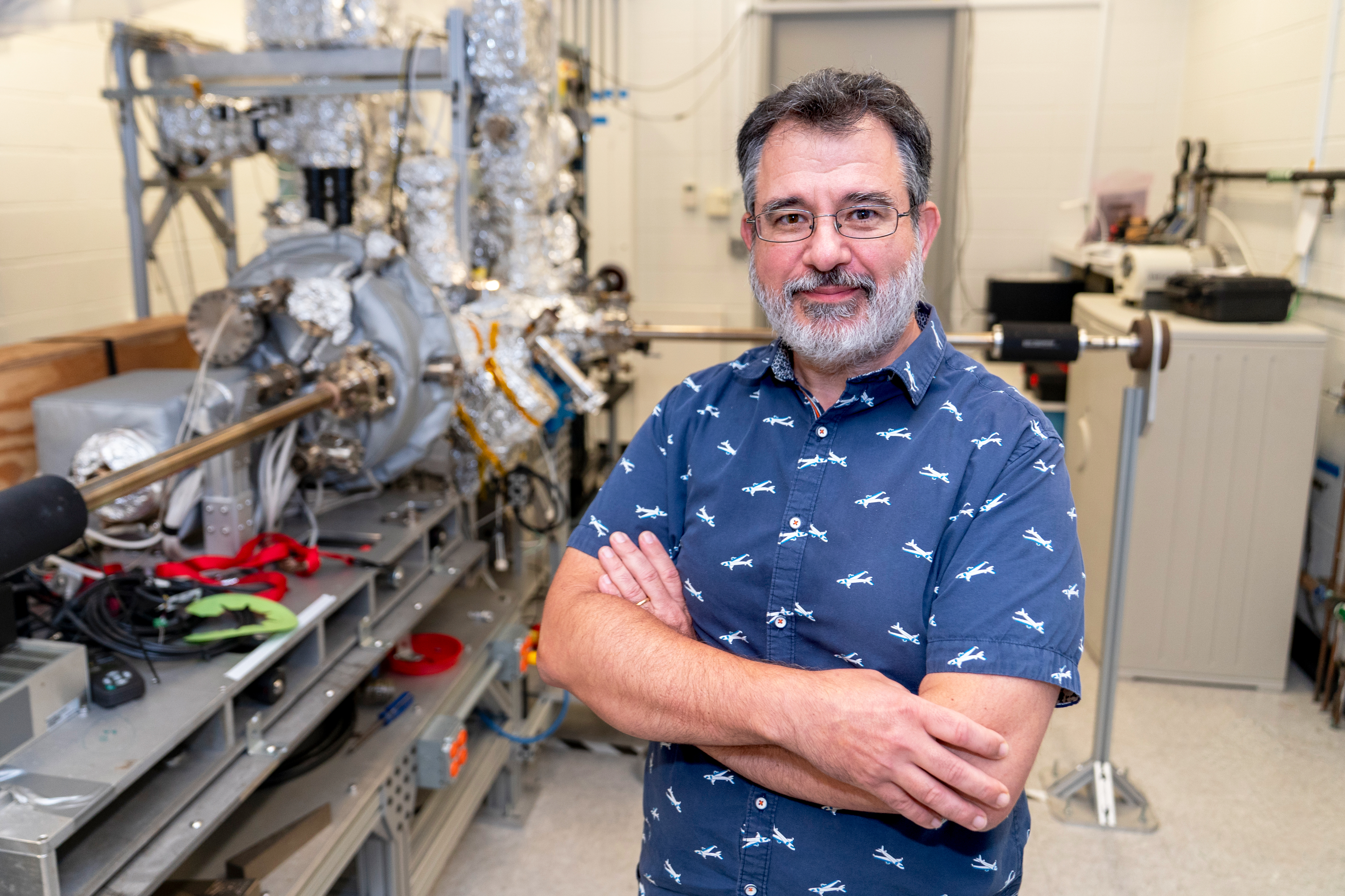
Luca Cultrera stands in an Instrumentation Division lab at Brookhaven National Laboratory. Cultrera is the section leader of the division and has over 20 years of experience in photocathode research. (David Rahner/Brookhaven National Laboratory)
To many, the phrase “you learn something new every day” is often a playful response to a surprising or humbling moment. But for Luca Cultrera, section leader of the Instrumentation Division at the U.S. Department of Energy’s (DOE) Brookhaven National Laboratory, these words describe an integral part of his job and the evolution of his career.
Cultrera, a scientist who has spent over 20 years studying electron sources, has thoroughly enjoyed his leadership role since he stepped into the position about a year ago. He has taken on many new administrative responsibilities, from coordinating budgets to managing the division’s world-class research facilities. But his favorite part is, and always will be, the science. He remains the lead of the division’s Photocathode Group, and now he has the opportunity to dive deeper into the many other research areas within the Instrumentation Division.
“I enjoy the challenge of coordinating a large number of activities across the division and figuring out how we can increase collaboration and scientific productivity,” Cultrera said. “It’s a way for me to learn more about other areas that intersect with my photocathode background and that make Brookhaven a world-leading lab.”
The Instrumentation Division advances the Laboratory’s research mission through collaborative partnerships and its own technology development. The division creates innovative sensors, detectors, and electronics, and it enables technologies that make unique experiments possible at Brookhaven and across the National Laboratory landscape. The division also houses multiple cutting-edge facilities such as the Quantum Network Facility, where researchers are developing secure communications systems for the nation.
The Photocathode Group designs and produces devices that generate electrons for machines like particle accelerators. Some of the largest facilities hosted by DOE National Laboratories depend on photocathodes, including the Linac Coherent Light Source –II (LCLS-II) free-electron laser at DOE’s SLAC National Accelerator Laboratory, the Continuous Electron Beam Accelerator Facility (CEBAF) at DOE’s Thomas Jefferson National Accelerator Facility and, soon, the new Electron-Ion Collider at Brookhaven. LCLS-II and CEBAF are DOE Office of Science user facilities.
“The electrons we generate at the source affect the whole operation of the accelerator,” Cultrera said. Cultrera loves the process of figuring out how to optimize photocathodes and find new ways to make them work even better. “The most exciting part is the science, trying to find solutions for the electron source issues and improving the reliability of operations and the overall performance of electron accelerator machines.”
Solving problems hands-on has been a source of joy for Cultrera throughout his life, even before he zeroed in on researching electron sources.
Cultrera has been fascinated by science and engineering since he was a child growing up in Italy. “I always liked to disassemble things and get an understanding of how they worked,” he said.
He followed this passion throughout his education, obtaining a bachelor’s degree and a Ph.D. in physics at the University of Salento.
“I was initially planning to have a career in engineering. But when I got to college, the engineering class was extremely crowded, so I opted to try physics,” Cultrera said, noting he was eventually swayed by the lab portion. “I really liked the idea of doing hands-on work in the lab, so I became an experimentalist.”
After working with lasers to synthesize materials in such a lab setting, he realized he wanted to specialize in materials science.
“Using lasers to grow or modify materials that do not exist in nature is what got me more engaged in material development and material growth,” he said.
As Cultrera got involved in different research projects, he also made meaningful connections that were instrumental in guiding his career. Specifically, a colleague of his mentor was inspired by his research group’s expertise in materials science and hoped to apply their techniques to developing electron sources for accelerators. With that opportunity, Cultrera made the jump to accelerator physics, a path that would ultimately lead him to Brookhaven.
While materials science and accelerator physics may seem like completely different fields, they overlap where Cultrera’s expertise lies.
“My education was mostly focused on materials science, so I was not really trained to work on an accelerator during school. But my training was actually very useful, since the properties of the electrons we generate are affected directly by the properties of the material we’re using,” Cultrera said.
Cultrera applied this experience in 2005 at the National Institute of Nuclear Particle Physics in Frascati, Italy, where he joined a collaboration to build a free electron laser (FEL). A FEL linearly accelerates electrons to create pulses of extremely bright laser light, which can be used to study chemical reactions and other fast-paced processes.
In 2010, he moved to the United States to continue his journey in accelerator research at Cornell University. He worked there as a senior research scientist developing electron sources for accelerators for over 10 years.
As Cultrera worked with accelerators more and more, he also started learning about the development of detectors, both for the electrons coming from his electron sources and for other uses within accelerators. Eventually, this combination of expertise in materials science, accelerators, electron sources, and detectors gave him the perfect skillset to join the Photocathode Group in Brookhaven’s Instrumentation Division in 2020.
“My job working in this field has opened me up to a lot more opportunities to expand my knowledge, not only in materials science, but in accelerator science as well,” Cultrera said.
As he now settles into his role as section leader, Cultrera plans to keep on learning as much as he can. All the while, he’s also making sure that the division can keep doing the best science.
“The research and development we do in Instrumentation will advance research across Brookhaven Lab, the DOE complex, and the nation,” Cultrera said.
When he’s not in a meeting or figuring out how to get electrons to jump out of a material, Cultrera can be found spending time outside fishing or gardening. He also enjoys playing heavy metal music from the 80s on his guitars, a hobby he’s had since high school.
Brookhaven National Laboratory is supported by the Office of Science of the U.S. Department of Energy. The Office of Science is the single largest supporter of basic research in the physical sciences in the United States and is working to address some of the most pressing challenges of our time. For more information, visit science.energy.gov.
Follow @BrookhavenLab on social media. Find us on Instagram, LinkedIn, X, and Facebook.
2026-23203 | INT/EXT | Newsroom