Observing Elusive Carriers of Angular Momentum with X-rays
December 22, 2025
 enlarge
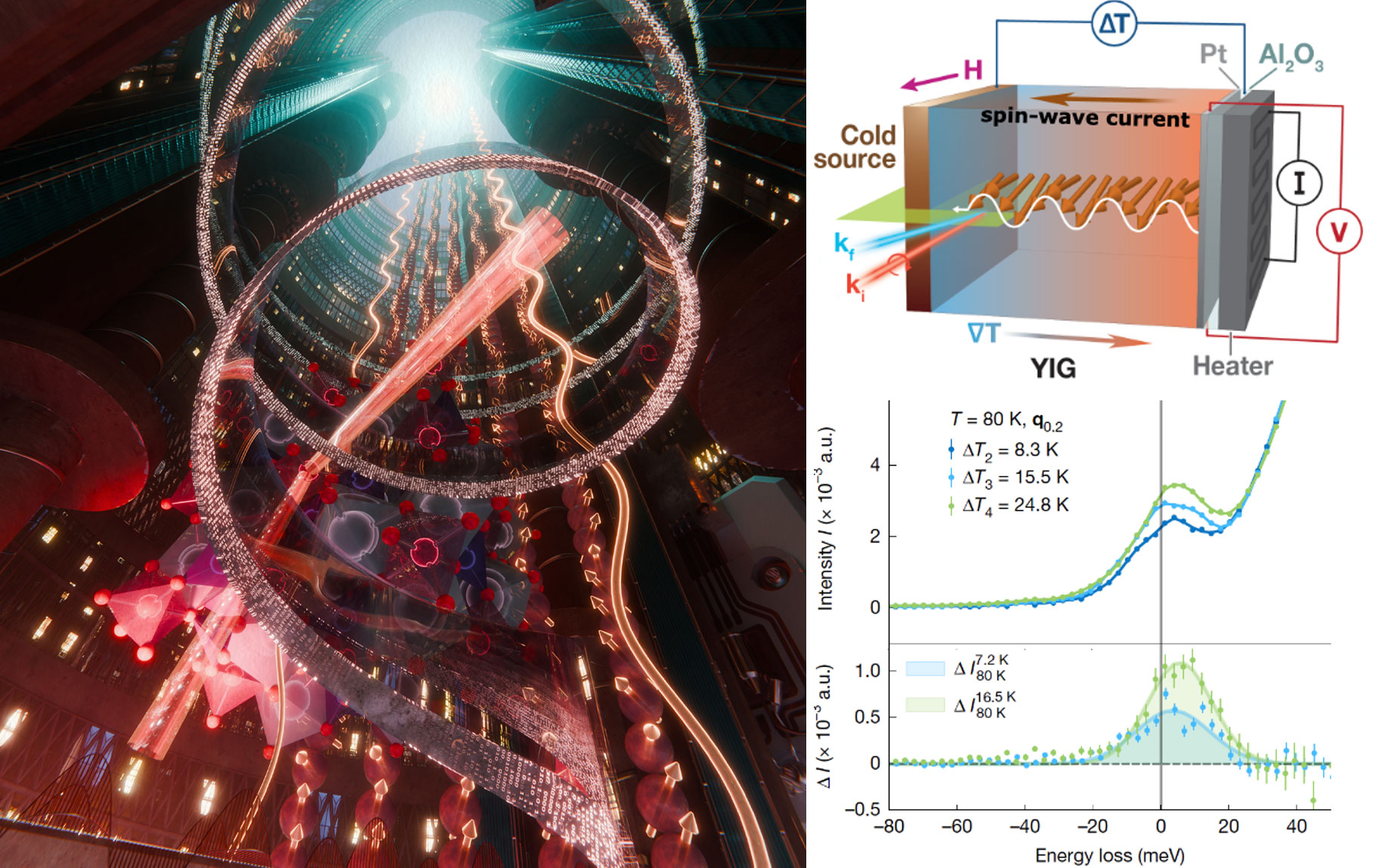
Left: An artist's representation of the spin current generated in YIG by the spin Seebeck effect and probed with RIXS at the SIX beamline at NSLS-II. Right: (Top) Schematic of the device used for the RIXS experiment. (Bottom) RIXS spectra measured at q=[0.2,0.2,0.2]r.l.u. for increasing thermal gradient DT or magnon current JS.
The Science
First Momentum- and energy-resolved observation of magnon spin current by resonant inelastic x-ray scattering (RIXS).
The Impact
Microscopic measurement of magnon spin current reveals the magnon mode responsible for the flow of information. This approach allows access to otherwise inaccessible momentum-dependent parameters.
Summary
Magnon-based transport in insulators is fostering the next generation of ultra-fast, low-power, miniaturized electronics. A complete understanding of the magnon current is, however, hampered by difficulty in detecting the flowing electron angular momenta, requiring, for example, a conversion to charge current through inverse spin Hall effect to determine its transport properties. This process may hinder the extraction of fundamental, microscopic transport parameters due to the involvement of complex mechanisms happening during the magnon/charge conversion.
A team led by scientists at the National Synchrotron Light Source II (NSLS-II), a Department of Energy (DOE) Office of Science user facility at DOE’s Brookhaven National Laboratory took on the challenge of directly visualizing the magnon current in yttrium iron garnet (YIG), with energy- and momentum-resolution. Using the Spin Seebeck effect as a magnon current source, they demonstrated that resonant inelastic x-ray scattering (RIXS) is sensitive to the non-equilibrium magnons conveying the current. In this research, the team realized the first spin Seebeck device for ultra-high vacuum and performed RIXS measurements in the presence of magnon current generated by the thermal gradient delta T, while transferring momentum q either parallel or antiparallel to the current propagation direction. Our results reveal that acoustic magnons (ferromagnons) with non-negligible momentum, e.g., q=0.2 r.l.u., contribute to transport phenomena. This approach enables researchers to assess key transport parameters, like the momentum-resolved magnon lifetime, as well as their relation to material properties, essential for developing faster electronics. Furthermore, our study can be extended to other non-equilibrium phenomena, opening the way to a momentum- and energy-resolved visualization of transport processes.
Download the research summary slide (PDF)
Related Links
- Scientific paper: "Observing differential spin currents by resonant inelastic X-ray scattering"
- Press release: Making Waves: RIXS Illuminates Elusive Carriers of Angular Momentum
Contact
Yanhong Gu
Brookhaven National Laboratory
gyhshan@gmail.com
Valentina Bisogni
Brookhaven National Laboratory
bisogni@bnl.gov
Publications
Y. Gu, J. Barker, J. Li, T. Kikkawa, F. Camino, K. Kisslinger, J. Sinsheimer, L. Lienhard, J. J. Bauer, C. A. Ross, Dmitri N. Basov, E. Saitoh, J. Pelliciari, G. E. W. Bauer & V. Bisogni, Observing differential spin currents by resonant inelastic X-ray scattering. Nature (2025). https://doi.org/10.1038/s41586-025-09488-9
Funding
This work was primarily supported by the US Department of Energy (DOE), Office of Science, Early Career Research Program. The SSE setup was co-supported as part of Programmable Quantum Materials, an Energy Frontier Research Center funded by the DOE, Office of Science, Basic Energy Sciences (BES), under award no. DE-SC0019443. This research used beamline 2-ID of the National Synchrotron Light Source II and the Nanofabrication and Electron Microscopy facilities of the Center for Functional Nanomaterials (CFN), which are DOE, Office of Science User Facilities operated for the DOE Office of Science by Brookhaven National Laboratory under contract no. DE-SC0012704. G.E.W.B. was supported by JSPS Kakenhi Grant Nos. JP22H04965 and JP24H02231. T.K. and E.S. were supported by the JST CREST (JPMJCR20C1 and JPMJCR20T2), the Grant-in-Aid for Scientific Research (grant nos. JP19H05600 and JP24K01326) and the Grant-in-Aid for Transformative Research Areas (grant no. JP22H05114) from JSPS KAKENHI, MEXT Initiative to Establish Next-Generation Novel Integrated Circuits Centers (X-NICS) (grant no. JPJ011438), Japan, and the Institute for AI and Beyond of the University of Tokyo. T.K. also acknowledges support from the Reimei Research Program of Japan Atomic Energy Agency. J.B. acknowledges support from a Royal Society University Research Fellowship. Finally, we are grateful to P. Gambardella, J. P. Hill and C. Mazzoli for their discussions and to D. Bacescu for the engineering support with the sample environment.
2025-22761 | INT/EXT | Newsroom