Patchy Nanoparticles by Atomic Stenciling
December 22, 2025
 enlarge
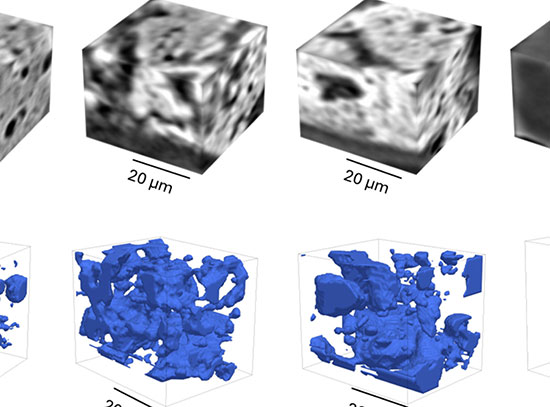
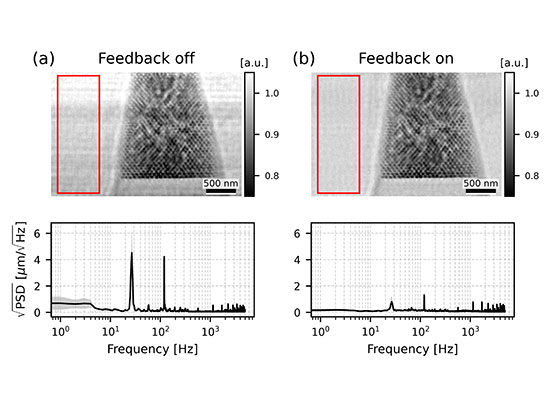
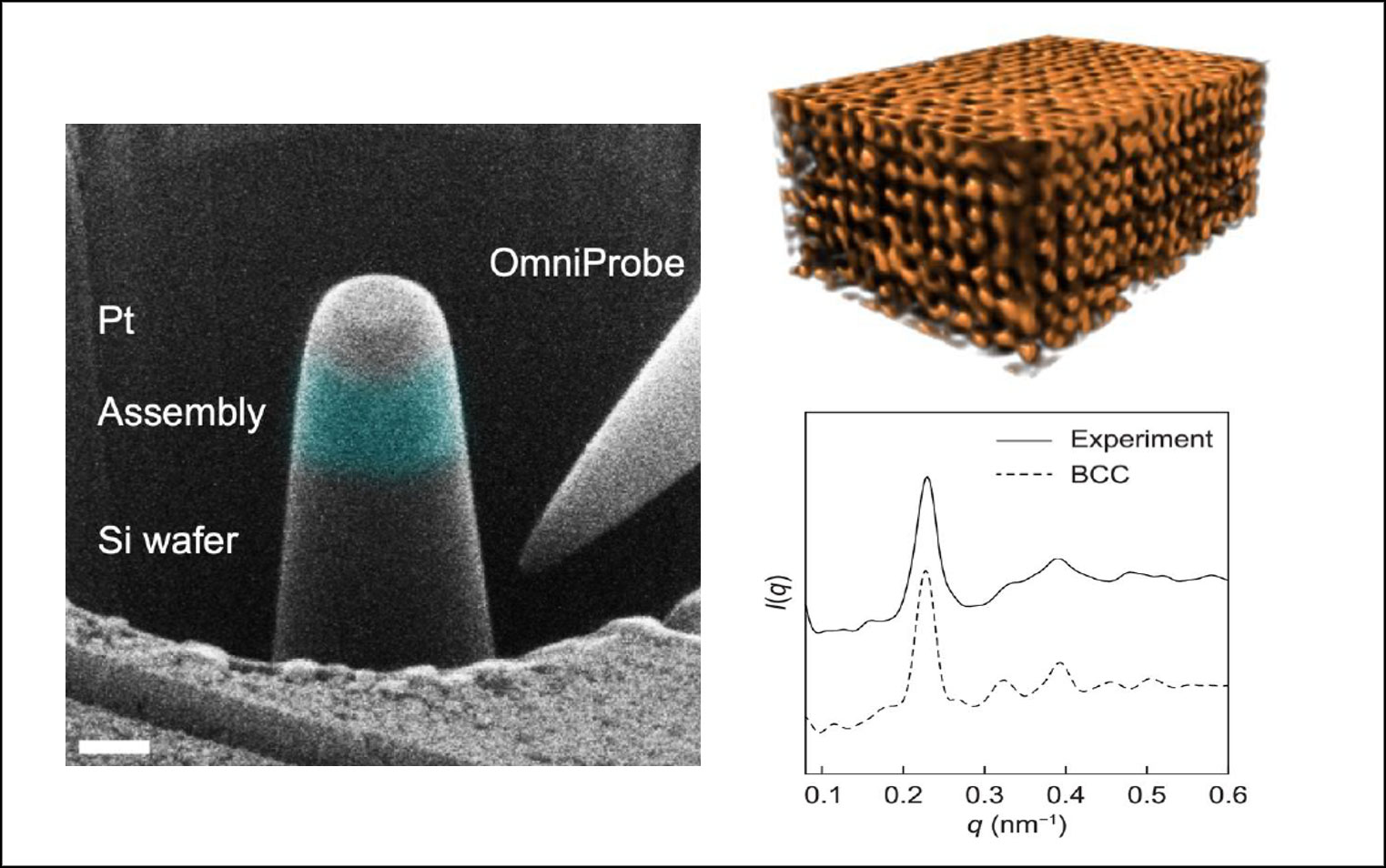
(Left) A focused ion beam (FIB) was used to prepare the sample for X-ray nanotomography at the HXN beamline. (Right, top) X-ray tomography of patchy rhombic dodecahedra assembly showing the positions of individual atoms. (Right, bottom) The scattering signal calculated from the tomography data matches a perfect scattering signal from the simulated body-centered cubic (BCC) lattice (dotted lines), confirming that the self-assembly of patchy rhombic dodecahedra forms a BCC lattice.
The Science
Scientists have developed a new way to “stencil” molecular patterns at the nanometer precision but here the mask is made of atoms adsorbed on a nanoparticle’s surface with facet selectivity.
The Impact
This new bottom-up, solution-based approach is less expensive, scalable, high precision, and works on curved or 3D objects—important for complex nanomaterials.
Summary
Stencilling — creating patterns by applying material through a mask—is widely used in art, manufacturing, and microfabrication. Modern top-down approaches have pushed mask sizes below 10 nm, enabling ever-smaller electronic devices, but such methods remain costly and are best suited to flat, rigid substrates. In contrast, bottom-up masking strategies that rely on chemical or physical interactions have been far less explored, despite their potential advantages in cost, scalability, and compatibility with curved or three-dimensional surfaces.
In this work, the authors introduce an atomic-scale stencilling method that uses adsorbed iodide submonolayers as temporary masks on nanoparticle surfaces. Polymers were then grafted selectively onto the unmasked regions, effectively “painting” nanoscale patches with high spatial precision. This approach allows the synthesis of more than 20 distinct types of polymer-patched nanoparticles in high yield.
Using X-ray nanotomography at the Hard X-ray Nanoprobe (HXN) beamline at NSLS-II, the individual atoms of a patchy rhombic dodecahedra assembly were imaged and the scattering signal from the tomography data confirmed that the self-assembly of the patchy rhombic dodecahedra forms a BCC lattice. Polymer scaling theory and molecular dynamics simulations reveal that the combination of the stencil and polymer thermodynamics produces patch geometries not previously observed. These patchy nanoparticles self-assemble into uniform, extended crystal structures, including non-closely packed superlattices that are difficult to obtain by other means.
Overall, atomic stencilling provides a versatile bottom-up route to nanoscale patterning, offering precise control over nanoparticle surface chemistry, reactivity, and interactions, with broad implications for targeted delivery, catalysis, microelectronics, metamaterials, and tissue engineering.
Download the research summary slide (PDF)
Contact
Kristen Fichthorn
The Pennsylvania State University
fichthorn@psu.edu
Sharon Glotzer
University of Michigan
sglotzer@umich.edu
Qian Chen
University of Illinois
qchen20@illinois.edu
Publications
A. Kim, C. Kim, T. Waltmann, T. Vo, E. M. Kim, J. Kim, Y.-T. Shao, A. Michelson, J. R. Crockett, F. C. Kalutantirige, E. Yang, L. Yao, C.-Y. Hwang, Y. Zhang, Y.-S. Liu, H. An, Z. Gao, J. Kim, S. Mandal, D. A. Muller, K. A. Fichthorn, S. C. Glotzer, Q. Chen. “Patchy nanoparticles by atomic stencilling.” Nature 646, 592–600 (2025). https://doi.org/10.1038/s41586-025-09605-8
Funding
The experimental synthesis, self-assembly and main characterizations of patchy NPs were supported by the US Department of Energy (DOE), Office of Science, Office of Basic Energy Sciences, Division of Materials Science and Engineering, under award number DE-SC0020723 (A.K., C.K., Q.C.). The polymer scaling theory and simulations (T.W., T.V., S.C.G.) were supported by the US National Science Foundation (NSF) under Cooperative Agreement No. 2243104, ‘Center for Complex Particle Systems (COMPASS)’ Science and Technology Center and in part by a Vannevar Bush Faculty Fellowship sponsored by the Department of the Navy, Office of Naval Research under ONR award number N00014-22-1-2821. Computational resources and services are provided by Advanced Research Computing at the University of Michigan. DFT calculation (E.M.K., Junseok Kim, K.A.F.) used Bridges-2 at the Pittsburgh Supercomputing Center through allocation DMR110061 from the ACCESS programme, which was supported by NSF grant no. 2138259, no. 2138286, no. 2138307, no. 2137603 and no. 2138296, and by the US DOE, Division of Materials Science and Engineering, under award number DE FG02-07ER46414. The STEM-EDX studies (Y.-T.S., D.A.M.) were supported by the Department of Defense, Air Force Office of Scientific Research under award FA9550-18-1-0480 and made use of the Cornell Center for Materials Research (CCMR) facilities supported by the NSF MRSEC programme (DMR-1719875), NSF MIP (DMR-2039380), NSF-MRI-1429155 and NSF (DMR-1539918). The X-ray tomography (A.M., Z.G.) work used the Hard X-ray Nanoprobe (HXN 3-ID) beamline of the National Synchrotron Light Source, a US Department of Energy Office of Science User Facility operated for the Department of Energy Office of Science by Brookhaven National Laboratory under contract no. DE-AC02-98CH10886.
2025-22763 | INT/EXT | Newsroom