Radiofrequency Upgrades Ensure Accelerator Stability and Reliability
NSLS-II's RF team implements high-tech solutions to eliminate operational vulnerabilities
December 11, 2025
 enlarge
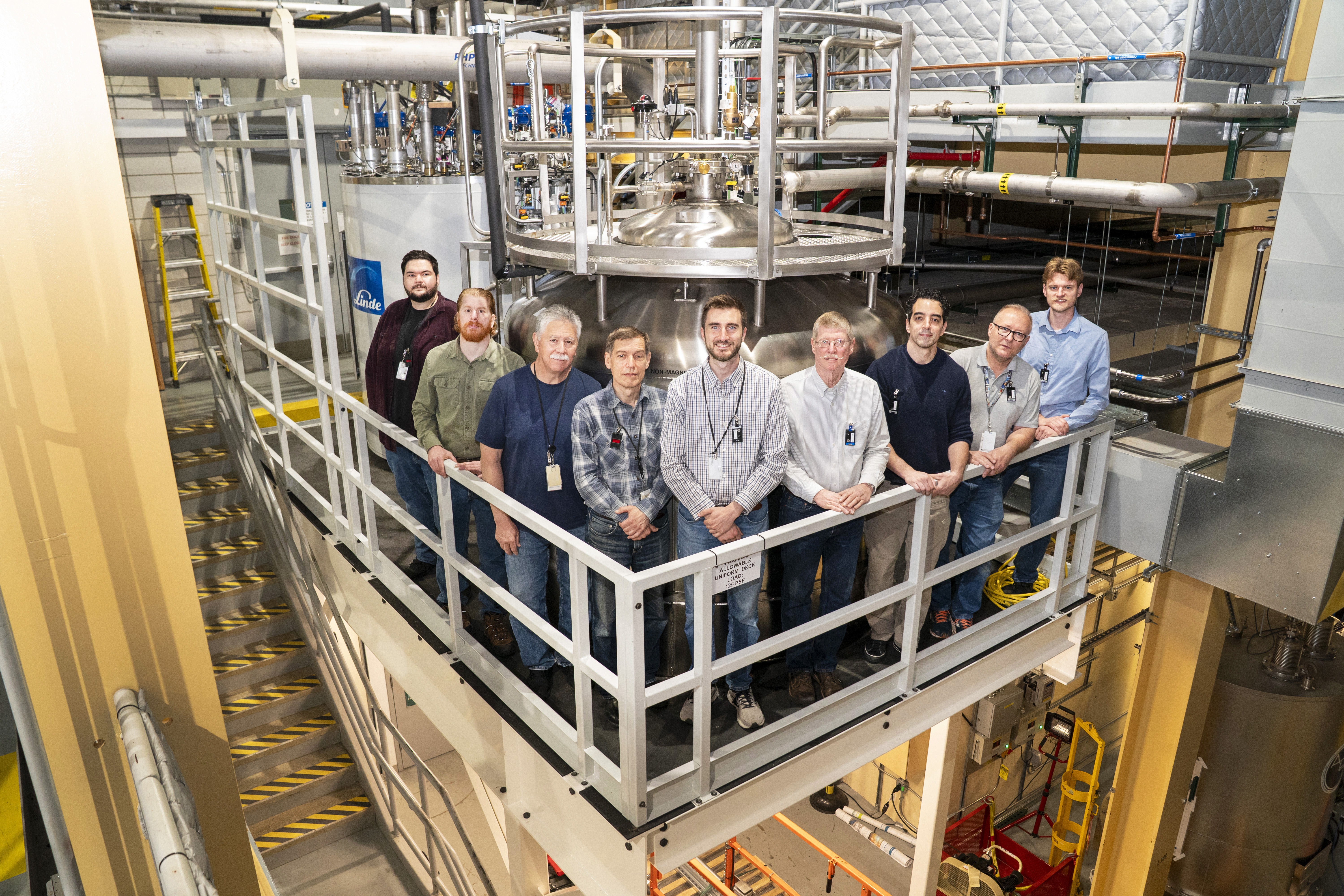
The NSLS-II radiofrequency (RF) group stands with a newly installed cold box, a key component that helps cool the facility's RF system. Pictured from left to right are Sean Lehn, Bob Sikora, Joe Papu, Alex Sitnikov, Brandon Bozeat, Jim Rose, Carlos Marques, Dariusz Lebiedzinski, and Michael Monteleone. Team members not pictured are William Gash, Brian Holub, Roger Borger, Feng Gao, Jerome D'Oyen-Stewart, Keith McDonald, Chris Sorrentino, David Livoti, Peter Davila, and Jorge Oliva. (David Rahner/Brookhaven National Laboratory)
Running a synchrotron light source is a massive team effort that brings hundreds of highly skilled and specialized professionals together. The radiofrequency (RF) group at the National Synchrotron Light Source II (NSLS-II), a U.S. Department of Energy (DOE) Office of Science user facility at DOE’s Brookhaven National Laboratory, plays an integral role in synchrotron operations. The work they do, often behind the scenes, ensures that the electron beam that enables cutting edge science at NSLS-II remains bright, powerful, and stable.
The electrons that circle through NSLS-II’s nearly half-mile-long storage ring lose energy as they produce X-rays, which scientists use to perform a variety of experiments at the facility. To keep the beam moving steadily, the electrons pass through hollow RF cavities. These cavities, tuned to a precise frequency, restore the electrons’ energy each time they pass through. When cooled to cryogenic temperatures, the material that the cavities are comprised of, niobium, takes on superconducting properties that nearly eliminate electrical resistance and drastically improve energy efficiency and beam stability. The design also allows unwanted high-frequency oscillations to be safely damped, ensuring a stable, high-intensity X-ray beam.
As NSLS-II surpasses a decade of operations, staff members are looking toward improvements and additions that will prepare the facility for the future and support aging infrastructure — from expanding current capabilities to imagining entirely new systems. This year, the RF team was challenged to do both, ensuring reliability for years to come.
The klystron: replacing a technology ahead of its time
Klystrons are vacuum tubes that scientists and engineers use to amplify high radio frequencies, and they were the first reliable and practical source of microwaves. They were developed in the 1930s by the Varian brothers, founders of one of the first tech businesses to set up shop in the Stanford Industrial Park, the birthplace of today’s Silicon Valley. These versatile devices could be found in television transmitters, radar systems, and even particle accelerators. The RF systems in accelerators provide energy gain to the electrons, initially to accelerate to 3 gigaelectron volts and then to replace the energy the electrons lose to the X-rays used by the beamlines.
NSLS-II has been running for nearly 10 years with klystrons powering the superconducting cavities that provide that energy to the electron beam. These amazing pieces of technology have had a long, productive run, but the creep towards obsolescence has already begun. This was accented by how difficult they were to find during the manufacturing challenges of the pandemic, bringing NSLS-II to a point of having no spare klystrons on hand.
“As companies that produce klystrons start to lose market share, they stop production,” said James Rose, deputy director for NSLS-II’s Accelerator Division and leader of the RF group. “Relying on obsolete technology poses a great risk, and to mitigate that, the RF team needed to embark on innovating a more modern and reliable solution.”
Their ingenuity led to the use of a solid-state transmitter that combines hundreds of amplifiers together, each consisting of a single transistor with up to 1,000 watts of output. This new transistor technology allows RF transistors to output more than 1,000 watts from a single device. The combination can replicate the 300-kilowatt output of klystron amplifiers as they currently face extinction. This new power source aims to keep the light source bright for years to come.
Ensuring NSLS-II doesn’t lose its cool
The superconducting RF cavities in NSLS-II’s storage ring require extremely cold temperatures to function optimally. Through the use of liquid helium, the cavities maintain a temperature of -452 degrees Fahrenheit, which is just three degrees above the average temperature found in outer space. Since starting operations a decade ago, NSLS-II has been able to rely on a single helium refrigerator and liquefier, also known as a “coldbox,” to cool these cavities. As the facility matures and grows, however, this may not be enough.
“Without another system, we start to run the risk of having a single point of failure,” Rose said. “If we lose the only helium refrigerator we have, it could cost the facility months of downtime.”
Adding a second system provides more than one preventative measure. Since the cavities need to be kept cold during operations, the coldbox could only be shut down briefly, making maintenance difficult. The addition of the second coldbox allows one system to be taken offline for repairs. It also enables technicians to perform maintenance on a regular schedule.
Adding the new coldbox wasn’t as simple as procuring and installing a second unit, though. In addition to purchasing the proper helium refrigerator and liquid helium dewar, the team needed to design and install a cryogenic piping system that would enable both units to operate separately or together. A large part of this program was to develop a specialized programable logic controls software that would control the process. The software has over 80 separate process control loops, each with proportional and integral functions.
The RF group at NSLS-II continues to work hard at maintaining current systems, investigating upgrades for future initiatives, and addressing anomalies that happen from time to time. These upgrades not only strengthen day-to-day operations but also prepare the facility for future scientific demands as research continues to push the boundaries of what’s possible.
Brookhaven National Laboratory is supported by the Office of Science of the U.S. Department of Energy. The Office of Science is the single largest supporter of basic research in the physical sciences in the United States and is working to address some of the most pressing challenges of our time. For more information, visit science.energy.gov.
Follow @BrookhavenLab on social media. Find us on Instagram, LinkedIn, X, and Facebook.
2025-22628 | INT/EXT | Newsroom