Customizable Protein Cages for Drug Delivery to Cells
October 14, 2026
 enlarge
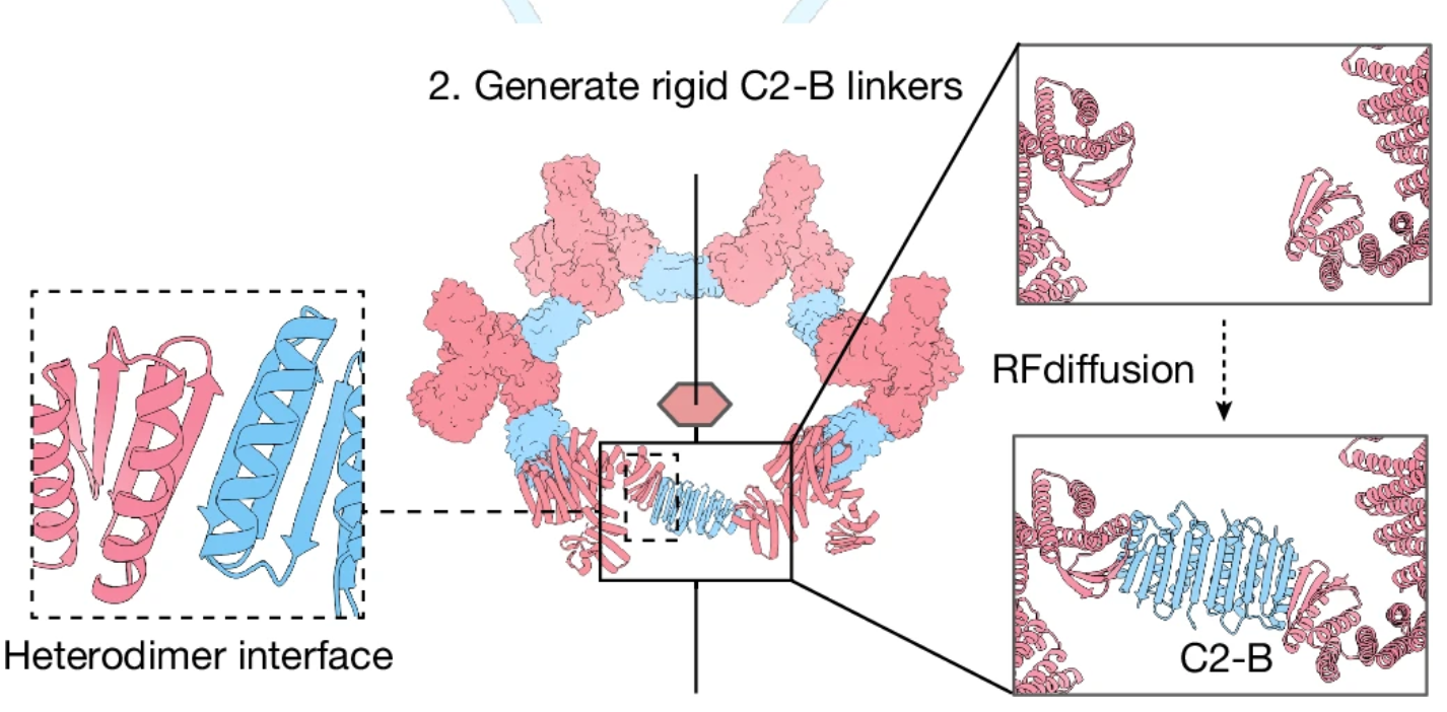
Design strategy for generating spherical protein cages. Protein cages form when pentagons and hexagons (red) combine to create the curvature needed for a closed, spherical structure. Rfdiffusion, which is a generative protein design method, was used to create dimeric linkers (blue) that rigidify the curvature and connect the protein building blocks to direct proper self-assembly. X-ray crystallography validated the linker structure and cryo-EM revealed the cage architecture.
The Science
Researchers computationally designed two-component protein cages that assemble into virus-like spherical cages with programmable size and function.
The Impact
These customizable cages provide a new platform for biologic drug delivery and for studying how large biomolecular assemblies move and organize inside cells.
Summary
Virus-like protein cages can serve as customizable platforms for molecular delivery, imaging, and synthetic biology. However, designing large, closed cages remains challenging because identical protein subunits must adopt different local shapes to create the required curvature.
In this work, researchers developed a computational design strategy for two-component, quasisymmetric protein cages that mimic the curved architectures of viral capsids. Trimeric building blocks and designed dimeric linkers assembled into curved hexagonal lattices; incorporation of pentagonal defects relieved geometric strain and enabled formation of closed cages ranging from roughly 40 to over 200 nm in diameter. The cages were further functionalized to load ribonucleoprotein cargo, enter cells, and probe size-dependent intracellular diffusion and protein localization.
X-ray crystallography at the FMX beamline at NSLS-II determined the structure of a key C2-B-α20 linker at 2.1 Å resolution and showed close agreement with the computational design. Cryo-EM and cryo-electron tomography resolved the assembled cages and revealed that the same linker adopts distinct bending conformations in hexagon–hexagon and hexagon–pentagon environments, producing the local symmetry breaking required for cage closure.
Together, the structural results validate a programmable approach for engineering large protein nanomaterials with controllable size, architecture, and function. More broadly, this work establishes a versatile framework for creating functional, genetically encodable protein materials that can be tailored for therapeutic delivery, intracellular sensing, and engineered cellular systems.
Download the research summary slide (PDF)
Related Links
Paper: De novo design of quasisymmetric two-component protein cages
Contact
Shunzhi Wang
University of Washington, New York University Langone Medical Center
shunzhi.wang@nyulangone.org
David Baker
University of Washington
dabaker@uw.edu
Publications
S. Wang, Y. Xie, D. Chmielewski, C. Weidle, T. Shu, G. Ahn, R. D. Kibler, C. Hernandez, W. Chen, D. C. Duran, A. Carr, A. K. Bera, S. Lee, J. Decarreau, A. Kang, E. Brackenbrough, E. Joyce, K. Wu, A. J. Borst, A. Favor, B. Huang, F. DiMaio, L. J. Holt, and D. Baker, “De novo design of quasisymmetric two-component protein cages,” Nature 655, 251–257 (2026). https://doi.org/10.1038/s41586-026-10464-0
Funding
This work was supported by the Defense Threat Reduction Agency (grant no. HDTRA1-19-1-0003 to S.W.) and the Burroughs Wellcome Fund (S.W.); The Audacious Project at the Institute for Protein Design (S.W., A.F., A.J.B., A.B., J.D., A.K., D.B.); a gift from Microsoft (D.C.); the National Science Foundation (grant no. CHE-2226466 to F.D.); the Human Frontiers Science Program (grant no. RGP0061/2019 to F.D.); the Bill and Melinda Gates Foundation (grant no. INV-043758 to C.W., J.D., A.K., A.B. and no. OPP1156262 to A.J.B.); the Howard Hughes Medical Institute (C.W., A.B., A.J.B., D.B.); the National Institutes of Health’s National Institute on Aging (grant no. R01AG063845 to A.B., A.F. A.J.B. and B.H.); Spark Therapeutics/Computational Design of a Half Size Functional (grant no. ABCA4 to K.W.); and The Nordstrom Barrier Institute for Protein Design Directors Fund (B.H.). Crystallographic work was done at the National Synchrotron Light Source II on beamline FMX (17-ID-2). The Center for BioMolecular Structure (CBMS) is primarily supported by the NIH-NIGMS through a Center Core P30 Grant (grant no. P30GM133893), and by the DOE Office of Biological and Environmental Research (grant no. KP1607011). NSLS-II is a US DOE Office of Science User Facility operated under contract no. DE-SC0012704. L.J.H. was funded by NIH (grant nos. R01 GM132447 and R37 CA240765) the NIH Director’s Transformative Research Award (no. TR01 NS127186), a Hypothesis Fund Award and a Research Grant from HFSP (grant no. RGP0016/2022).
2026-23232 | INT/EXT | Newsroom