ModSim 2026 Models What Comes Next for SI and HPC
October 15, 2026
 enlarge
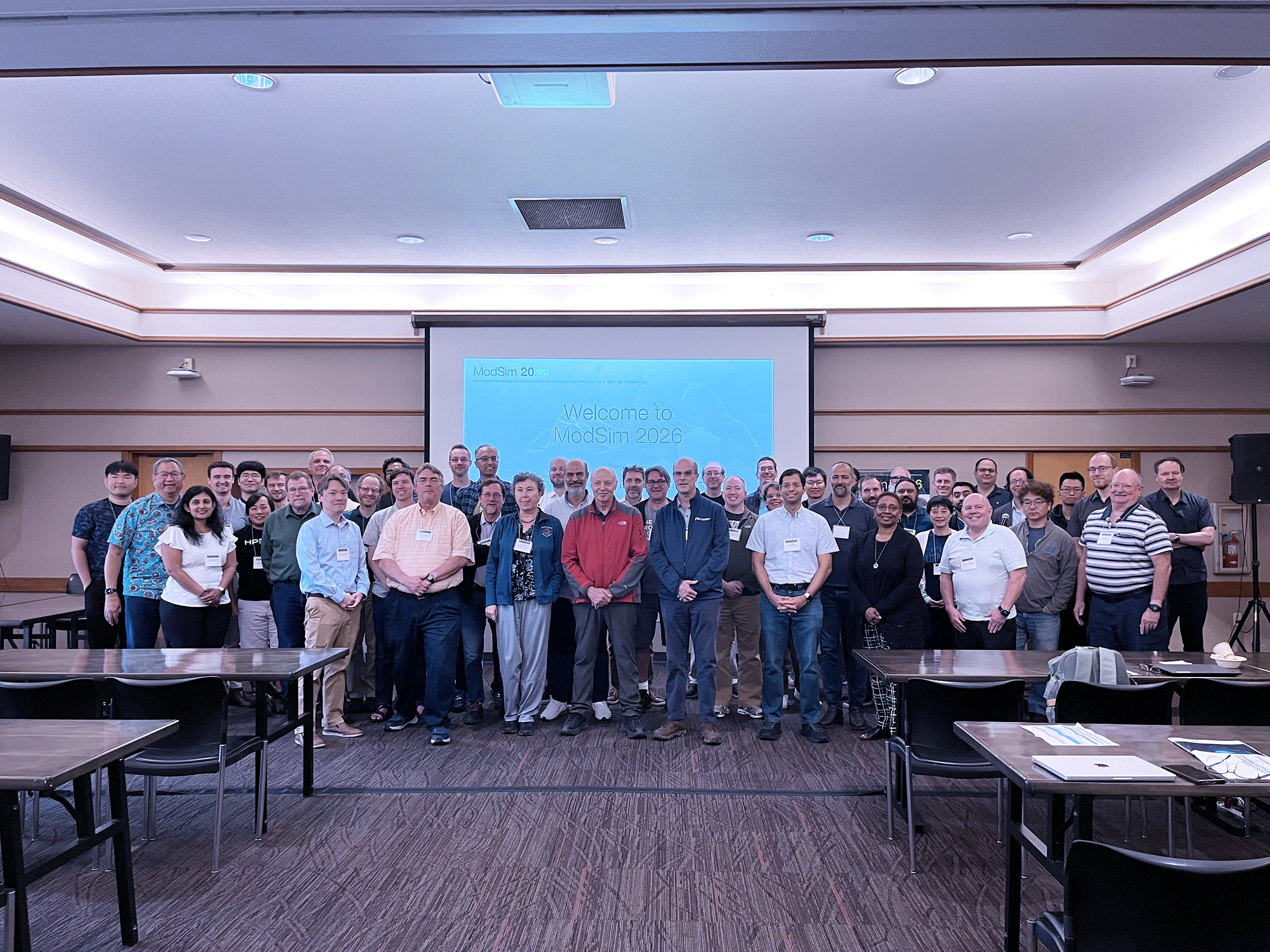
To honor the final ModSim workshop in Seattle, everyone came together for a "group huddle." Adolfy Hoisie (in red jacket, center), the Systems, Architectures, and Computing Technologies division lead at DOE's Brookhaven Lab, has chaired the ModSim organizing committee since the workshop's inception in 2012. (C. Plata/Brookhaven National Laboratory)
For 15 years, the Workshop on Modeling & Simulation of Systems and Applications has brought National Laboratories, academia, and industry together to advance the design, optimization, and modeling of scientific computing systems. Hosted by the U.S. Department of Energy’s (DOE) Brookhaven National Laboratory, ModSim 2026 marked its final gathering in Seattle by focusing on “ModSim-Integrated AI and HPC.” Over two and a half days, participants explored how modeling and simulation intersect with the rapidly evolving Super Intelligence (SI) landscape and examined broader ramifications for the field.
ModSim meets the Genesis Mission
As keynote speaker, Hal Finkel, associate director of DOE’s Advanced Scientific Computing Research program, opened the workshop with “Genesis Mission, its Platform, and Challenges and Opportunities for ModSim.” Finkel explained why the Genesis Mission, the DOE-led, government-wide effort to unite federal resources, supercomputers, experimental facilities, scientific data, SI capabilities, and researchers to accelerate scientific discovery, is needed right now. He also cast the relationship between SI, high-performance computing (HPC), and ModSim as “a cornerstone” for DOE’s approach to computer science that will influence how the Genesis Mission proceeds.
“Applying the scientific method to computing systems and having a quantitative method for modeling of systems has never been more important,” Finkel said. “We need models refined for these high-performance computing systems, edge systems, and others. The ModSim community is essential if you want to do this for real. The kinds of things you work on here also are important to Genesis.”
Finkel’s keynote established that understanding how increasingly complex computing systems behave, especially interactions between hardware, software, networks, SI, data, and scientific workflows — all staples of ModSim research — is integral to building the infrastructure needed for the next generation of SI-augmented science. This sentiment echoed throughout the workshop.

Hover over image to reveal slideshow controls.
From first time to longtime
Each day of ModSim 2026 was punctuated by sessions featuring invited speakers, many new to the workshop, and lively panel discussions.
ModSim “first timer” Kevin Sheridan, from DOE’s Los Alamos National Laboratory (LANL), offered a closer look at how ModSim tactics are informing ATS-5, the next-generation, national-security supercomputer being built for LANL. Ilan Tayari, co-founder of NextSilicon and another ModSim “newbie,” took everyone on a technical dive into his company’s accelerator technology that overcomes barriers for moving data, accessing memory, and coordinating computation to improve simulation performance for SI and HPC. Meanwhile, Trevor Carlson, an associate professor at the National University of Singapore, reminded the audience that trusting how and if models are doing the job users want takes considerable work as SI does not have all the answers.
Some of HPC best-known leaders and institutions, from AMD, Microsoft, DOE’s Sandia National Laboratories, Georgia Tech, ETH Zürich, and RIKEN (Japan), were represented on the day one panel, “Agents of Change: How AI is or isn't Rewriting the Rules of ModSim.” As usual, the panel prompted much discussion and debate, particularly when posed with determining: “When will AI be better than us?” The answers spanned from “one year” to “between five and 10 years” to “never,” proving uncertainty remains in the age of SI.
Lav Varshney, Della Pietra Infinity Professor and inaugural director of the AI Innovation Institute at Stony Brook University and a Brookhaven Lab lead AI scientist, spoke to the community about challenges involved with scaling scientific foundation models, actively seeking their feedback. He also was part of day two’s popular ad hoc panel. This time, the panelists addressed: “Can AI fully replace ModSim?” Although agentic SI has made tremendous inroads, the consensus seemed to be that people still play a considerable part.
“It will come down to specifying what you want,” said panelist Rishi Khan, chief technology officer of Extreme Scale Solutions. “AI will be completely wrong sometimes, but it will come to a solution.”
“What humans bring to the concept — we think, create, we charter the path forward. AI needs human prompting,” added David Donofrio, a longtime ModSim participant formerly of Tactical Computing Laboratories. He later emphasized the “human touch” needed for ModSim-integrated SI in a talk, “Future of ModSim when Considering Advanced AI Architectures,” which had a pointedly bare-bones design “to prove AI did not create the presentation.”
“Manual development of simulation libraries will allow AI users to better drive the tools,” Donofrio said.
As it has done for many years, the ad hoc panel veered in several directions in search of SI’s fitness to do science, including if trust in SI or mutual understanding between AI and human operators are necessary.
“I didn’t think this panel would cover everything from humanities to taxes, but here we are,” said Bruce Childers, dean of the University of Pittsburgh’s Computer Science department, who again served as the ad hoc panel’s moderator.
Rapid Fire ModSim
A staple event that helps expand the community’s research pipeline, ModSim’s Rapid Fire session featured short presentations that spanned distributed computing, graphics processing units (GPUs) and SI accelerators, scientific software, scheduling, digital twins, surrogate models, and even the effects of space radiation on SI hardware.
Brookhaven Lab had healthy representation during Rapid Fire and the poster session that followed with Sankha Dutta, Kuan-Chieh Hsu, and Sairam Sri Vatsavai, scientists from the Computing and Data Sciences directorate, providing flash talks about their respective research involving SI workload scheduling and SI agents and SI-enabled ModSim for distributed computing.
Other Rapid Fire presentations demonstrated how the relationship between SI and ModSim increasingly is becoming part of a continuous loop, where one is used to improve the other, sometimes simultaneously. Notably, this aspect was showcased by some of the field’s most recognized leaders who generously brought their projects to the session.
For her Rapid Fire segment, Valerie Taylor, director of the Mathematics and Computer Science Division at DOE’s Argonne National Laboratory, discussed LASSI-EE, the large language model used to optimize scientific computing codes so they run better on HPC systems. Taylor detailed how employing SI resulted in 30% energy savings on the evaluated GPU platforms.
Meanwhile, Shantenu Jha, from DOE’s Princeton Plasma Physics Laboratory, closed the session with a deeper look at continuous surrogate learning “in the loop.” Here, an advanced computing workflow combines SI and HPC to run complex scientific simulations and training continuously in the background while an existing model remains in operation. Informed by such training, the improved models get integrated as they become available.
Top performer: Will Won
Each year, the ModSim organizing committee presents the Dr. Sudhakar Yalamanchili (Sudha) Award to a young researcher who demonstrates an “outstanding contribution” to modeling and simulation. William “Will” Won, from AMD Research and Advanced Development, earned the 2026 Sudha Award with his presentation, “ASTRA-sim 3.0: Taking Distributed ML [Machine Learning] Simulation to the Next Level via Fine-Grained GPU Modeling.” The research represents a major upgrade to ASTRA-sim, an open-source distributed machine learning system simulator that works with any network, compute, or memory simulator backends.
Won’s work demonstrated how ASTRA-sim 3.0 strikes a balance between simple SI models that run quickly but can omit important details versus more complex GPU simulators that provide greater fidelity yet require more time and computing resources. ASTRA-sim 3.0 can capture behavior that matters without system-level exploration being impractically slow.
Signing off after 15 years in Seattle
Technologies have changed since the ModSim workshop first convened back in 2012, along with the questions researchers are asking. It fits as the scale and complexity of HPC systems have evolved, and SI keeps adding new tuning knobs to the mix. Throughout this evolution, the ModSim workshop in Seattle has brough this community together, driving many of the advances in the field.
That continuity was not lost on those on hand for ModSim’s final bow in “The Emerald City.” During his presentation, Jeffrey Vetter, a Corporate Fellow at DOE’s Oak Ridge National Laboratory and longtime workshop attendee, took a moment from his call “to focus this community on the quantum computing problem” to recognize Adolfy Hoisie, Systems, Architectures, and Computing Technologies division lead at Brookhaven Lab who has chaired the ModSim organizing committee since the workshop’s inception.
“For 15 years, Adolfy kept this moving forward,” Vetter said. “Thanks to him for staying so devoted to ModSim and its success.”
Notably, Hoisie will pass the torch to University of Pittsburgh’s Childers, who will chair the organizing committee for ModSim 2027.
Hoisie’s technical leadership and vision for the field, along with a devoted research community, have carried ModSim through a transformative period in computing, from achieving exascale to an era defined by the convergence of HPC and SI. Increasingly, ModSim is embedded with SI as the field’s methodologies learn from and contribute to SI, conceiving new computing ecosystems capable of evolving in tandem with the science they support.
“ModSim 2026 brought together an extraordinary community of researchers, practitioners, and thought leaders at the forefront of modeling and simulation, along with some new perspectives,” Hoisie said. “I was deeply impressed by this year’s participants. Their depth of expertise, innovative contributions, and collaborative spirit elevated the workshop. It has been an incredible 15-year journey. Still, to me, it is clear our ModSim community will keep adapting as we push the boundaries of computing and SI, seeking better ways to understand systems and make the next ones better for discovery and society.”
For additional details about the 2026 Workshop on Modeling & Simulation of Systems and Applications, visit the website.
Brookhaven National Laboratory is supported by the U.S. Department of Energy’s Office of Science. The Office of Science is the single largest supporter of basic research in the physical sciences in the United States and is working to address some of the most pressing challenges of our time. For more information, visit science.energy.gov.
Follow @BrookhavenLab on social media. Find us on Instagram, LinkedIn, X, and Facebook.
2026-23147 | INT/EXT | Newsroom