Oxygen Collisions Quench Jets' Energy at RHIC
Strong evidence for jet quenching in oxygen-oxygen smashups offers clear sign of a quark-gluon plasma in a small nuclear system at lowest collision energy yet
October 20, 2026
 enlarge
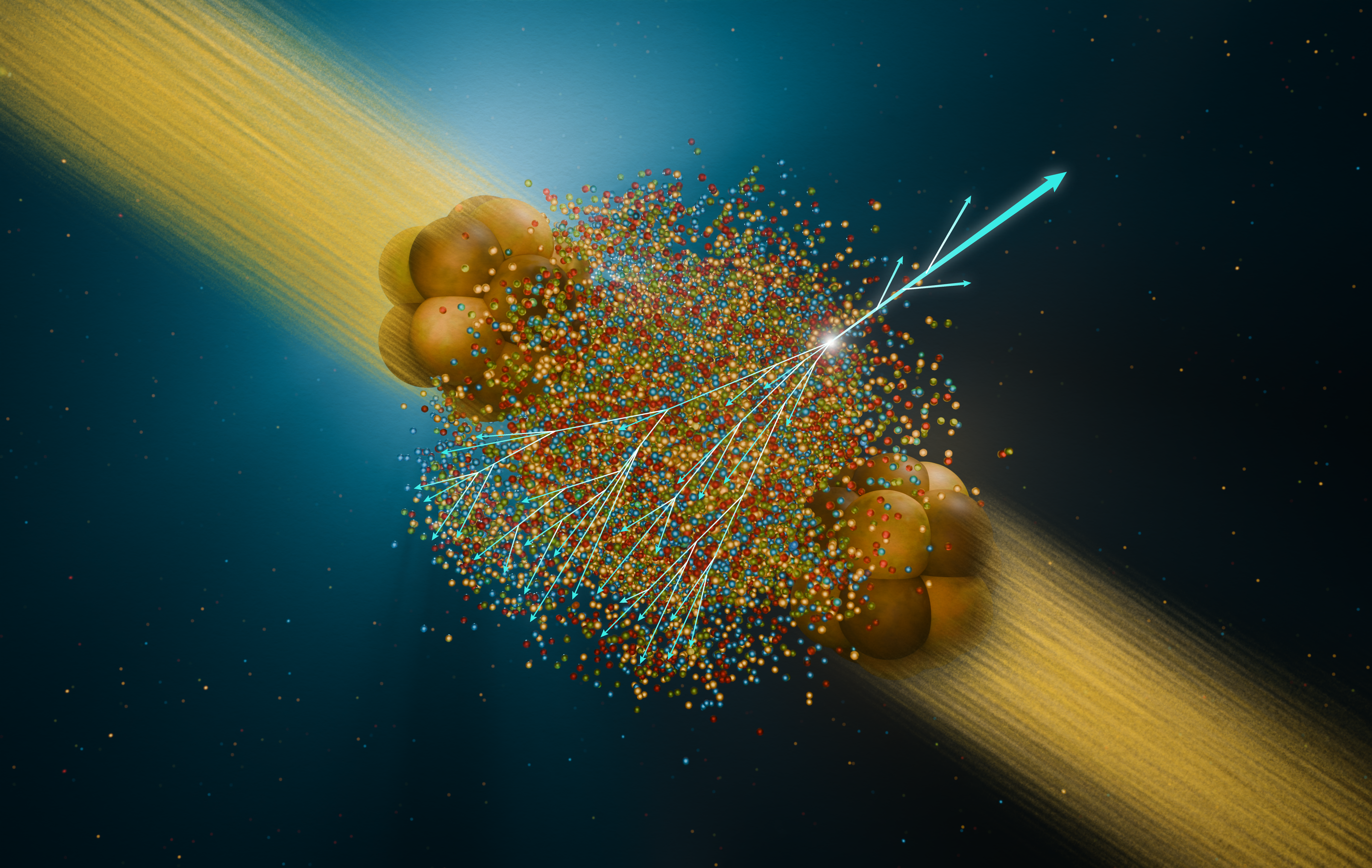
This image shows back-to-back jets produced in the quark-gluon plasma formed when two oxygen nuclei collide at the Relativistic Heavy Ion Collider (RHIC). The jet near the edge of the plasma, upper right, escapes easily while the jet moving a longer distance through the plasma loses energy, or gets "quenched," as it interacts with the soup of quarks and gluons. (Valerie A. Lentz/Brookhaven National Laboratory)
UPTON, N.Y. — New results from the STAR experiment at the Relativistic Heavy Ion Collider (RHIC) provide strong evidence that smashing oxygen nuclei together at nearly the speed of light generates a quark-gluon plasma (QGP), a type of matter that existed just after the birth of the universe. The data, just published in Physical Review Letters, show that energetic jets of particles lose energy as they traverse the hot, dense matter left in the collision’s wake.
This energy loss phenomenon, known as jet quenching, has been one of the “smoking gun” signatures of QGP formation in collisions of larger atomic nuclei at RHIC, a U.S. Department of Energy (DOE) Office of Science User Facility that operated at DOE’s Brookhaven National Laboratory from 2000 until earlier this year. This signature has also been observed in oxygen-oxygen collisions at the Large Hadron Collider (LHC), located at CERN, the European Particle Physics Laboratory. The analysis from RHIC at significantly lower collision energy sets a new lower boundary for the conditions capable of producing the primordial QGP in this small collision system.
“The QGP is believed to be the form of matter that filled the early universe — before the protons and neutrons that make up today’s atoms formed. Understanding its properties is essential for uncovering how the early universe evolved in its first microseconds,” said Li Yi, a professor of physics at Shandong University who oversaw the STAR analysis. “One of the most powerful ways scientists study the QGP is by identifying where its signatures appear — and just as importantly, where these signatures turn off,” she said.
Rongrong Ma, a STAR physicist from Brookhaven Lab, said, “This analysis is pushing the boundaries to an extreme case to help us learn something about this jet quenching phenomenon and the conditions needed to generate a QGP.”
Tracking jets
RHIC was built to create and study the QGP. Its collisions of gold nuclei, each packed with 79 protons and 118 neutrons, effectively melt the boundaries of these atoms’ protons and neutrons, thus setting free their constituent quarks and gluons. The collisions also deposit enough energy to be transformed via Einstein’s famous equation, E=mc2, into thousands of new quarks and gluons. But because the resulting QGP is a speck smaller than a single atomic nucleus and lasts less than a billionth of a billionth of a second before the quarks and gluons join up to form more ordinary particles, the only way to know if a QGP has formed is to study particles flying out of the collisions using giant detectors like STAR.
Seeing signs that some particles emerge with less energy than expected implies that they’ve gotten “stuck,” or quenched, by interacting with the soup of quarks and gluons on the way out. Energy loss by collimated sprays of very energetic particles known as jets has been a particular interest. These jets are typically produced when a single quark or gluon in one nucleus interacts with a quark or gluon in the other, shooting out two sprays of energetic particles back-to-back from the point of that interaction. When these “di-jets” are produced near the edge of the collision zone, they give physicists a built-in way to study the plasma by tracking how each half of the jet gets affected as it moves different distances through the blob of hot nuclear matter.
“You can think of it like shooting a bullet through, say, water,” Yi said. “Because of the resistance, the bullet will slow down. It's the same thing with these high-energy particles. When they go through the QGP, they will lose energy.”
For many years, RHIC physicists have seen definitive evidence of quenching in gold-gold collisions, particularly in jet particles that traverse a relatively long distance through the matter generated in the collisions. Presumably these long-distance travelers interact with more quarks and gluons along their longer escape path than jets escaping from closer to the edge of the QGP blob. These observations were among the evidence RHIC scientists presented as part of the case for having created the QGP in gold-gold collisions, backed by a trove of other QGP signature measurements from multiple RHIC experiments.
Among those other measurements was the observation that lower-energy particles emerging from gold-gold smashups move in a coordinated way. These observations of collective behavior led physicists to declare that the matter created in RHIC’s collisions flows like a nearly perfect liquid with nearly zero viscosity or resistance. This was a major RHIC discovery that, at the time, was completely unexpected, but has since become another “smoking gun” signature of the QGP.
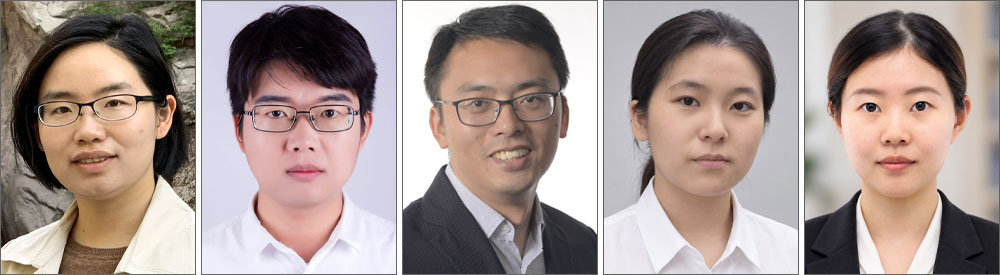
Members of the STAR Collaboration who led the analysis of results that led to this publication on jet quenching in oxygen-oxygen collisions at the Relativistic Heavy Ion Collider (left to right): Li Yi, Maowu Nie, Rongrong Ma, Sijie Zhang, and Yang He.
QGP in small systems?
Years after the definitive flow and jet-quenching results from RHIC emerged, physicists at the LHC and then later at RHIC began to see signs of collective flow in much smaller collision systems, including collisions of tiny protons, deuterons, and helium-3 nuclei with large gold or lead nuclei. Experiments at the LHC even observed flow patterns in data from proton-proton collisions. These observations in small collision systems at both facilities raised the intriguing question of whether the flow signature is sufficient to say that these systems are creating a QGP.
“The next natural question is: Can you see jet quenching, the other key signature that QGP is formed, in these very small collision systems?” asked Brookhaven’s Ma. “We haven’t seen any unambiguous signal, so it’s still kind of under debate in these small systems. We want to search for the smallest system where we can still see an unambiguous jet-quenching signal,” he said.
Enter the oxygen-oxygen smashups.
Oxygen collisions offer a small system with just 8 protons and 8 neutrons in each colliding nucleus. Also, the oxygen nuclei are symmetrically spherical.
“That means we can more easily look for signs of asymmetric quenching of di-jets produced close to the edge of the circular interaction region in head-on collisions,” said Maowu Nie, an associate professor at Shandong University who was also involved in the analysis.
“We can also compare how jets behave in head-on central collisions — those that produce the most particles and therefore have the highest likelihood of making a QGP — with collisions where the two oxygen nuclei barely strike each other, which aren’t expected to generate a QGP.” The latter can be distinguished because they produce many fewer particles, he said.
The oxygen-oxygen results
“Our measurements are essentially counting experiments,” said Sijie Zhang, who worked on this project for her master’s thesis under Yi and Nie’s guidance at Shandong University and is now pursuing a Ph.D. at Yale University. “We have an algorithm that finds the collimated groups of high energy particles, the jets, and we count how many of these particles above a certain energy threshold come out.”
Yang He, another former Ph.D. student at Shandong University who set up the analysis framework and now analyzes oxygen-oxygen collisions at the LHC, added, “We compare what we see in back-to-back jets produced near the edge of the system, and we compare what we see in head-on collisions with the counts in non-central collisions where we don’t expect to see quenching.”
The analysis, based on STAR data collected from oxygen-oxygen collisions at 200 billion electron volts (GeV) at RHIC in 2021, revealed a 20% suppression in high-energy particles due to jet quenching. That’s lower than the level seen in RHIC’s gold-gold smashups, which is what the scientists would expect from this much smaller system, but it’s still a clear sign that these collisions are creating a QGP.
In addition, because oxygen is the only nuclear species — aside from proton-proton collisions — that has been studied at both RHIC and the LHC, physicists are able to do an “apples-to-apples” comparison of the results from the two facilities.
The LHC collided oxygen atoms for the first time in 2025. A recent CERN article summarizes their results to date, including observations of collective flow and jet quenching in oxygen-oxygen collisions.
Importantly, the LHC jet-quenching data come from collisions at much higher energies than at RHIC — more than 5,000 GeV.
“With a higher energy collision, it’s more likely to create more and more quarks and gluons and a hotter, denser QGP system,” Yi said. “That means the jet quenching signal, if it’s there, should be bigger at LHC compared to RHIC.”
But when physicists are trying to see where a QGP signature turns off, turning down the collision energy may get them closer to that limit.
“We are pushing the boundaries in two ways to explore the minimal conditions for creating a QGP, both in terms of the nucleus size by looking at these small oxygen-oxygen collisions, but also by looking at data from lower collision energies — and we still see this crucial QGP signature. That’s a unique feature of our measurement,” Ma said.
There will be much more to come in the oxygen-oxygen story from RHIC, using data collected by STAR and sPHENIX, RHIC’s newest detector, during the collider’s final run. Indeed, that final run ended with oxygen-oxygen smashups at both detectors on Feb. 6, 2026. What that data show and what it means in the quest for understanding the conditions needed to generate the QGP offer an exciting opportunity for new insights.
This research was supported by the DOE Office of Science, the U.S. National Science Foundation (NSF), and a range of international agencies and organizations listed in the scientific paper. In addition to using the Open Science Grid, supported directly by NSF, the researchers made use of computing resources in the Scientific Data and Computing Facilities at Brookhaven Lab and the National Energy Research Scientific Computing Center (NERSC), which is another DOE Office of Science User Facility at DOE’s Lawrence Berkeley National Laboratory.
Brookhaven National Laboratory is supported by the Office of Science of the U.S. Department of Energy. The Office of Science is the single largest supporter of basic research in the physical sciences in the United States and is working to address some of the most pressing challenges of our time. For more information, visit science.energy.gov.
Follow @BrookhavenLab on social media. Find us on Instagram, LinkedIn, X, and Facebook.
2026-23196 | INT/EXT | Newsroom