Seagull Nebula Through the Eyes of NSF–DOE Vera C. Rubin Observatory Commissioning Camera
Before Rubin Observatory's First Look event, its engineering camera captured exquisite details of star formation taking place in the Seagull Nebula
October 21, 2026
 enlarge
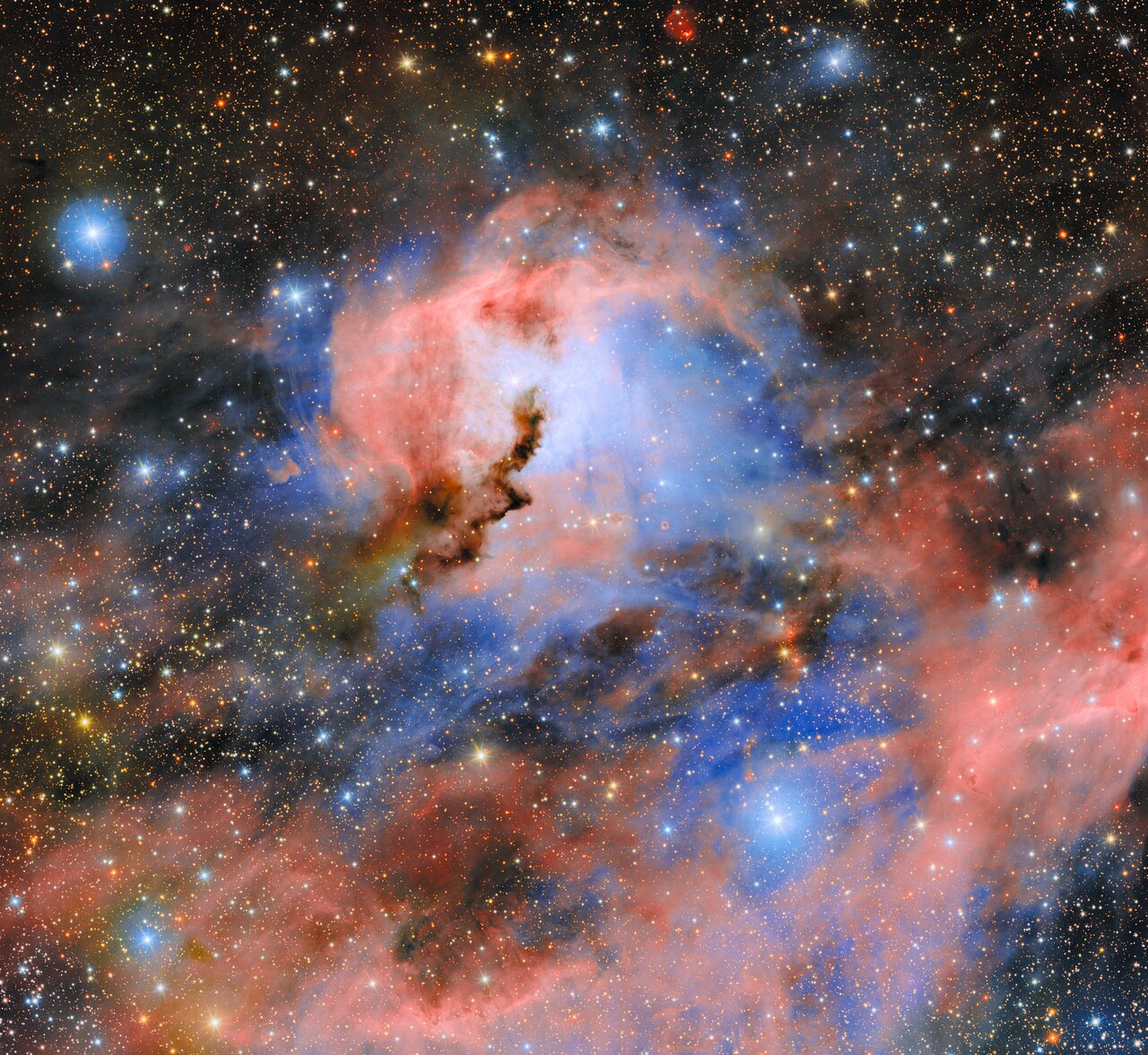
Two years ago this month, NSF–DOE Vera C. Rubin Observatory's engineering test camera, named the LSST Commissioning Camera (ComCam), began capturing images of the sky to prepare for the revolutionary Legacy Survey of Space and Time, which began earlier this year. This image featuring the head of the Seagull Nebula was one of many ComCam images that led to the success of Rubin First Look and helped to document the observatory's excellent performance.
Editor’s note: The following news release was originally issued by NOIRLab. Scientists, engineers, and technicians at the U.S. Department of Energy’s Brookhaven National Laboratory played key roles in developing the Rubin Observatory, such as creating the 3,200-megapixel sensor array for the telescope’s camera. To learn more about this sensor array — the largest charge-coupled device array ever built — and the world-leading capabilities at Brookhaven Lab that made this achievement possible, visit Brookhaven’s Rubin Observatory website. For additional information on Brookhaven’s ongoing contributions to the Rubin Observatory, including analyses of data collected through the Legacy Survey of Space and Time, please contact Stephanie Rucco (srucco@bnl.gov).
Active star formation populates this image of the Seagull Nebula taken in Fall 2024 by NSF–DOE Vera C. Rubin Observatory’s engineering test camera, known as the Commissioning Camera (ComCam). This image is being released today in recognition of the two-year anniversary of the beginning of engineering testing with ComCam.
ComCam’s work was an important step towards the ongoing Legacy Survey of Space and Time (LSST). Collecting the data for this Seagull Nebula image provided an opportunity to test Rubin’s hardware and software systems, as well as the image processing pipelines that would later be used with the much larger images from the LSST Camera.
With a mosaic of nine CCD sensors and a total of 144 megapixels, ComCam covers an area in the sky about twice that of the full Moon. Over the seven-week ComCam engineering test campaign, from 24 October to 11 December 2024, approximately 16,000 exposures were acquired. Within the data collected is this image featuring IC 2177, a region recognizable as the head of the Seagull Nebula.
Rubin Observatory is a joint initiative of the U.S. National Science Foundation (NSF) and the U.S. Department of Energy’s Office of Science (DOE/SC). Rubin is operated jointly by NSF NOIRLab and SLAC National Accelerator Laboratory.
Located about 3700 light-years away from Earth, between the constellations of Monoceros (The Unicorn) and Canis Major (The Great Dog), lie three expansive clouds of gas. These clouds, Sharpless 2-292, Sharpless 2-296, and Sharpless 2-297, form a shape that looks like a seagull in flight. Sharpless 2-292 represents the head of the nebulous bird and is pictured here.
The spectacular pink and blue colors of this nebula are caused by the rich star formation within it. When stars are born in molecular clouds, they emit ultraviolet radiation hot enough to ionize, or energize, the surrounding hydrogen gas and cause it to glow. The pressure of this radiation sweeps away light-obscuring material, such as dust, and makes the glowing hydrogen gas visible. In this image these regions appear pink. The contrasting blue haze is composed of dust particles reflecting the light of the other young stars in the area.
Sharpless 2-292 is a cloud of ionized (energized) hydrogen gas, known as an H II region, within IC 2177. The source of Sharpless 2-292 is HD 53367, a triple star system of massive young stars that sits at the top of the dark, jagged ridge in this image where it represents the Seagull’s blue eye.
With just 144 megapixels, ComCam is much smaller than the 3200-megapixel LSST Camera, which is now mounted on the Simonyi Survey Telescope and executing the Legacy Survey of Space and Time (LSST). LSSTCam’s field of view is 21 times larger than ComCam’s, which enables it to capture images of the entire southern hemisphere sky every 3–4 nights. Until LSST collects more data, this image is the deepest and sharpest view of this region.
This ComCam image of the Seagull Nebula gave Rubin’s image processing team early experience working with the complex structures found in star-forming regions. That experience helped the team identify and solve processing challenges that would also arise with the much larger LSST Camera images, including the Trifid and Lagoon Nebulae, one of the Rubin First Look images released in June 2025.
With its job on the telescope completed, ComCam now serves as a test stand in the summit clean room, supporting LSST Camera software testing and the regular cycling of spare vacuum pumps and refrigeration compressors to keep them in good working order. Although ComCam is no longer taking images of the sky, it continues to play an important role in supporting Rubin behind the scenes as the Legacy Survey of Space and Time gets underway.
More information
NSF–DOE Vera C. Rubin Observatory, funded by the U.S. National Science Foundation and the U.S. Department of Energy’s Office of Science, is a groundbreaking new astronomy and astrophysics observatory on Cerro Pachón in Chile. It is named after astronomer Vera Rubin, who provided the first convincing evidence for the existence of dark matter. Using the largest camera ever built, Rubin is repeatedly scanning the sky for 10 years to create an ultra-wide, ultra-high-definition, time-lapse record of our Universe.
NSF–DOE Vera C. Rubin Observatory is a joint initiative of the U.S. National Science Foundation (NSF) and the U.S. Department of Energy’s Office of Science (DOE/SC). Its primary mission is to carry out the Legacy Survey of Space and Time, providing an unprecedented data set for scientific research supported by both agencies. Rubin is operated jointly by NSF NOIRLab and SLAC National Accelerator Laboratory. NSF NOIRLab is managed by the Association of Universities for Research in Astronomy (AURA) and SLAC is operated by Stanford University for the DOE. France provides key support to the construction and operations of Rubin Observatory through contributions from CNRS/IN2P3. Rubin Observatory is privileged to conduct research in Chile and gratefully acknowledges additional contributions from more than 40 international organizations and teams.
The U.S. National Science Foundation (NSF) is an independent federal agency created by Congress in 1950 to promote the progress of science. NSF supports basic research and people to create knowledge that transforms the future.
The DOE’s Office of Science is the single largest supporter of basic research in the physical sciences in the United States and is working to address some of the most pressing challenges of our time.
NSF NOIRLab, the U.S. National Science Foundation center for ground-based optical-infrared astronomy, operates the International Gemini Observatory (a facility of NSF, NRC–Canada, ANID–Chile, MCTIC–Brazil, MINCyT–Argentina, and KASI–Republic of Korea), NSF Kitt Peak National Observatory (KPNO), NSF Cerro Tololo Inter-American Observatory (CTIO), the Community Science and Data Center (CSDC), and NSF–DOE Vera C. Rubin Observatory (in cooperation with DOE’s SLAC National Accelerator Laboratory). It is managed by the Association of Universities for Research in Astronomy (AURA) under a cooperative agreement with NSF and is headquartered in Tucson, Arizona.
The scientific community is honored to have the opportunity to conduct astronomical research on I’oligam Du’ag (Kitt Peak) in Arizona, on Maunakea in Hawai‘i, and on Cerro Tololo and Cerro Pachón in Chile. We recognize and acknowledge the very significant cultural role and reverence of I’oligam Du’ag to the Tohono O’odham Nation, and Maunakea to the Kanaka Maoli (Native Hawaiians) community.
SLAC National Accelerator Laboratory explores how the universe works at the biggest, smallest, and fastest scales and invents powerful tools used by researchers around the globe. As world leaders in ultrafast science and bold explorers of the physics of the universe, we forge new ground in understanding our origins and building a healthier and more sustainable future. Our discovery and innovation help develop new materials and chemical processes and open unprecedented views of the cosmos and life’s most delicate machinery. Building on more than 60 years of visionary research, we help shape the future by advancing areas such as quantum technology, scientific computing, and the development of next-generation accelerators. SLAC is operated by Stanford University for the U.S. Department of Energy’s Office of Science.
Links
- Explore the Seagull Nebula in more detail
- Press release on rubinobservatory.org
- Vera C. Rubin Observatory website
- Vera C. Rubin Observatory image gallery
- More Rubin images
- More Rubin videos
- Check out other NOIRLab Photo Releases
Contacts
Josie Fenske
Public Information Officer
NSF NOIRLab
Email: josie.fenske@noirlab.edu
2026-23235 | INT/EXT | Newsroom