X-ray Data and Simulations Explore Porous Polymer Framework
October 14, 2026
 enlarge
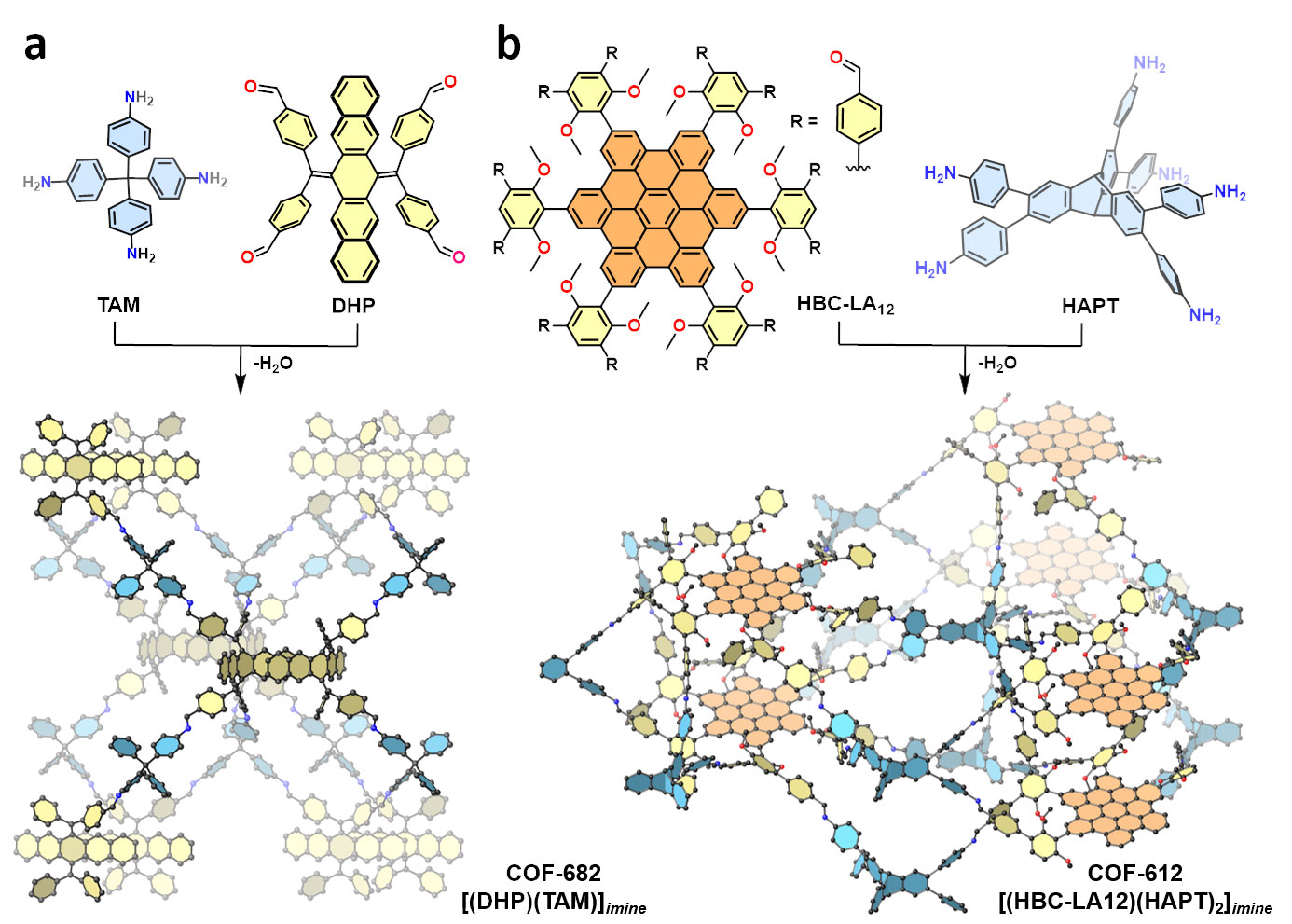
To create COF-682 (a) and COF-612 (b), specifically shaped molecular building blocks are chemically linked together. COF-682 is built from smaller, V-shaped units, while COF-612 incorporates much larger, flatter building blocks. Researchers found that these differences in size combined with the shape of their molecular components give each framework different properties and dynamics.
The Science
Scientists use X-ray pair distribution function (PDF) data and machine-learning-assisted molecular dynamics simulations to reveal the local structure and dynamics of 3D covalent organic frameworks (COFs).
The Impact
Because framework dynamics influence material properties, understanding and controlling flexibility could help researchers design COFs with specific functions and applications.
Summary
Covalent organic frameworks (COFs) are porous materials made by linking organic molecules together into carefully designed structures. They are strong, lightweight, and customizable, properties that make them promising for applications such as gas storage, chemical separation, and catalysis. To understand and improve their performance, scientists need to know not only how these materials are structured but also how their atoms and molecular building blocks move and rearrange.
COFs typically do not form large, highly ordered crystals, limiting what conventional X-ray diffraction can reveal. Other techniques can provide information about chemical bonds but do not fully capture how atoms are arranged and move across different length scales. This has made important aspects of COF flexibility, such as the rotation, tilting, and movement of their molecular components, difficult to analyze.
By combining synchrotron X-ray pair distribution function (PDF) measurements from the PDF beamline at the National Synchrotron Light Source II (NSLS-II), with molecular dynamics (MD) simulations assisted by machine learning, a team of scientists developed an approach to address this challenge. PDF provides information about the distances between pairs of atoms, allowing researchers to examine local structure even when a material is not perfectly ordered. The simulations help interpret these complex experimental measurements and reveal how the atoms move over time.
The team investigated two three-dimensional COFs and found that they behaved very differently because of the design of their molecular building blocks. COF-682 was comparatively flexible, while COF-612 had a much more rigid structure. Strong agreement between the experimental PDF measurements and simulated MD results provided confidence in the molecular dynamics models, allowing the researchers to quantify how different parts of each framework
Download the research summary slide (PDF)
Related Links
Paper: Local Structure and Dynamics of Three-Dimensional Covalent Organic Frameworks
Contact
Francesco Tavani
University of California, Universita` degli Studi di Roma La Sapienza
ftavani@berkeley.edu
Omar M. Yaghi
University of California
yaghi@tsinghua.edu.cn
Publications
F. Tavani, S. Mirzaei, J. Yin, Y. H. Lin, C. Myers, C. H. Lin, A. M. M. Abeykoon, S. J. L. Billinge, O. M. Yaghi, “Local Structure and Dynamics of Three-Dimensional Covalent Organic Frameworks,” Journal American Chemical Society, (2026). https://doi.org/10.1021/jacs.6c17514
Funding
F.T. acknowledges funding from the European Union’s Horizon Europe research and innovation program under the Marie Sklodowska-Curie grant agreement No. 101201413 (AQUAFRAME). Effort of S.J.L.B. and C.M. on PDF analysis, modeling and writing was supported by U.S. Department of Energy, Office of Science, Office of Basic Energy Sciences (DOE-BES) under contract No. DESC0024141. This research used beamline 28-ID-1 of the National Synchrotron Light Source II, a U.S. DOE Office of Science User Facility operated for the DOE Office of Science by Brookhaven National Laboratory under Contract No. DE-SC0012704.
2026-23233 | INT/EXT | Newsroom