Manganese Oxide Holds More Organic Matter in Forest Soil
October 14, 2026
 enlarge
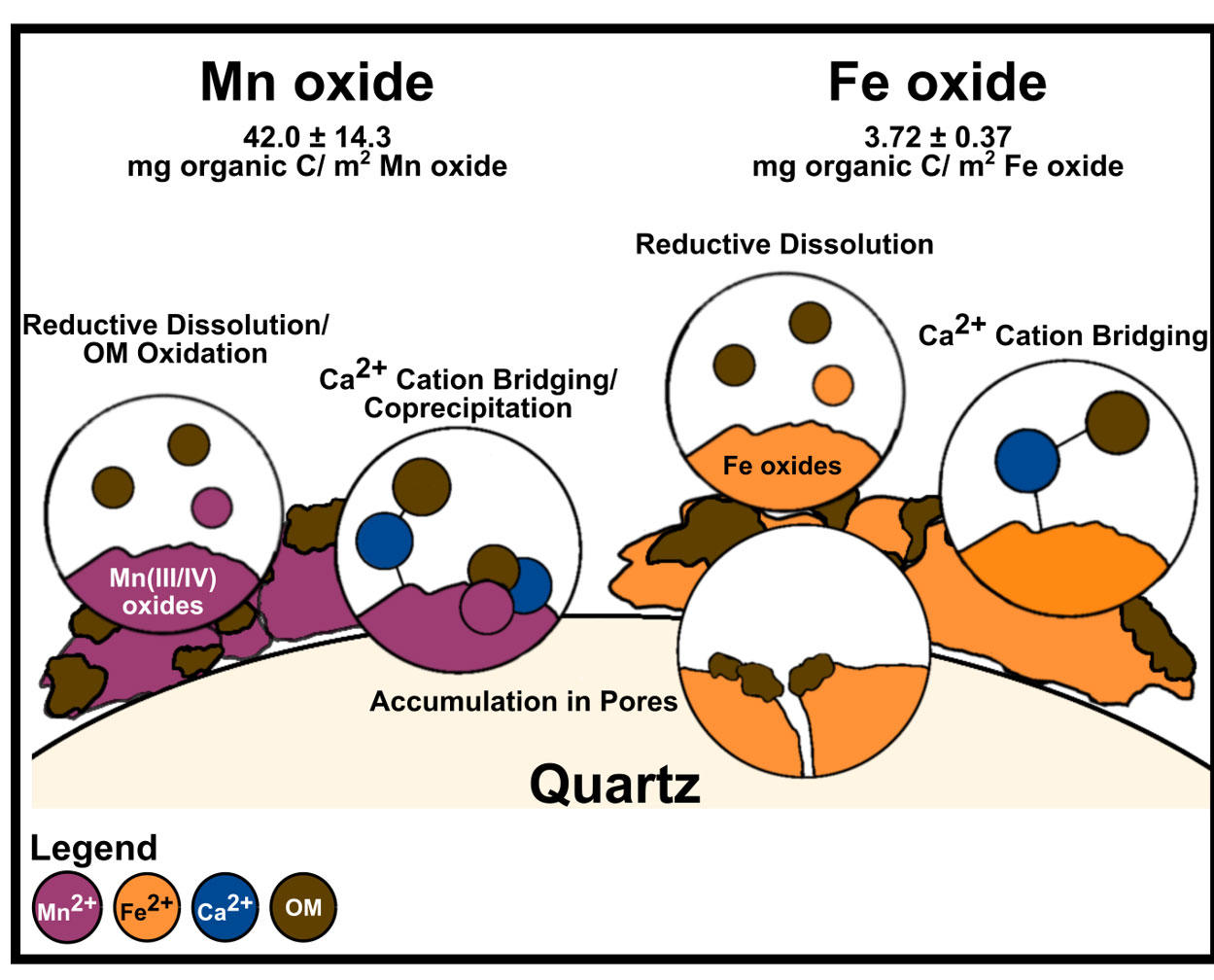
The quantity of organic matter that associated with manganese (Mn) and iron (Fe) oxides buried in acidic forest soil for one year and the proposed mechanisms influencing these organo-mineral associations.
The Science
Scientists discover that manganese (Mn) oxide in is much more effective at holding onto organic carbon than iron (Fe) oxide in acidic soil.
The Impact
Understanding this balance could improve scientists' understanding of how carbon is stored and cycled through forest ecosystem.
Summary
Immense amounts of carbon (C) are stored in the Earth’s soils; four to six times more than in the atmosphere and nearly eight times more than what is stored in living vegetation. Minerals play an important role in keeping that carbon from breaking down and returning to the atmosphere as carbon dioxide. Iron (Fe) oxides are known to bind organic matter in soils, protecting it from decomposition and helping it remain stored for longer periods. Manganese (Mn) oxides may also influence carbon storage, but their role is less well understood.
To get a clearer picture of the role of Mn oxides, a collaborative team of researchers compared Mn oxides with Fe oxides to determine how much organic C each can capture and retain in soil. They placed mesh bags of mineral-coated sands in soil and examined the amount and types of organic matter that accumulated on them over time. They found that Mn oxide was much more effective at holding onto organic C than Fe oxide. When differences in mineral surface area were taken into account, the Mn oxide stored about 11 times more carbon after one year.
The researchers found evidence that calcium (Ca) may help explain this effect. Ca accumulated strongly on the Mn oxide and was found in the same locations as Mn and C. The researchers propose that Ca can act somewhat like a bridge, helping connect organic molecules to the Mn mineral surface and potentially keeping that C from being broken down.
Chemical extractions, X-ray absorption and photon spectroscopies, scanning electron microscopy, and neutron scattering at DOE-supported user facilities were used to evaluate organic and mineral associations and transformations. At NSLS-II, Ca K-edge X-ray absorption near edge structure (XANES) at the X-ray Fluorescence Microprobe (XFM) beamline helped determine how Ca was associated with the mineral-coated sands. Bulk Mn and Fe K-edge XANES measurements at the Beamline for Materials Measurement (BMM) at NSLS-II helped the team examine the oxidation states of Mn and Fe.
The study suggests that manganese minerals may play a larger role in storing carbon in acidic forest soils than previously recognized. This new finding could improve scientists' understanding of how carbon is stored and cycled through forest ecosystems.
Download the research summary slide (PDF)
Related Links
Paper: Manganese Oxides Incubated in Acidic Forest Soil Retain More Organic Carbon Than Iron Oxides
Contact
Kristen Bidas
Oak Ridge National Laboratory, University of Tennessee
kbidas@alum.utk.edu
Elizabeth Herndon
Oak Ridge National Laboratory
herndonem@ornl.gov
Publications
K. Bidas, H. Li, F. Santos, E. C. Rooney, B. Reinhart, L. He, C. Do, Q. Zhao, R. Tappero, and E. Herndon. "Manganese Oxides Incubated in Acidic Forest Soil Retain More Organic Carbon Than Iron Oxides." Environmental Science & Technology 60, no. 36 (2026): 25578-25589. https://doi.org/10.1021/acs.est.6c07327
Funding
Funding for this project was provided by the LDRD grant 9958 from ORNL, the Watershed Dynamics and Evolution (WaDE) Science Focus Area of the U.S. Department of Energy (DOE) Biological and Environmental Research (BER) program, and the University of Tennessee Knoxville Science Alliance. This research used resources of the Advanced Photon Source, a U.S. DOE Office of Science user facility operated for the DOE Office of Science by Argonne National Laboratory under Contract No. DE-AC02-06CH11357. Carbon NEXAFS was performed at the Canadian Light Source, a national research facility of the University of Saskatchewan, which is supported by the Canada Foundation for Innovation (CFI), the Natural Sciences and Engineering Research Council (NSERC), the National Research Council (NRC), the Canadian Institutes of Health Research (CIHR), the Government of Saskatchewan, and the University of Saskatchewan. XPS data were collected on a project award (Exploratory User Project #60557) from the Environmental Molecular Sciences Laboratory, a DOE Office of Science User Facility sponsored by the Biological and Environmental Research program under Contract No. DE-AC05-76RL01830. Program SEM/EDS research conducted as part of a user project at the Center for Nanophase Materials Sciences (CNMS), which is a US Department of Energy, Office of Science User Facility at Oak Ridge National Laboratory. This research used resources 6-BM of the National Synchrotron Light Source II, a U.S. Department of Energy (DOE) Office of Science User Facility operated for the DOE Office of Science by Brookhaven National Laboratory under Contract No. DE-SC0012704. A portion of this research used resources at the Spallation Neutron Source, a DOE Office of Science User Facility operated by the Oak Ridge National Laboratory. The beam time was allocated to EQ-SANS on proposal number IPTS-31311.
2026-23234 | INT/EXT | Newsroom