


More to Come at NSLS-II
New beamlines, new experimental capabilities, and new opportunities for AI-enabled science at NSLS-II
September 21, 2026
 enlarge
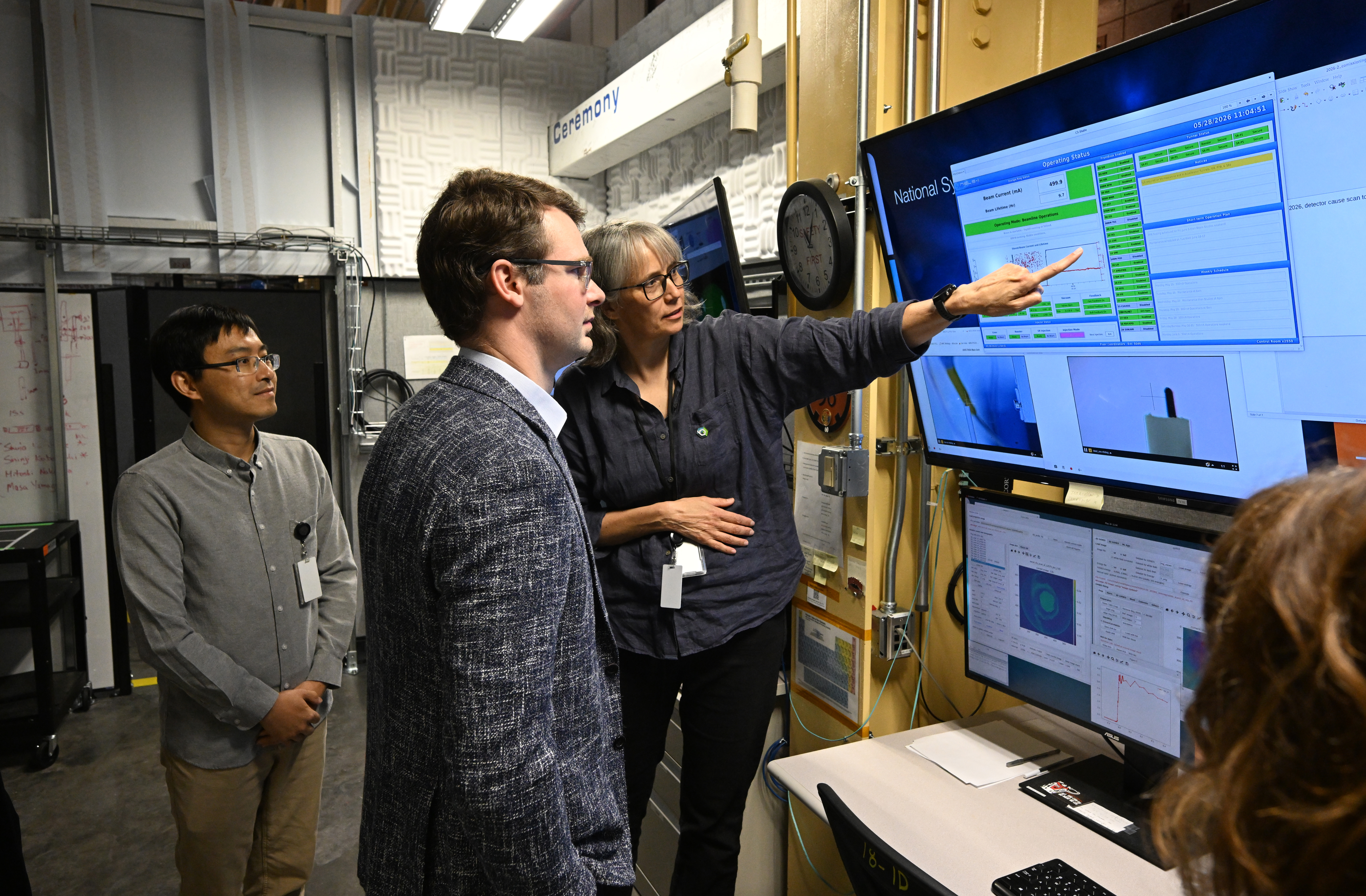
NSLS-II director Elke Arenholz (right) hosts Nick Poradek (center), Senior Advisor to DOE Secretary of Energy Chris Wright, at the Full-Field X-ray Imaging beamline with beamline scientist Mingyuan Ge (left). (Kevin Coughlin/Brookhaven National Laboratory)
Dear Colleagues,
NSLS-II has had a busy year, and there is a lot more ahead. New beamlines are coming online, NEXT-III is moving forward, and we are exploring new approaches to experiments through AI, automation, and our campaign pilot programs. I wanted to share a few updates on where we are and where we are headed.
NEXT-II moves toward the finish line
The NEXT-II project is entering its final stages. In the upcoming fall cycle, the Coherent Diffractive Imaging (CDI) beamline will begin accepting general users. With exceptionally bright, highly coherent X-rays, CDI will enable imaging and scattering experiments to investigate materials at the micron scale with nanometer resolution.
In late August, we completed the accelerator readiness review (ARR) for the Soft X-ray Photoemission and Scattering Imaging (ARI) and Soft X-ray Nanoprobe (SXN) beamlines. We expect both beamlines to achieve first light this fall, with early science commissioning proposals planned for next summer.
 enlarge
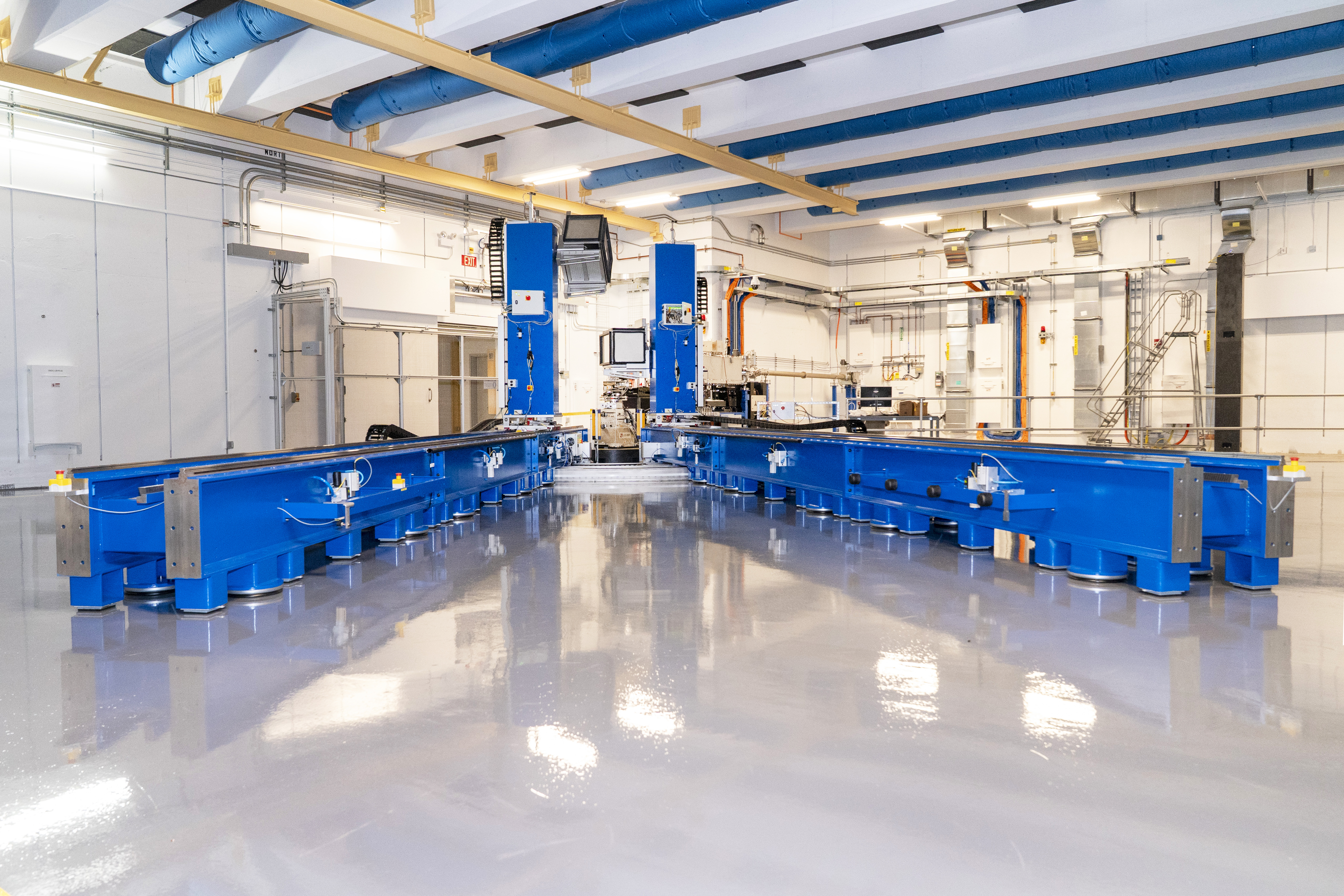
The Coherent Diffractive Imaging (CDI) beamline features a novel dual-area-detector scheme. (David Rahner/Brookhaven National Laboratory)
NEXT-III Subproject A takes shape
NEXT-III Subproject A is developing the next generation of NSLS-II beamlines and capabilities, designed from the outset to take advantage of automation, autonomous operations, seamless workflows, and AI.
The project is advancing the design and construction of the High-Resolution Powder Diffraction (HRD) and Quantitative Cellular Tomography (QCT) beamlines, together with N3XTware, the software infrastructure being developed to support integrated and increasingly automated experimental workflows.
The NEXT-III team is preparing for a comprehensive director’s review in October. The review will assess final design maturity and readiness to move forward with HRD, QCT, and N3XTware. Together, HRD, QCT, and N3XTware will help us explore new ways of integrating instrumentation, automation, data, and analysis.
AI-Enabled Science at NSLS-II
The U.S. Department of Energy (DOE) recently announced the projects selected for funding through Phase I of the Genesis Mission. Many of you put a tremendous amount of work into these proposals. Thank you to everyone who contributed, and congratulations to those whose projects were selected.
NSLS-II staff are also contributing to broader AI and advanced computing efforts across the DOE user facilities. One example is SYNAPS-I (SYnergistic Neutron and Photon Science – Intelligence), which developed an AI platform to integrate data from neutron, X-ray, and microscopy experiments across national laboratories into a unified model. The American Science Cloud (AmSC) is another important initiative, developing federated digital infrastructure to connect data and computing resources across the DOE complex.
We are also exploring AI-enabled experiments directly at NSLS-II. Our first AI Campaign Pilot Program received 21 proposals! Selected experiments are using AI and machine learning together with multimodal characterization and advanced X-ray techniques to study lightweight alloys, phase-change materials, bio-derived polymers, and other systems. These experiments will also help us understand what capabilities are needed to enable AI-driven experiments more broadly across NSLS-II.
We are continuing the AI Campaign Pilot Program in the upcoming cycle and encourage interested teams to submit proposals. The deadline is Wednesday, September 30, 2026, at 11:59 p.m. ET.
We are also introducing a new Microelectronics Measurements Campaign Pilot, focused on measurement challenges in the development and manufacturing of microelectronics devices. The campaign will bring together researchers from industry, academia, and NSLS-II to combine advanced methods at NSLS-II with complementary measurements and expertise from participating organizations. The proposal deadline is also Wednesday, September 30, 2026, at 11:59 p.m. ET.
Celebrating Achievements
I would like to congratulate our partner cryo-electron microscopy facility, the Laboratory for BioMolecular Structure (LBMS), on its fifth anniversary of operations. Congratulations to the entire LBMS team on this important milestone. If you or your colleagues have received a major award or recognition, or have another notable achievement involving work at NSLS-II, please let us know through our short NSLS-II Awards Form.
There is a lot of excellent work across the NSLS-II community, and we want to recognize it. Please share your recent publications, Ph.D. theses, and journal covers through our publications database.
Thank you, as always, for everything you do to make NSLS-II successful.
— Elke Arenholz, NSLS-II Director
